• 文献检索
  • 文档翻译
  • 深度研究
  • 学术资讯
  • Suppr Zotero 插件Zotero 插件
  • 邀请有礼
  • 套餐&价格
  • 历史记录
应用&插件
Suppr Zotero 插件Zotero 插件浏览器插件Mac 客户端Windows 客户端微信小程序
定价
高级版会员购买积分包购买API积分包
服务
文献检索文档翻译深度研究API 文档MCP 服务
关于我们
关于 Suppr公司介绍联系我们用户协议隐私条款
关注我们

Suppr 超能文献

核心技术专利:CN118964589B侵权必究
粤ICP备2023148730 号-1Suppr @ 2026

文献检索

告别复杂PubMed语法,用中文像聊天一样搜索,搜遍4000万医学文献。AI智能推荐,让科研检索更轻松。

立即免费搜索

文件翻译

保留排版,准确专业,支持PDF/Word/PPT等文件格式,支持 12+语言互译。

免费翻译文档

深度研究

AI帮你快速写综述,25分钟生成高质量综述,智能提取关键信息,辅助科研写作。

立即免费体验

利用基于深度学习的自然语言处理技术识别动脉粥样硬化性心血管疾病患者未使用他汀类药物的原因。

Using deep learning-based natural language processing to identify reasons for statin nonuse in patients with atherosclerotic cardiovascular disease.

作者信息

Sarraju Ashish, Coquet Jean, Zammit Alban, Chan Antonia, Ngo Summer, Hernandez-Boussard Tina, Rodriguez Fatima

机构信息

Division of Cardiovascular Medicine and Cardiovascular Institute, Stanford University, Stanford, CA USA.

Department of Medicine, Stanford University, Stanford, CA USA.

出版信息

Commun Med (Lond). 2022 Jul 15;2:88. doi: 10.1038/s43856-022-00157-w. eCollection 2022.

DOI:10.1038/s43856-022-00157-w
PMID:35856080
原文链接:https://pmc.ncbi.nlm.nih.gov/articles/PMC9287295/
Abstract

BACKGROUND

Statins conclusively decrease mortality in atherosclerotic cardiovascular disease (ASCVD), the leading cause of death worldwide, and are strongly recommended by guidelines. However, real-world statin utilization and persistence are low, resulting in excess mortality. Identifying reasons for statin nonuse at scale across health systems is crucial to developing targeted interventions to improve statin use.

METHODS

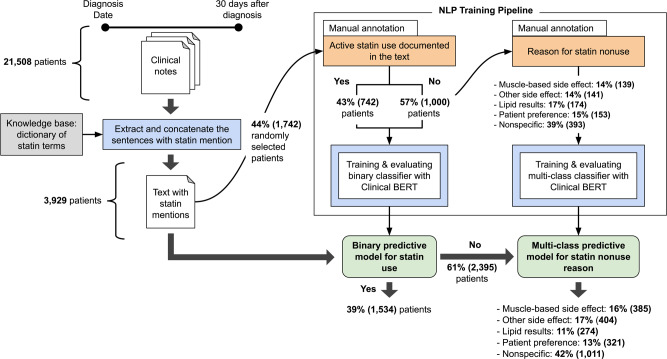
We developed and validated deep learning-based natural language processing (NLP) approaches (Clinical Bidirectional Encoder Representations from Transformers [BERT]) to classify statin nonuse and reasons for statin nonuse using unstructured electronic health records (EHRs) from a diverse healthcare system.

RESULTS

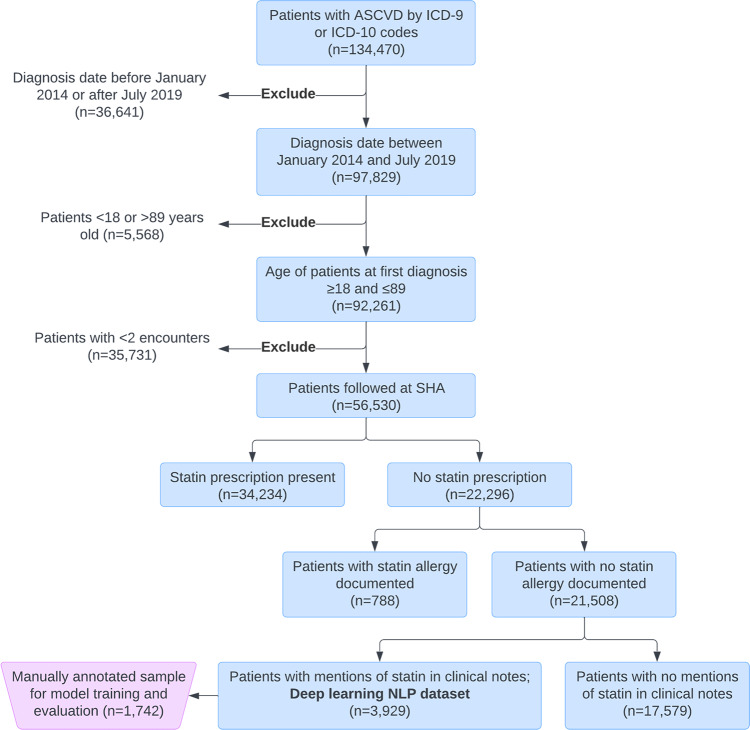
We present data from a cohort of 56,530 ASCVD patients, among whom 21,508 (38%) lack guideline-directed statin prescriptions and statins listed as allergies in structured EHR portions. Of these 21,508 patients without prescriptions, only 3,929 (18%) have any discussion of statin use or nonuse in EHR documentation. The NLP classifiers identify statin nonuse with an area under the curve (AUC) of 0.94 (95% CI 0.93-0.96) and reasons for nonuse with a weighted-average AUC of 0.88 (95% CI 0.86-0.91) when evaluated against manual expert chart review in a held-out test set. Clinical BERT identifies key patient-level reasons (side-effects, patient preference) and clinician-level reasons (guideline-discordant practices) for statin nonuse, including differences by type of ASCVD and patient race/ethnicity.

CONCLUSIONS

Our deep learning NLP classifiers can identify crucial gaps in statin nonuse and reasons for nonuse in high-risk populations to support education, clinical decision support, and potential pathways for health systems to address ASCVD treatment gaps.

摘要

背景

他汀类药物能显著降低动脉粥样硬化性心血管疾病(ASCVD)的死亡率,ASCVD是全球主要死因,且指南强烈推荐使用。然而,现实中他汀类药物的使用率和持续用药率较低,导致死亡率过高。确定整个卫生系统中他汀类药物未使用的原因对于制定有针对性的干预措施以改善他汀类药物的使用至关重要。

方法

我们开发并验证了基于深度学习的自然语言处理(NLP)方法(临床双向编码器表征从变换器[BERT]),以使用来自多样化医疗系统的非结构化电子健康记录(EHR)对他汀类药物未使用情况及未使用原因进行分类。

结果

我们展示了56530例ASCVD患者队列的数据,其中21508例(38%)缺乏指南指导的他汀类药物处方,且在结构化EHR部分中他汀类药物被列为过敏。在这21508例无处方患者中,只有3929例(18%)在EHR文档中有关于他汀类药物使用或未使用的任何讨论。当在一个预留测试集中与人工专家图表审查进行对比评估时,NLP分类器识别他汀类药物未使用情况的曲线下面积(AUC)为0.94(95%CI 0.93 - 0.96),识别未使用原因的加权平均AUC为0.88(95%CI 0.86 - 0.91)。临床BERT识别出他汀类药物未使用的关键患者层面原因(副作用, 患者偏好)和临床医生层面原因(与指南不一致的做法),包括ASCVD类型和患者种族/族裔的差异。

结论

我们的深度学习NLP分类器可以识别高危人群中他汀类药物未使用情况及未使用原因的关键差距,以支持教育、临床决策支持以及卫生系统解决ASCVD治疗差距的潜在途径。
https://cdn.ncbi.nlm.nih.gov/pmc/blobs/a308/9287295/8f2fe2a3d8d1/43856_2022_157_Fig2_HTML.jpg
https://cdn.ncbi.nlm.nih.gov/pmc/blobs/a308/9287295/eca4156eb419/43856_2022_157_Fig1_HTML.jpg
https://cdn.ncbi.nlm.nih.gov/pmc/blobs/a308/9287295/8f2fe2a3d8d1/43856_2022_157_Fig2_HTML.jpg
https://cdn.ncbi.nlm.nih.gov/pmc/blobs/a308/9287295/eca4156eb419/43856_2022_157_Fig1_HTML.jpg
https://cdn.ncbi.nlm.nih.gov/pmc/blobs/a308/9287295/8f2fe2a3d8d1/43856_2022_157_Fig2_HTML.jpg

相似文献

1
Using deep learning-based natural language processing to identify reasons for statin nonuse in patients with atherosclerotic cardiovascular disease.利用基于深度学习的自然语言处理技术识别动脉粥样硬化性心血管疾病患者未使用他汀类药物的原因。
Commun Med (Lond). 2022 Jul 15;2:88. doi: 10.1038/s43856-022-00157-w. eCollection 2022.
2
Identifying Reasons for Statin Nonuse in Patients With Diabetes Using Deep Learning of Electronic Health Records.利用电子健康记录的深度学习识别糖尿病患者他汀类药物未使用的原因。
J Am Heart Assoc. 2023 Apr 4;12(7):e028120. doi: 10.1161/JAHA.122.028120. Epub 2023 Mar 28.
3
Natural language processing to identify reasons for sex disparity in statin prescriptions.利用自然语言处理技术识别他汀类药物处方中性别差异的原因。
Am J Prev Cardiol. 2023 Apr 11;14:100496. doi: 10.1016/j.ajpc.2023.100496. eCollection 2023 Jun.
4
Leveraging structured and unstructured electronic health record data to detect reasons for suboptimal statin therapy use in patients with atherosclerotic cardiovascular disease.利用结构化和非结构化电子健康记录数据来检测动脉粥样硬化性心血管疾病患者他汀类药物治疗欠佳的原因。
Am J Prev Cardiol. 2021 Dec 3;9:100300. doi: 10.1016/j.ajpc.2021.100300. eCollection 2022 Mar.
5
A Natural Language Processing Model for COVID-19 Detection Based on Dutch General Practice Electronic Health Records by Using Bidirectional Encoder Representations From Transformers: Development and Validation Study.基于荷兰全科电子健康记录的 COVID-19 检测自然语言处理模型:使用转换器的双向编码器表示进行开发和验证研究。
J Med Internet Res. 2023 Oct 4;25:e49944. doi: 10.2196/49944.
6
Impact of Guideline-Directed Statin Prescriptions on Cardiovascular Outcomes by Race in a Real-World Primary Prevention Cohort.在真实世界的一级预防队列中,指南指导的他汀类药物处方对不同种族心血管结局的影响。
JACC Adv. 2024 Sep 10;3(10):101231. doi: 10.1016/j.jacadv.2024.101231. eCollection 2024 Oct.
7
Classifying social determinants of health from unstructured electronic health records using deep learning-based natural language processing.利用基于深度学习的自然语言处理技术从非结构化电子健康记录中分类社会健康决定因素。
J Biomed Inform. 2022 Mar;127:103984. doi: 10.1016/j.jbi.2021.103984. Epub 2022 Jan 7.
8
EHR-BERT: A BERT-based model for effective anomaly detection in electronic health records.EHR-BERT:一种基于 BERT 的电子健康记录中有效异常检测模型。
J Biomed Inform. 2024 Feb;150:104605. doi: 10.1016/j.jbi.2024.104605. Epub 2024 Feb 6.
9
Identification of asthma control factor in clinical notes using a hybrid deep learning model.使用混合深度学习模型从临床记录中识别哮喘控制因素。
BMC Med Inform Decis Mak. 2021 Nov 9;21(Suppl 7):272. doi: 10.1186/s12911-021-01633-4.
10
Clinical Characteristics and Unmet Need Among Patients with Atherosclerotic Cardiovascular Disease Stratified by Statin Use.根据他汀类药物使用情况分层的动脉粥样硬化性心血管疾病患者的临床特征及未满足的需求
Am Health Drug Benefits. 2016 Nov;9(8):434-444.

引用本文的文献

1
Understanding Reasons for Oral Anticoagulation Nonprescription in Atrial Fibrillation Using Large Language Models.使用大语言模型理解心房颤动患者未接受口服抗凝治疗的原因
J Am Heart Assoc. 2025 Apr;14(7):e040419. doi: 10.1161/JAHA.124.040419. Epub 2025 Mar 27.
2
Global disparities in drug-related adverse events of patients with multiple myeloma: a pharmacovigilance study.多发性骨髓瘤患者药物相关不良事件的全球差异:一项药物警戒研究。
Blood Cancer J. 2024 Dec 20;14(1):223. doi: 10.1038/s41408-024-01206-4.
3
Artificial Intelligence and Health Inequities in Dietary Interventions on Atherosclerosis: A Narrative Review.

本文引用的文献

1
Statin treatment and muscle symptoms: series of randomised, placebo controlled n-of-1 trials.他汀类药物治疗与肌肉症状:一系列随机、安慰剂对照的 n-of-1 试验。
BMJ. 2021 Feb 24;372:n135. doi: 10.1136/bmj.n135.
2
Machine Learning and the Future of Cardiovascular Care: JACC State-of-the-Art Review.机器学习与心血管病护理的未来:《美国心脏病学会杂志》观点述评。
J Am Coll Cardiol. 2021 Jan 26;77(3):300-313. doi: 10.1016/j.jacc.2020.11.030.
3
N-of-1 Trial of a Statin, Placebo, or No Treatment to Assess Side Effects.一项比较他汀类药物、安慰剂或不治疗以评估副作用的单病例试验。
人工智能与饮食干预动脉粥样硬化的健康不平等:叙事性综述。
Nutrients. 2024 Aug 7;16(16):2601. doi: 10.3390/nu16162601.
4
Obicetrapib-the Rebirth of CETP Inhibitors?奥利司他贝特——CETP 抑制剂的重生?
Curr Atheroscler Rep. 2024 Oct;26(10):603-608. doi: 10.1007/s11883-024-01231-5. Epub 2024 Aug 16.
5
Applicability of Artificial Intelligence in the Field of Clinical Lipidology: A Narrative Review.人工智能在临床脂质学领域的适用性:一篇叙述性综述。
J Lipid Atheroscler. 2024 May;13(2):111-121. doi: 10.12997/jla.2024.13.2.111. Epub 2024 Feb 27.
6
Artificial Intelligence in Cardiovascular Disease Prevention: Is it Ready for Prime Time?人工智能在心血管疾病预防中的应用:是否已准备好投入使用?
Curr Atheroscler Rep. 2024 Jul;26(7):263-272. doi: 10.1007/s11883-024-01210-w. Epub 2024 May 23.
7
Patterns and gaps in guideline-directed statin use for atherosclerotic cardiovascular disease by race and ethnicity.按种族和民族划分的、用于动脉粥样硬化性心血管疾病的指南指导他汀类药物使用模式及差距。
Am J Prev Cardiol. 2024 Mar 11;17:100647. doi: 10.1016/j.ajpc.2024.100647. eCollection 2024 Mar.
8
Artificial intelligence in clinical workflow processes in vascular surgery and beyond.人工智能在血管外科学及其他临床工作流程中的应用。
Semin Vasc Surg. 2023 Sep;36(3):401-412. doi: 10.1053/j.semvascsurg.2023.07.002. Epub 2023 Jul 22.
9
Natural Language Processing Methods to Identify Oncology Patients at High Risk for Acute Care with Clinical Notes.利用临床记录识别急性护理高风险肿瘤患者的自然语言处理方法
AMIA Jt Summits Transl Sci Proc. 2023 Jun 16;2023:138-147. eCollection 2023.
10
Natural language processing to identify reasons for sex disparity in statin prescriptions.利用自然语言处理技术识别他汀类药物处方中性别差异的原因。
Am J Prev Cardiol. 2023 Apr 11;14:100496. doi: 10.1016/j.ajpc.2023.100496. eCollection 2023 Jun.
N Engl J Med. 2020 Nov 26;383(22):2182-2184. doi: 10.1056/NEJMc2031173. Epub 2020 Nov 15.
4
Machine learning and atherosclerotic cardiovascular disease risk prediction in a multi-ethnic population.多民族人群中的机器学习与动脉粥样硬化性心血管疾病风险预测
NPJ Digit Med. 2020 Sep 23;3:125. doi: 10.1038/s41746-020-00331-1. eCollection 2020.
5
Real world evidence in cardiovascular medicine: ensuring data validity in electronic health record-based studies.心血管医学中的真实世界证据:确保电子健康记录研究中的数据有效性。
J Am Med Inform Assoc. 2019 Nov 1;26(11):1189-1194. doi: 10.1093/jamia/ocz119.
6
Is it possible to automatically assess pretreatment digital rectal examination documentation using natural language processing? A single-centre retrospective study.是否可以使用自然语言处理自动评估直肠指检前的文档记录?一项单中心回顾性研究。
BMJ Open. 2019 Jul 18;9(7):e027182. doi: 10.1136/bmjopen-2018-027182.
7
Finding missed cases of familial hypercholesterolemia in health systems using machine learning.利用机器学习在医疗系统中发现家族性高胆固醇血症的漏诊病例。
NPJ Digit Med. 2019 Apr 11;2:23. doi: 10.1038/s41746-019-0101-5. eCollection 2019.
8
The STatin Adverse Treatment Experience Survey: Experience of patients reporting side effects of statin therapy.他汀类药物不良反应治疗体验调查:报告他汀类药物治疗副作用患者的体验。
J Clin Lipidol. 2019 May-Jun;13(3):415-424. doi: 10.1016/j.jacl.2019.04.011. Epub 2019 May 18.
9
Association of Statin Adherence With Mortality in Patients With Atherosclerotic Cardiovascular Disease.他汀类药物依从性与动脉粥样硬化性心血管疾病患者死亡率的关系。
JAMA Cardiol. 2019 Mar 1;4(3):206-213. doi: 10.1001/jamacardio.2018.4936.
10
2018 AHA/ACC/AACVPR/AAPA/ABC/ACPM/ADA/AGS/APhA/ASPC/NLA/PCNA Guideline on the Management of Blood Cholesterol: Executive Summary: A Report of the American College of Cardiology/American Heart Association Task Force on Clinical Practice Guidelines.2018年美国心脏协会/美国心脏病学会/美国心血管和肺康复协会/美国医师助理学会/美国心脏协会/美国预防医学学会/美国糖尿病协会/美国老年医学会/美国药剂师协会/美国临床内分泌医师协会/美国国家脂质协会/美国初级保健医师学会血胆固醇管理指南:执行摘要:美国心脏病学会/美国心脏协会临床实践指南工作组报告
J Am Coll Cardiol. 2019 Jun 25;73(24):3168-3209. doi: 10.1016/j.jacc.2018.11.002. Epub 2018 Nov 10.