UK Health Security Agency, London, UK.
Joint first authors: contributed equally.
BMJ. 2022 Jul 20;378:e070379. doi: 10.1136/bmj-2022-070379.
To describe the incidence of, risk factors for, and impact of vaccines on primary SARS-CoV-2 infection during the second wave of the covid-19 pandemic in susceptible hospital healthcare workers in England.
Multicentre prospective cohort study.
National Health Service secondary care health organisations (trusts) in England between 1 September 2020 and 30 April 2021.
Clinical, support, and administrative staff enrolled in the SARS-CoV-2 Immunity and Reinfection Evaluation (SIREN) study with no evidence of previous infection. Vaccination status was obtained from national covid-19 vaccination registries and self-reported.
SARS-CoV-2 infection confirmed by polymerase chain reaction. Mixed effects logistic regression was conducted to determine demographic and occupational risk factors for infection, and an individual based mathematical model was used to predict how large the burden could have been if vaccines had not been available from 8 December 2020 .
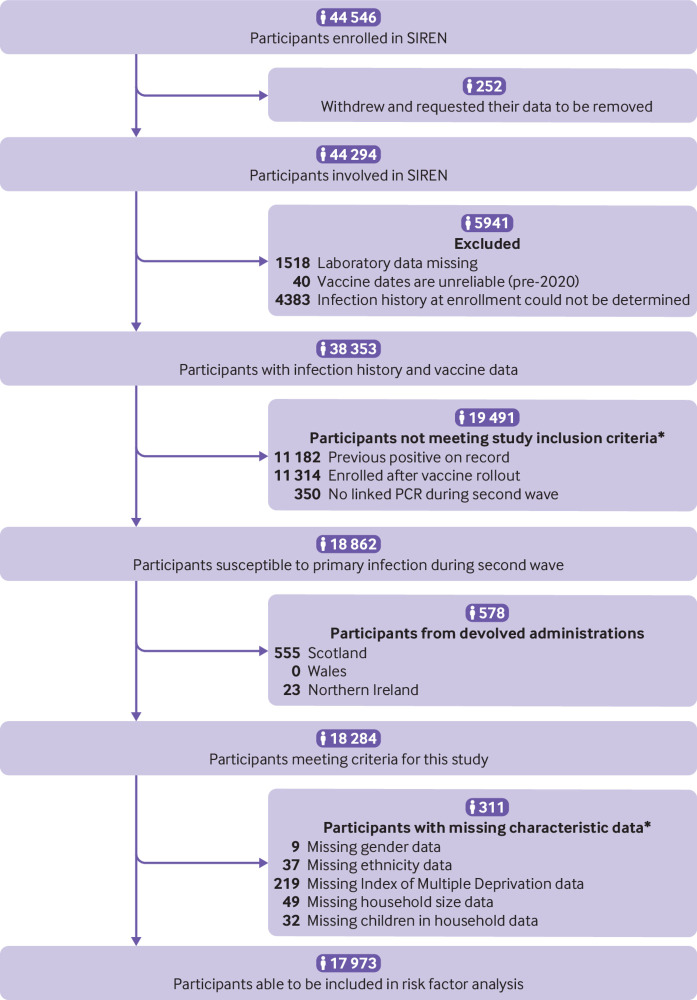
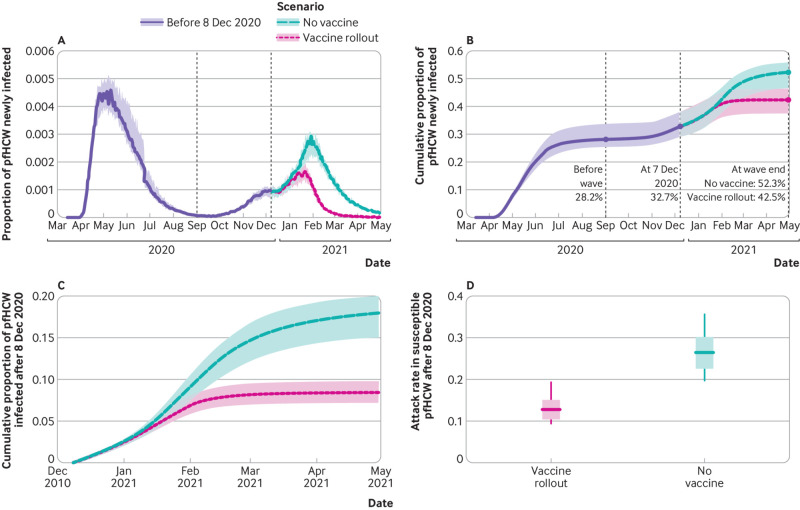
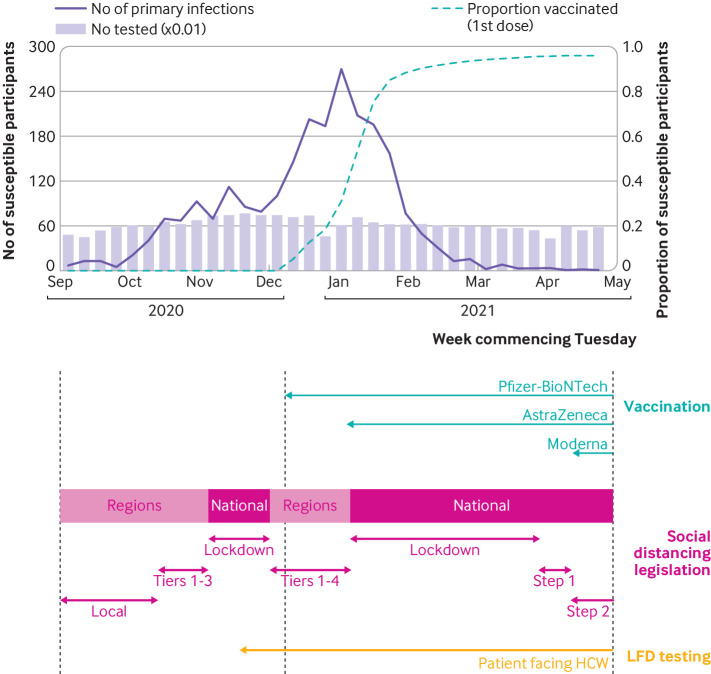
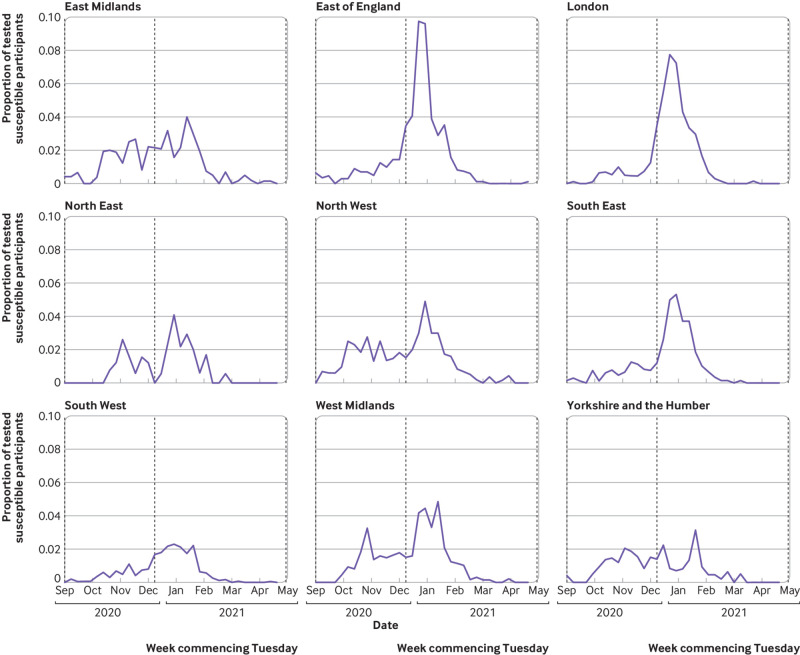
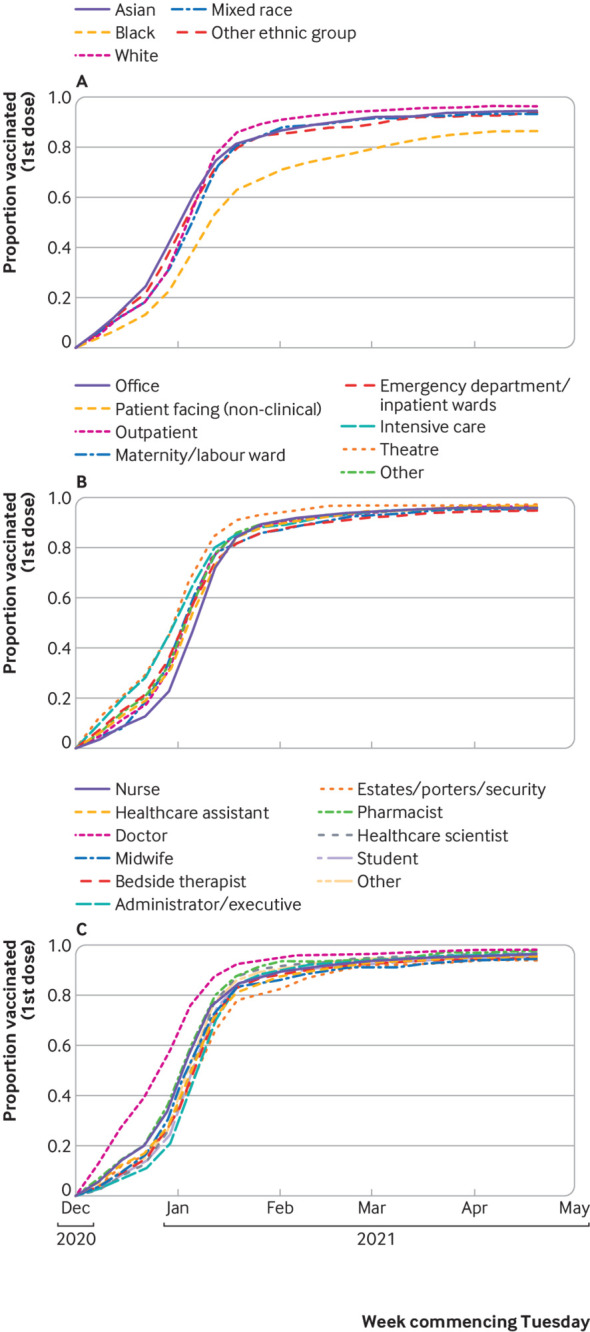
During England's second wave, 12.9% (2353/18 284) of susceptible SIREN participants became infected with SARS-CoV-2. Infections peaked in late December 2020 and decreased from January 2021, concurrent with the cohort's rapid vaccination coverage and a national lockdown. In multivariable analysis, factors increasing the likelihood of infection in the second wave were being under 25 years old (20.3% (132/651); adjusted odds ratio 1.35, 95% confidence interval 1.07 to 1.69), living in a large household (15.8% (282/1781); 1.54, 1.23 to 1.94, for participants from households of five or more people), having frequent exposure to patients with covid-19 (19.2% (723/3762); 1.79, 1.56 to 2.06, for participants with exposure every shift), working in an emergency department or inpatient ward setting (20.8% (386/1855); 1.76, 1.45 to 2.14), and being a healthcare assistant (18.1% (267/1479); 1.43, 1.16 to 1.77). Time to first vaccination emerged as being strongly associated with infection (P<0.001), with each additional day multiplying a participant's adjusted odds ratio by 1.02. Mathematical model simulations indicated that an additional 9.9% of all patient facing hospital healthcare workers would have been infected were it not for the rapid vaccination coverage.
The rapid covid-19 vaccine rollout from December 2020 averted infection in a large proportion of hospital healthcare workers in England: without vaccines, second wave infections could have been 69% higher. With booster vaccinations being needed for adequate protection from the omicron variant, and perhaps the need for further boosters for future variants, ensuring equitable delivery to healthcare workers is essential. The findings also highlight occupational risk factors that persisted in healthcare workers despite vaccine rollout; a greater understanding of the transmission dynamics responsible for these is needed to help to optimise the infection prevention and control policies that protect healthcare workers from infection and therefore to support staffing levels and maintain healthcare provision.
ISRCTN registry ISRCTN11041050.
描述在英格兰易感医院医护人员中,新冠病毒-2 (SARS-CoV-2)第二波疫情期间,疫苗对原发性 SARS-CoV-2 感染的发生率、危险因素和影响。
多中心前瞻性队列研究。
2020 年 9 月 1 日至 2021 年 4 月 30 日期间,英格兰国民保健服务(NHS)二级保健组织(信托机构)。
在 SARS-CoV-2 免疫和再感染评估(SIREN)研究中登记,且无先前感染证据的临床、支持和行政工作人员。疫苗接种状况通过国家 covid-19 疫苗接种登记和自我报告获得。
通过聚合酶链反应(PCR)确认 SARS-CoV-2 感染。采用混合效应逻辑回归确定感染的人口统计学和职业危险因素,并使用基于个体的数学模型来预测如果 2020 年 12 月 8 日没有疫苗可用,感染负担会有多大。
在英格兰第二波疫情中,12.9%(2353/18284)易感 SIREN 参与者感染了 SARS-CoV-2。感染高峰出现在 2020 年 12 月底,从 2021 年 1 月开始下降,这与队列的快速疫苗接种覆盖率和全国封锁同步。多变量分析显示,第二波疫情中感染的可能性增加的因素包括年龄在 25 岁以下(20.3%(132/651);调整后的优势比 1.35,95%置信区间 1.07 至 1.69),居住在大家庭中(15.8%(282/1781);1.54,1.23 至 1.94,对于来自五人或更多人的家庭的参与者),频繁接触新冠病毒感染者(19.2%(723/3762);1.79,1.56 至 2.06,对于每班次接触的参与者),在急诊室或住院病房工作(20.8%(386/1855);1.76,1.45 至 2.14,对于医疗保健助理(18.1%(267/1479);1.43,1.16 至 1.77)。首次接种疫苗的时间与感染密切相关(P<0.001),每增加一天,参与者的调整优势比增加 1.02。数学模型模拟表明,如果没有快速疫苗接种覆盖率,那么额外将有 9.9%的所有面对患者的医院医护人员会感染。
2020 年 12 月以来,新冠病毒疫苗的快速推出避免了英格兰大部分医院医护人员的感染:如果没有疫苗,第二波感染可能会增加 69%。随着奥密克戎变异株需要加强疫苗接种以获得充分保护,或许未来变异株还需要进一步加强疫苗接种,确保公平地向医护人员提供疫苗至关重要。这些发现还突出了疫苗推出后仍在医护人员中持续存在的职业危险因素;需要更深入地了解导致这些因素的传播动态,以帮助优化感染预防和控制政策,从而保护医护人员免受感染,进而支持人员配置水平并维持医疗服务。
ISRCTN 注册 ISRCTN8051216。