
用于培养三维肿瘤的翻转孔板悬滴技术
Flipped Well-Plate Hanging-Drop Technique for Growing Three-Dimensional Tumors.
作者信息
Jeong Yoon, Tin Ashley, Irudayaraj Joseph
机构信息
Department of Bioengineering, University of Illinois at Urbana-Champaign, Urbana, IL, United States.
Cancer Center at Illinois, University of Illinois at Urbana-Champaign, Urbana, IL, United States.
出版信息
Front Bioeng Biotechnol. 2022 Jul 4;10:898699. doi: 10.3389/fbioe.2022.898699. eCollection 2022.
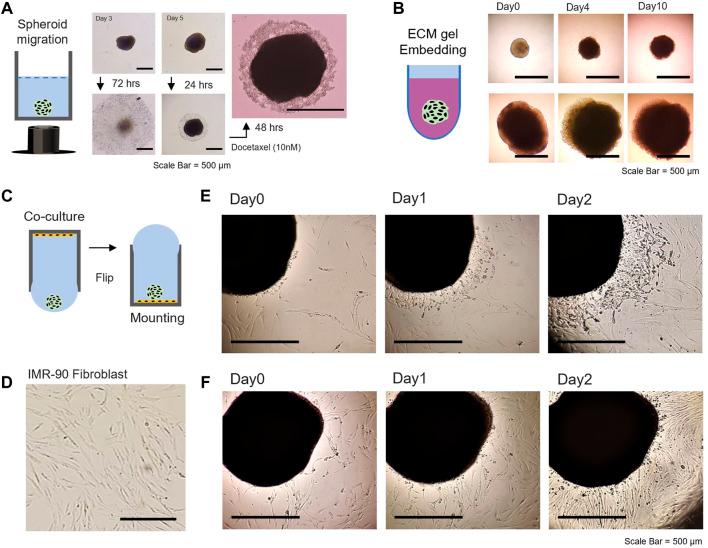
Three-dimensional (3D) tumor culture techniques are gaining popularity as models of tumoral tissue analogues. Despite the widespread interest, need, and present-day effort, most of the 3D tumor culturing methodologies have not gone beyond the inventors' laboratories. This, in turn, limits their applicability and standardization. In this study, we introduce a straightforward and user-friendly approach based on standard 96-well plates with basic amenities for growing 3D tumors in a scaffold-free/scaffold-based format. Hanging drop preparation can be easily employed by flipping a universal 96-well plate. The droplets of the medium generated by the well-plate flip (WPF) method can be easily modified to address various mechanisms and processes in cell biology, including cancer. To demonstrate the applicability and practicality of the conceived approach, we utilized human colorectal carcinoma cells (HCT116) to first show the generation of large scaffold-free 3D tumor spheroids over 1.5 mm in diameter in single-well plates. As a proof-of-concept, we also demonstrate matrix-assisted tumor culture techniques in advancing the broader use of 3D culture systems. The conceptualized WPF approach can be adapted for a range of applications in both basic and applied biological/engineering research.
三维(3D)肿瘤培养技术作为肿瘤组织类似物模型正越来越受欢迎。尽管受到广泛关注、存在需求且当下也有人努力,但大多数3D肿瘤培养方法尚未走出发明者的实验室。这反过来限制了它们的适用性和标准化。在本研究中,我们介绍一种基于标准96孔板的简单且用户友好的方法,该方法具备用于以无支架/基于支架的形式培养3D肿瘤的基本条件。通过翻转通用96孔板可轻松进行悬滴制备。由孔板翻转(WPF)方法产生的培养基液滴可轻松修改,以研究细胞生物学(包括癌症)中的各种机制和过程。为证明所设想方法的适用性和实用性,我们利用人结肠癌细胞(HCT116)首先展示在单孔板中生成直径超过1.5毫米的大型无支架3D肿瘤球体。作为概念验证,我们还展示了基质辅助肿瘤培养技术在推动3D培养系统更广泛应用方面的作用。概念化的WPF方法可适用于基础和应用生物学/工程研究中的一系列应用。


 Zotero 插件