Fukuoka City Health Promotion Support Center, Fukuoka City Medical Association, Maizuru 2-5-1, Chuou-ku, Fukuoka, 810-0073, Japan.
Division of Endocrinology and Metabolism, Department of Internal Medicine, Kurume University School of Medicine, Kurume, 830-0011, Japan.
Sci Rep. 2022 Jul 21;12(1):12482. doi: 10.1038/s41598-022-16451-5.
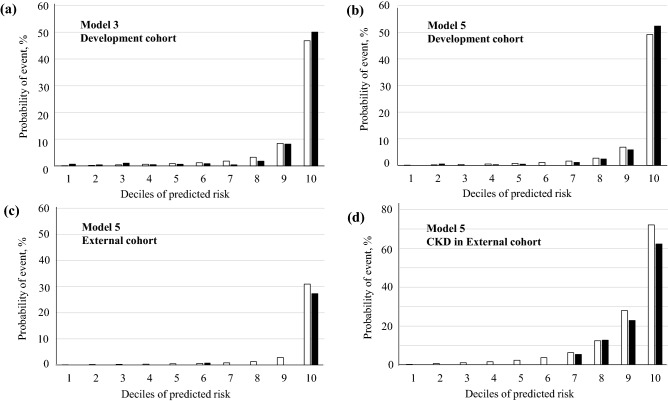
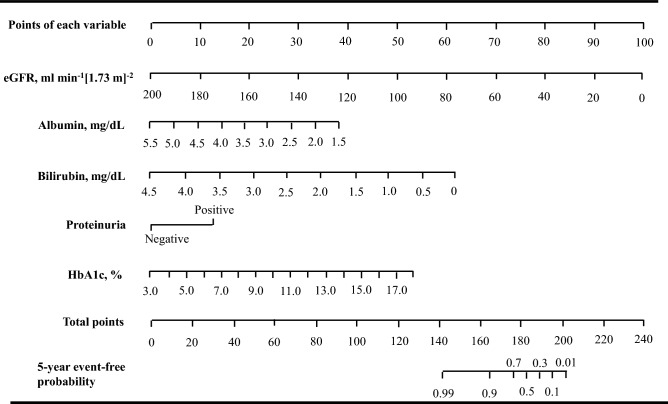
This study aimed to develop a simplified model for predicting end-stage kidney disease (ESKD) in patients with diabetes. The cohort included 2549 individuals who were followed up at Kyushu University Hospital (Japan) between January 1, 2008 and December 31, 2018. The outcome was a composite of ESKD, defined as an eGFR < 15 mL min [1.73 m], dialysis, or renal transplantation. The mean follow-up was 5.6 [Formula: see text] 3.7 years, and ESKD occurred in 176 (6.2%) individuals. Both a machine learning random forest model and a Cox proportional hazard model selected eGFR, proteinuria, hemoglobin A1c, serum albumin levels, and serum bilirubin levels in a descending order as the most important predictors among 20 baseline variables. A model using eGFR, proteinuria and hemoglobin A1c showed a relatively good performance in discrimination (C-statistic: 0.842) and calibration (Nam and D'Agostino [Formula: see text] statistic: 22.4). Adding serum albumin and bilirubin levels to the model further improved it, and a model using 5 variables showed the best performance in the predictive ability (C-statistic: 0.895, [Formula: see text] statistic: 7.7). The accuracy of this model was validated in an external cohort (n = 5153). This novel simplified prediction model may be clinically useful for predicting ESKD in patients with diabetes.
本研究旨在为糖尿病患者开发一种预测终末期肾病(ESKD)的简化模型。该队列纳入了 2008 年 1 月 1 日至 2018 年 12 月 31 日期间在九州大学医院(日本)接受随访的 2549 名个体。结局为 ESKD,定义为 eGFR<15 mL min [1.73 m]、透析或肾移植。平均随访时间为 5.6 [Formula: see text] 3.7 年,176 名(6.2%)个体发生 ESKD。机器学习随机森林模型和 Cox 比例风险模型均选择 eGFR、蛋白尿、糖化血红蛋白、血清白蛋白和血清胆红素水平作为 20 个基线变量中最重要的预测因素。使用 eGFR、蛋白尿和糖化血红蛋白的模型在判别性能(C 统计量:0.842)和校准(Nam 和 D'Agostino [Formula: see text] 统计量:22.4)方面表现出较好的性能。将血清白蛋白和胆红素水平添加到模型中进一步提高了模型的性能,使用 5 个变量的模型在预测能力方面表现最佳(C 统计量:0.895,[Formula: see text] 统计量:7.7)。该模型的准确性在外部队列(n=5153)中得到验证。这种新的简化预测模型可能对预测糖尿病患者的 ESKD 具有临床应用价值。