Department of Optical Nanoscopy, Max Planck Institute for Medical Research, Heidelberg, Germany.
Department of NanoBiophotonics, Max Planck Institute for Multidisciplinary Sciences, Göttingen, Germany.
Nat Chem. 2022 Sep;14(9):1013-1020. doi: 10.1038/s41557-022-00995-0. Epub 2022 Jul 21.
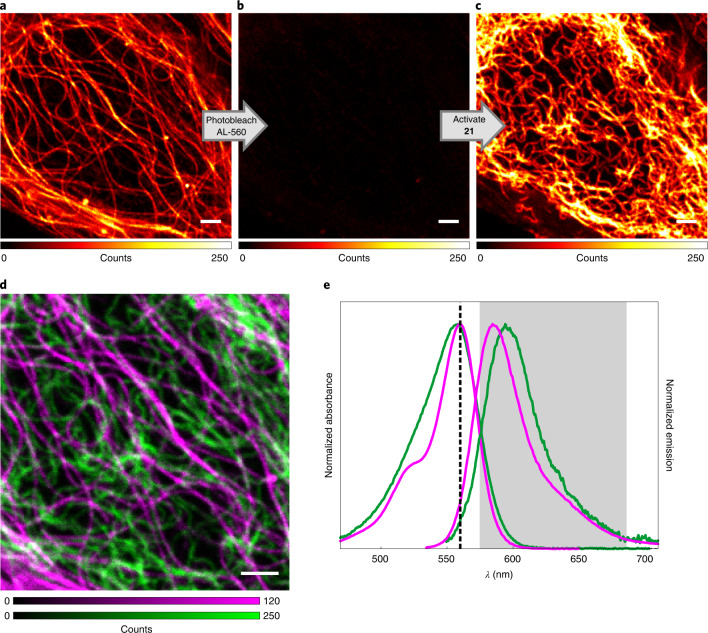
The controlled switching of fluorophores between non-fluorescent and fluorescent states is central to every super-resolution fluorescence microscopy (nanoscopy) technique, and the exploration of radically new switching mechanisms remains critical to boosting the performance of established, as well as emerging super-resolution methods. Photoactivatable dyes offer substantial improvements to many of these techniques, but often rely on photolabile protecting groups that limit their applications. Here we describe a general method to transform 3,6-diaminoxanthones into caging-group-free photoactivatable fluorophores. These photoactivatable xanthones (PaX) assemble rapidly and cleanly into highly fluorescent, photo- and chemically stable pyronine dyes upon irradiation with light. The strategy is extendable to carbon- and silicon-bridged xanthone analogues, yielding a family of photoactivatable labels spanning much of the visible spectrum. Our results demonstrate the versatility and utility of PaX dyes in fixed and live-cell labelling for conventional microscopy, as well as the coordinate-stochastic and deterministic nanoscopies STED, PALM and MINFLUX.
荧光团在非荧光和荧光状态之间的受控转换是每一种超分辨率荧光显微镜(纳米显微镜)技术的核心,探索全新的转换机制对于提高现有和新兴超分辨率方法的性能仍然至关重要。光活化染料为许多这些技术提供了实质性的改进,但通常依赖于光不稳定的保护基团,限制了它们的应用。在这里,我们描述了一种将 3,6-二氨基吖啶酮转化为无笼组光活化荧光团的通用方法。这些光活化的吖啶酮(PaX)在光照下迅速且干净地组装成高荧光、光稳定和化学稳定的吡咯啉染料。该策略可扩展到碳桥和硅桥接的吖啶酮类似物,得到一系列跨越可见光谱大部分范围的光活化标记物。我们的结果证明了 PaX 染料在常规显微镜固定和活细胞标记中的多功能性和实用性,以及协调随机和确定性纳米显微镜 STED、PALM 和 MINFLUX。