Division of Endocrinology and Metabolism, Department of Medicine, Thyroid Center, Samsung Medical Center, Sungkyunkwan University School of Medicine, Seoul, Korea.
Department of Pathology and Translational Genomics, Sungkyunkwan University School of Medicine, Seoul, Korea.
Endocrinol Metab (Seoul). 2022 Aug;37(4):652-663. doi: 10.3803/EnM.2022.1477. Epub 2022 Jul 22.
Telomerase reverse transcriptase (TERT) promoter mutations are associated with increased recurrence and mortality in patients with thyroid carcinoma. Previous studies on TERT promoter mutations were retrospectively conducted on a limited number of patients.
We prospectively collected data on all consecutive patients who underwent thyroid carcinoma surgery between January 2019 and December 2020 at the Samsung Medical Center, Seoul, Korea. We included 2,092 patients with thyroid carcinoma.
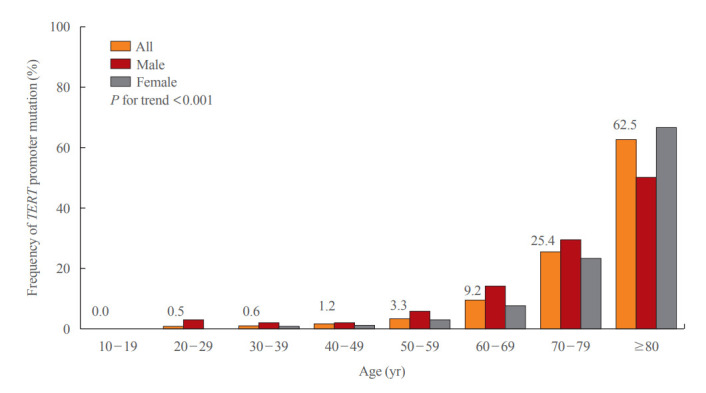
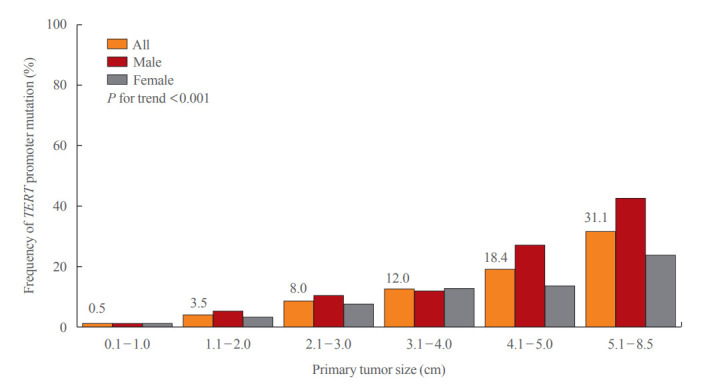
Of 2,092 patients, 72 patients (3.4%) had TERT promoter mutations. However, the frequency of TERT promoter mutations was 0.5% in papillary thyroid microcarcinoma (PTMC) ≤1 cm and it was 5.8% in papillary thyroid carcinoma (PTC) >1 cm. The frequency of TERT promoter mutations was significantly associated with older age at diagnosis (odds ratio [OR], 1.12; P<0.001), larger primary tumor size (OR, 2.02; P<0.001), and aggressive histological type (OR, 7.78 in follicular thyroid carcinoma; OR, 10.33 in poorly differentiated thyroid carcinoma; OR, 45.92 in anaplastic thyroid carcinoma; P<0.001). Advanced T stage, advanced N stage, and distant metastasis at diagnosis were highly prevalent in mutated thyroid cancers. However, initial distant metastasis was not present in patients with TERT promoter mutations in PTMC. Although the C228T mutation was more highly detected than the C250T mutation (64 cases vs. 7 cases), there were no significant clinicopathological differences.
This study is the first attempt to investigate the frequency of TERT promoter mutations in a real-world setting. The frequency of TERT promoter mutations in PTC was lower than expected, and in PTMC, young patients, and female patients, the frequency was very low.
端粒酶逆转录酶(TERT)启动子突变与甲状腺癌患者的复发和死亡率增加相关。先前关于 TERT 启动子突变的研究是在有限数量的患者中进行的回顾性研究。
我们前瞻性收集了 2019 年 1 月至 2020 年 12 月在韩国首尔三星医疗中心接受甲状腺癌手术的所有连续患者的数据。我们纳入了 2092 例甲状腺癌患者。
在 2092 例患者中,有 72 例(3.4%)存在 TERT 启动子突变。然而,在直径≤1cm 的甲状腺微小乳头状癌(PTMC)中 TERT 启动子突变的频率为 0.5%,而在直径>1cm 的甲状腺乳头状癌(PTC)中则为 5.8%。TERT 启动子突变的频率与诊断时的年龄较大(优势比[OR],1.12;P<0.001)、原发肿瘤较大(OR,2.02;P<0.001)和侵袭性组织学类型显著相关(滤泡状甲状腺癌的 OR 为 7.78,未分化甲状腺癌的 OR 为 10.33,间变性甲状腺癌的 OR 为 45.92;P<0.001)。在突变型甲状腺癌中,晚期 T 分期、晚期 N 分期和诊断时的远处转移较为常见。然而,在 PTMC 中存在 TERT 启动子突变的患者中,初始远处转移并不存在。尽管 C228T 突变的检出率高于 C250T 突变(64 例与 7 例),但两者在临床病理方面无显著差异。
本研究首次尝试在真实环境中调查 TERT 启动子突变的频率。PTC 中 TERT 启动子突变的频率低于预期,而在 PTMC 中,年轻患者和女性患者的频率非常低。