Zhang Jiangbo, Liu Yang, Han Qing, Zhang Aobo, Chen Hao, Ma Mingyue, Li Yongyue, Chen Bingpeng, Wang Jincheng
Department of Orthopedics, The Second Hospital of Jilin University, Changchun, China.
Department of Breast Surgery, The First Hospital of Jilin University, Changchun, China.
Front Bioeng Biotechnol. 2022 Jul 5;10:939371. doi: 10.3389/fbioe.2022.939371. eCollection 2022.
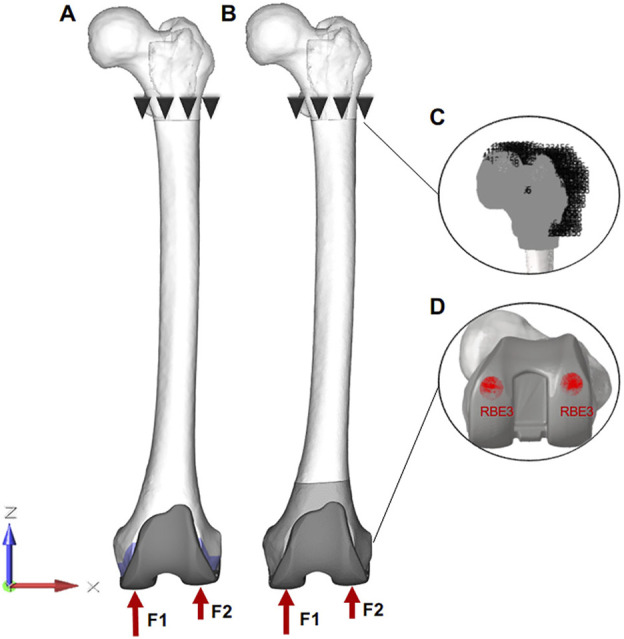
The management of bone defects is a crucial content of total knee revision. This study compared the biomechanical performance of porous Ti6Al4V block and tumor prosthesis UHMWPE block in treating distal femoral bone defects. The finite element models of AORI type 3 distal femoral bone defect treated with porous Ti6Al4V block and UHMWPE block were established. Sensitivity analysis was performed to obtain the appropriate mesh size. The biomechanical performance of treatment methods in bone defects were evaluated according to the peak stress, the Von Mises stress distribution, and the average stresses of regions of interest under the condition of standing on one foot and flexion of the knee. Statistical analysis was conducted by independent samples -test in SPSS ( < 0.05). In the standing on one-foot state, the peak stress of the porous Ti6Al4V block was 12.42 MPa and that of the UHMWPE block was 19.97 MPa, which is close to its yield stress (21 MPa). Meanwhile, the stress distribution of the UHMWPE block was uneven. In the flexion state, the peak stress of the porous Ti6Al4V block was 16.28 MPa, while that of the UHMWPE block was 14.82 MPa. Compared with the porous Ti6Al4V block group, the average stress of the region of interest in UHMWPE block group was higher in the standing on one foot state and lower in the flexion state ( < 0.05). More uniform stress distribution was identified in the porous Ti6Al4V block application which could reserve more bone. On the contrary, uneven stress distribution and a larger high-stress concentration area were found in the UHMWPE block. Hence, the porous Ti6Al4V block is recommended for the treatment of AORI type 3 distal femoral bone defect.
骨缺损的处理是全膝关节翻修的关键内容。本研究比较了多孔钛合金(Ti6Al4V)块与肿瘤假体超高分子量聚乙烯(UHMWPE)块在治疗股骨远端骨缺损时的生物力学性能。建立了采用多孔Ti6Al4V块和UHMWPE块治疗AORI 3型股骨远端骨缺损的有限元模型。进行敏感性分析以获得合适的网格尺寸。根据单脚站立和膝关节屈曲状态下的峰值应力、冯·米塞斯应力分布以及感兴趣区域的平均应力,评估骨缺损治疗方法的生物力学性能。在SPSS中采用独立样本t检验进行统计分析(P<0.05)。在单脚站立状态下,多孔Ti6Al4V块的峰值应力为12.42MPa,UHMWPE块的峰值应力为19.97MPa,接近其屈服应力(21MPa)。同时,UHMWPE块的应力分布不均匀。在屈曲状态下,多孔Ti6Al4V块的峰值应力为16.28MPa,而UHMWPE块的峰值应力为14.82MPa。与多孔Ti6Al4V块组相比,UHMWPE块组在单脚站立状态下感兴趣区域的平均应力较高,在屈曲状态下较低(P<0.05)。多孔Ti6Al4V块应用中的应力分布更均匀,可保留更多骨质。相反,UHMWPE块存在应力分布不均匀且高应力集中区域较大的情况。因此,推荐使用多孔Ti6Al4V块治疗AORI 3型股骨远端骨缺损。