Department of Biostatistics, University of Florida, Gainesville, FL, USA.
Department of Biostatistics, University of Washington, Seattle, WA, USA.
Clin Trials. 2022 Dec;19(6):647-654. doi: 10.1177/17407745221110880. Epub 2022 Jul 22.
The threat of a possible Marburg virus disease outbreak in Central and Western Africa is growing. While no Marburg virus vaccines are currently available for use, several candidates are in the pipeline. Building on knowledge and experiences in the designs of vaccine efficacy trials against other pathogens, including SARS-CoV-2, we develop designs of randomized Phase 3 vaccine efficacy trials for Marburg virus vaccines.
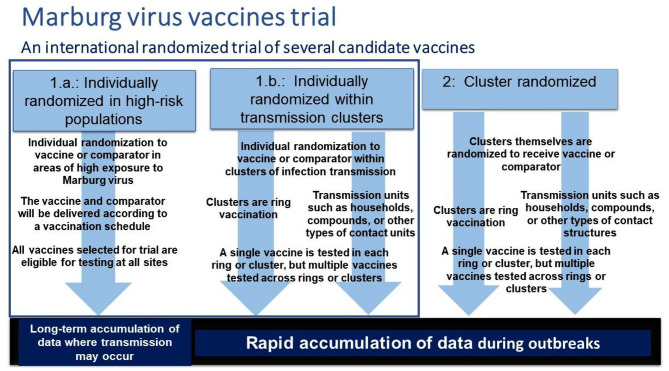
A core protocol approach will be used, allowing multiple vaccine candidates to be tested against controls. The primary objective of the trial will be to evaluate the effect of each vaccine on the rate of virologically confirmed Marburg virus disease, although Marburg infection assessed via seroconversion could be the primary objective in some cases. The overall trial design will be a mixture of individually and cluster-randomized designs, with individual randomization done whenever possible. Clusters will consist of either contacts and contacts of contacts of index cases, that is, ring vaccination, or other transmission units.
The primary efficacy endpoint will be analysed as a time-to-event outcome. A vaccine will be considered successful if its estimated efficacy is greater than 50% and has sufficient precision to rule out that true efficacy is less than 30%. This will require approximately 150 total endpoints, that is, cases of confirmed Marburg virus disease, per vaccine/comparator combination. Interim analyses will be conducted after 50 and after 100 events. Statistical analysis of the trial will be blended across the different types of designs. Under the assumption of a 6-month attack rate of 1% of the participants in the placebo arm for both the individually and cluster-randomized populations, the most likely sample size is about 20,000 participants per arm.
This event-driven design takes into the account the potentially sporadic spread of Marburg virus. The proposed trial design may be applicable for other pathogens against which effective vaccines are not yet available.
在中非和西非,可能暴发马尔堡病毒病的威胁日益增加。虽然目前尚无可用的马尔堡病毒疫苗,但已有几种候选疫苗正在研发中。我们借鉴针对其他病原体(包括 SARS-CoV-2)疫苗效力试验设计方面的知识和经验,制定了马尔堡病毒疫苗的随机 3 期疫苗效力试验设计。
采用核心方案方法,允许同时测试多种疫苗候选物与对照。试验的主要目的将是评估每种疫苗对经病毒学确认的马尔堡病毒病发病率的影响,尽管在某些情况下,通过血清转换评估的马尔堡感染可能是主要目标。总体试验设计将是个体随机化和群组随机化设计的混合体,尽可能进行个体随机化。群组将由病例的接触者和接触者的接触者组成,即环式接种,或其他传播单位。
主要疗效终点将作为时间事件结果进行分析。如果估计的疫苗效力大于 50%,且具有足够的精度排除真实效力小于 30%,则认为疫苗有效。这将需要大约 150 个总终点,即每个疫苗/对照组合的确诊马尔堡病毒病病例。将在 50 个和 100 个事件后进行中期分析。试验的统计分析将混合使用不同类型的设计。假设个体和群组随机化人群中安慰剂组的 6 个月攻击率为参与者的 1%,则最有可能的样本量约为每个臂 20000 名参与者。
这种基于事件的设计考虑到了马尔堡病毒可能呈散发性传播。所提出的试验设计可能适用于其他尚无有效疫苗的病原体。