Division of Surgery & Interventional Science, Royal National Orthopaedic Hospital, University College London, Stanmore HA7 4LP, U.K.
Centre for the Cellular Microenvironment, University of Glasgow, Glasgow G12 8LT, U.K.
ACS Appl Mater Interfaces. 2022 Aug 3;14(30):34400-34414. doi: 10.1021/acsami.2c07652. Epub 2022 Jul 22.
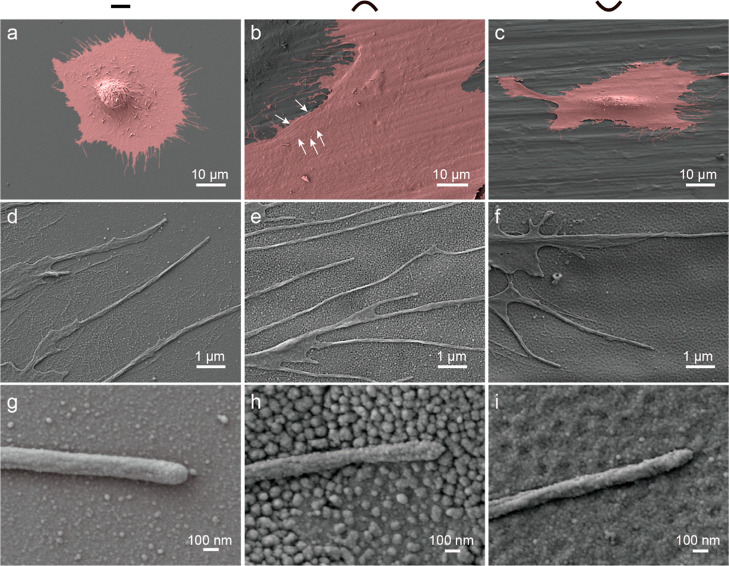
Nanotopography is an effective method to regulate cells' behaviors to improve Ti orthopaedic implants' in vivo performance. However, the mechanism underlying cellular matrix-nanotopography interactions that allows the modulation of cell adhesion has remained elusive. In this study, we have developed novel nanotopographic features on Ti substrates and studied human osteoblast (HOb) adhesion on nanotopographies to reveal the interactive mechanism regulating cell adhesion and spreading. Through nanoflat, nanoconvex, and nanoconcave TiO nanotopographies, the evolution of Coulomb's force between the extracellular matrix and nanotopographies has been estimated and comparatively analyzed, along with the assessment of cellular responses of HOb. We show that HObs exhibited greater adhesion and spreading on nanoconvex surfaces where they formed super matured focal adhesions and an ordered actin cytoskeleton. It also demonstrated that Coulomb's force on nanoconvex features exhibits a more intense and concentrated evolution than that of nanoconcave features, which may result in a high dense distribution of fibronectin. Thus, this work is meaningful for novel Ti-based orthopaedic implants' surface designs for enhancing their in vivo performance.
纳米形貌是一种有效的调节细胞行为的方法,可以改善 Ti 骨科植入物的体内性能。然而,细胞基质-纳米形貌相互作用的机制,即允许调节细胞黏附的机制,仍然难以捉摸。在这项研究中,我们在 Ti 基底上开发了新型的纳米形貌,并研究了人成骨细胞(HOb)在纳米形貌上的黏附,以揭示调节细胞黏附和铺展的相互作用机制。通过纳米平面、纳米凸面和纳米凹面 TiO 纳米形貌,估计了细胞外基质和纳米形貌之间库仑力的演变,并进行了比较分析,同时评估了 HOb 的细胞反应。我们发现,HOb 在纳米凸面表面表现出更强的黏附和铺展,在那里它们形成了超成熟的焦点黏附,并形成了有序的肌动蛋白细胞骨架。研究还表明,纳米凸面特征上的库仑力表现出比纳米凹面特征更强烈和集中的演变,这可能导致纤维连接蛋白的高密度分布。因此,这项工作对于增强 Ti 基骨科植入物的体内性能的新型表面设计具有重要意义。