Department of Biosciences, Manipal University Jaipur, Dehmi Kalan, Jaipur-Ajmer Expressway, Jaipur, Rajasthan, 303007, India.
Department of Biotechnology, Invertis University, Bareilly, 243123, India.
BMC Public Health. 2022 Jul 22;22(1):1402. doi: 10.1186/s12889-022-13720-w.
The world has been battling several vector-borne diseases since time immemorial. Socio-economic marginality, precipitation variations and human behavioral attributes play a major role in the proliferation of these diseases. Lockdown and social distancing have affected social behavioral aspects of human life and somehow impact on the spread of vector borne diseases. This article sheds light into the relationship between COVID-19 lockdown and global dengue burden with special focus on India. It also focuses on the interconnection of the COVID-19 pandemic (waves 1 and 2) and the alteration of human behavioral patterns in dengue cases.
We performed a systematic search using various resources from different platforms and websites, such as Medline; Pubmed; PAHO; WHO; CDC; ECDC; Epidemiology Unit Ministry of Health (Sri Lanka Government); NASA; NVBDCP from 2015 until 2021. We have included many factors, such as different geographical conditions (tropical climate, semitropic and arid conditions); GDP rate (developed nations, developing nations, and underdeveloped nations). We also categorized our data in order to conform to COVID-19 duration from 2019 to 2021. Data was extracted for the complete duration of 10 years (2012 to 2021) from various countries with different geographical region (arid region, semitropic/semiarid region and tropical region).
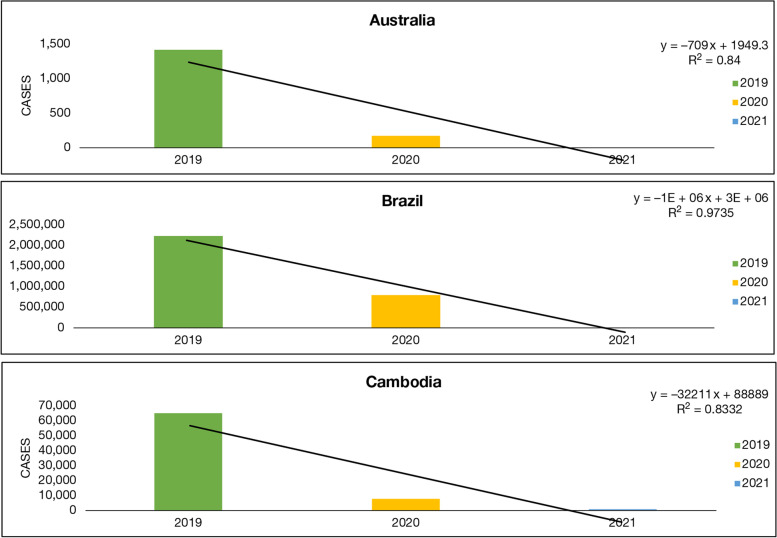
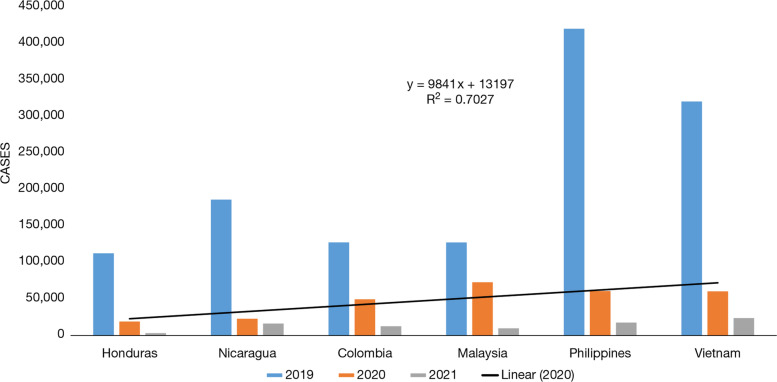
There was a noticeable reduction in dengue cases in underdeveloped (70-85%), developing (50-90%), and developed nations (75%) in the years 2019 and 2021. The dengue cases drastically reduced by 55-65% with the advent of COVID-19 s wave in the year 2021 across the globe.
At present, we can conclude that COVID-19 and dengue show an inverse relationship. These preliminary, data-based observations should guide clinical practice until more data are made public and basis for further medical research.
自古以来,世界一直在与几种虫媒传染病作斗争。社会经济边缘化、降水变化和人类行为特征在这些疾病的传播中起着重要作用。封锁和社会隔离影响了人类生活的社会行为方面,并在某种程度上影响了虫媒传染病的传播。本文探讨了 COVID-19 封锁与全球登革热负担之间的关系,特别关注印度。它还侧重于 COVID-19 大流行(第 1 波和第 2 波)与登革热病例中人类行为模式的改变之间的相互联系。
我们使用来自不同平台和网站的各种资源(如 Medline;Pubmed;PAHO;WHO;CDC;ECDC;斯里兰卡政府卫生部流行病学股;美国宇航局;NVBDCP)进行了系统搜索,时间范围为 2015 年至 2021 年。我们纳入了许多因素,如不同的地理位置(热带气候、亚热带和干旱条件);国内生产总值(发达国家、发展中国家和不发达国家)。我们还对数据进行了分类,以便符合 2019 年至 2021 年 COVID-19 的持续时间。我们从不同地理位置(干旱地区、亚热带/半干旱地区和热带地区)的不同国家提取了 10 年来(2012 年至 2021 年)的完整数据。
在 2019 年和 2021 年,不发达国家(70-85%)、发展中国家(50-90%)和发达国家(75%)的登革热病例明显减少。随着 2021 年 COVID-19 第 1 波的到来,全球登革热病例减少了 55-65%。
目前,我们可以得出结论,COVID-19 和登革热呈负相关。这些基于数据的初步观察结果应指导临床实践,直到更多的数据公布,并为进一步的医学研究提供依据。