Department of Epidemiology and Global Health, Umeå University, Umeå, Sweden.
Ministry of Health, Colombo, 01000, Sri Lanka.
PLoS Negl Trop Dis. 2021 Jun 10;15(6):e0009420. doi: 10.1371/journal.pntd.0009420. eCollection 2021 Jun.
Dengue is one of the major public health problems in Sri Lanka. Its outbreak pattern depends on a multitude of drivers, including human mobility. Here we evaluate the impact of COVID-19 related mobility restriction (lockdown) on the risk of dengue in Sri Lanka.
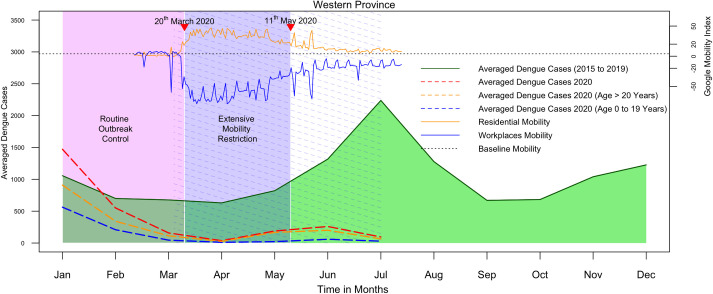
Two-stage hierarchical models were fitted using an interrupted time-series design based on the notified dengue cases, January 2015 to July 2020. In the first stage model, the district level impact was estimated using quasi-Poisson regression models while accounting for temporal trends. Estimates were pooled at zonal and national levels in the second stage model using meta-analysis. The influence of the extended period of school closure on dengue in children in the western province was compared to adults.
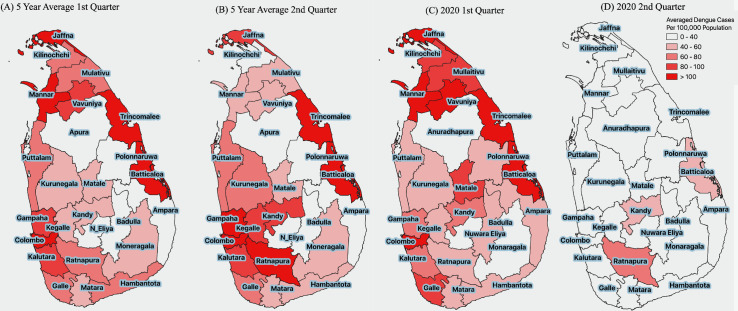
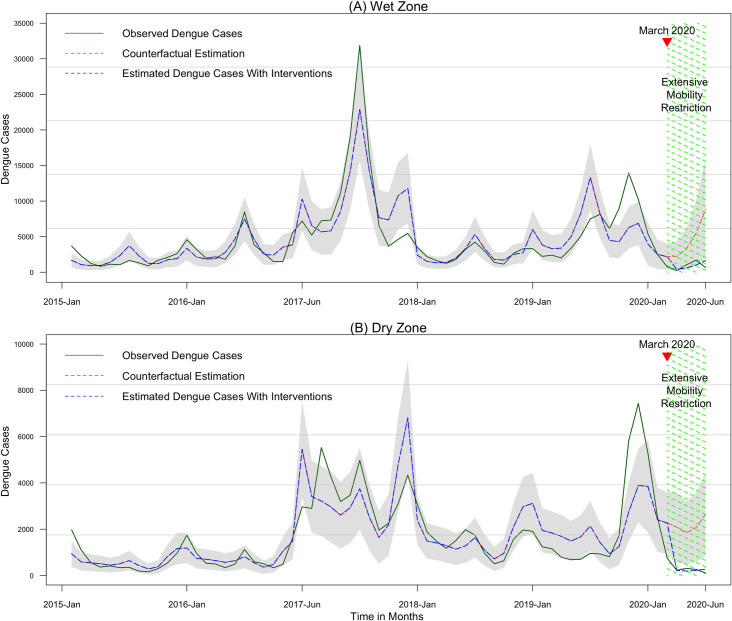
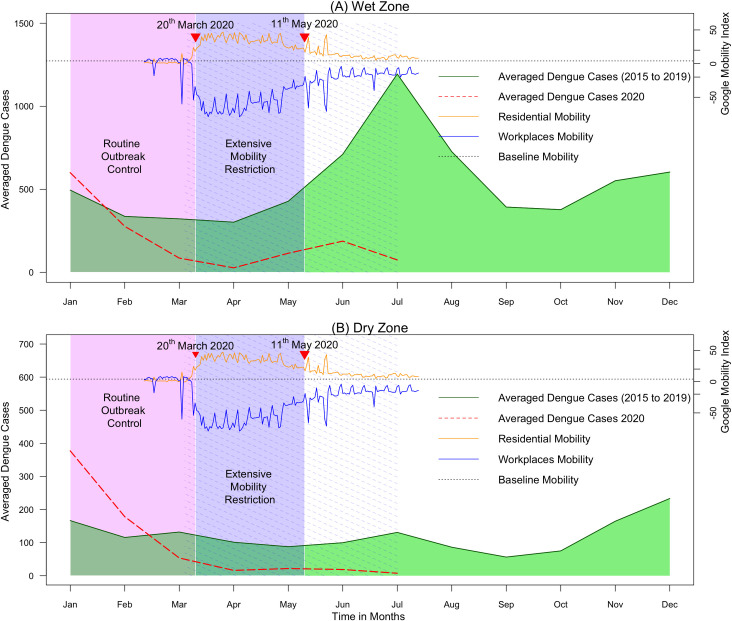
Statistically significant and homogeneous reduction of dengue risk was observed at all levels during the lockdown. Overall an 88% reduction in risk (RR 0.12; 95% CI from 0.08 to 0.17) was observed at the national level. The highest impact was observed among children aged less than 19 years showing a 92% reduction (RR 0.8; 95% CI from 0.03 to 0.25). We observed higher impact in the dry zone having 91% reduction (RR 0.09; 95% CI from 0.05 to 0.15) compared to wet zone showing 83% reduction (RR 0.17; 95% CI from 0.09 to 0.30). There was no indication that the overall health-seeking behaviour for dengue had a substantial influence on these estimates.
This study offers a broad understanding of the change in risk of dengue during the COVID-19 pandemic and associated mobility restrictions in Sri Lanka. The analysis using the mobility restrictions as a natural experiment suggests mobility patterns to be a very important driver of dengue transmission.
登革热是斯里兰卡主要的公共卫生问题之一。其爆发模式取决于多种因素,包括人类流动性。在这里,我们评估与 COVID-19 相关的流动性限制(封锁)对斯里兰卡登革热风险的影响。
使用基于通知的登革热病例的两阶段分层模型,采用中断时间序列设计,时间范围为 2015 年 1 月至 2020 年 7 月。在第一阶段模型中,使用准泊松回归模型估计区县级影响,同时考虑时间趋势。在第二阶段模型中,使用荟萃分析汇总区县级和国家级估计值。比较了西部省延长学校关闭时间对儿童登革热的影响与成人的影响。
在封锁期间,所有级别均观察到登革热风险的统计学显著和同质降低。总体而言,国家级风险降低了 88%(RR 0.12;95%CI 为 0.08 至 0.17)。在年龄小于 19 岁的儿童中观察到的影响最大,风险降低了 92%(RR 0.8;95%CI 为 0.03 至 0.25)。我们观察到,在干旱地区的影响更高,风险降低了 91%(RR 0.09;95%CI 为 0.05 至 0.15),而在潮湿地区的风险降低了 83%(RR 0.17;95%CI 为 0.09 至 0.30)。没有迹象表明整体寻求登革热治疗的行为对这些估计值有重大影响。
本研究广泛了解了斯里兰卡 COVID-19 大流行期间和相关流动性限制下登革热风险的变化。使用流动性限制作为自然实验的分析表明,流动模式是登革热传播的一个非常重要的驱动因素。