Department of Biochemistry, Yong Loo Lin School of Medicine, National University of Singapore, Singapore, 117596, Singapore.
Singapore Lipidomics Incubator, Life Sciences Institute, National University of Singapore, Singapore, Singapore.
BMC Med. 2022 Jul 25;20(1):242. doi: 10.1186/s12916-022-02432-y.
Lipids play a vital role in health and disease, but changes to their circulating levels and the link with obesity remain poorly characterized in expecting mothers and their offspring in early childhood.
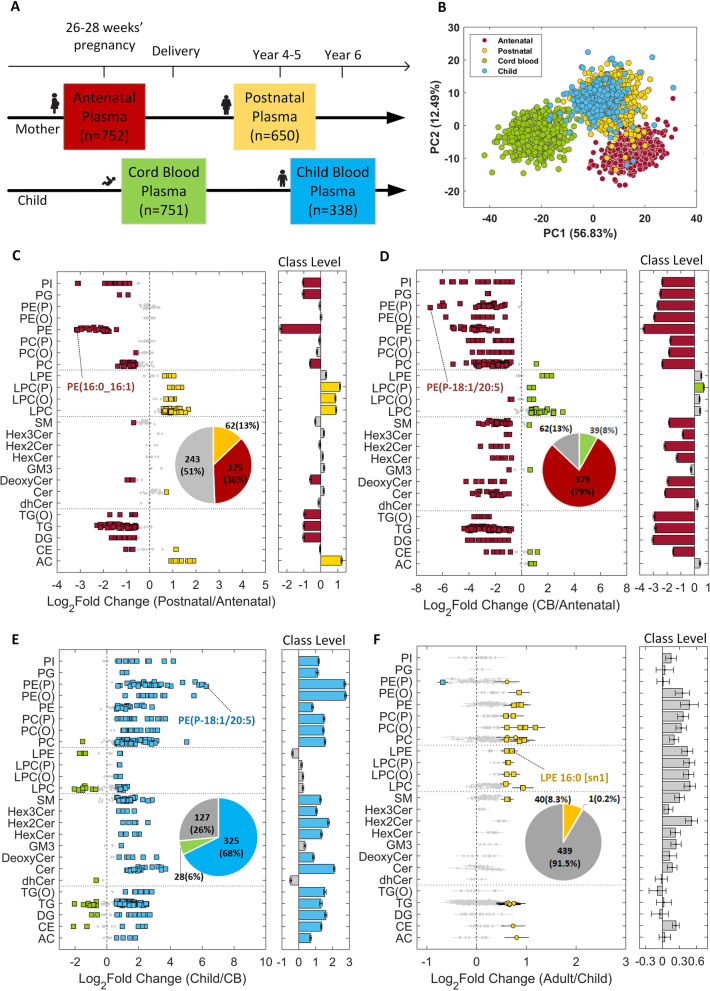
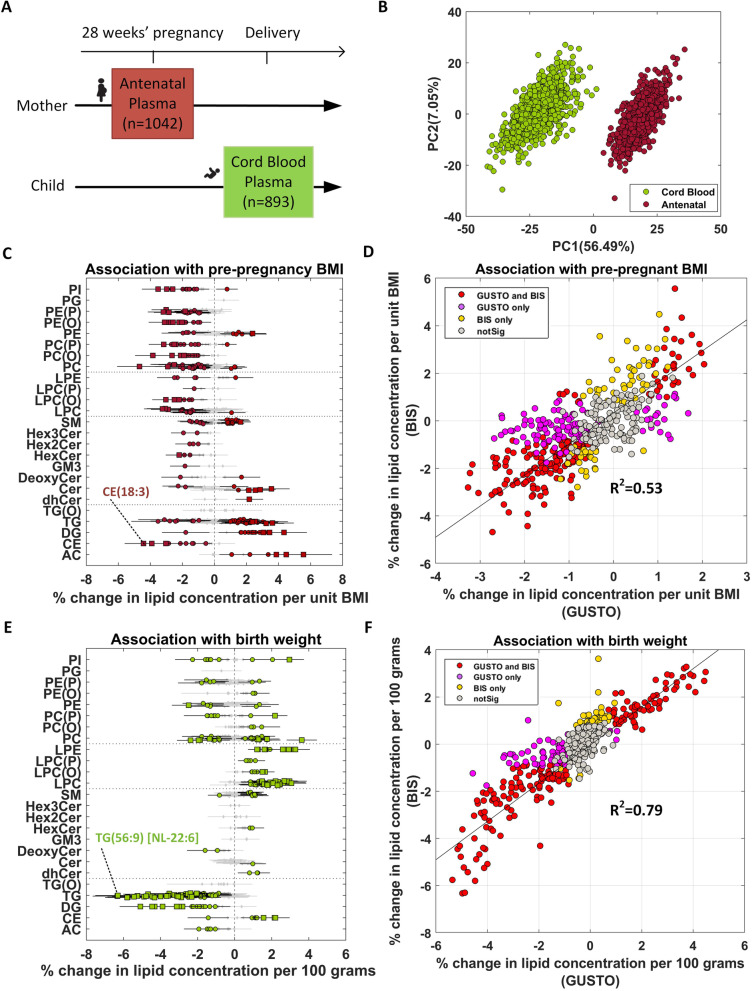
LC-MS/MS-based quantitation of 480 lipid species was performed on 2491 plasma samples collected at 4 time points in the mother-offspring Asian cohort GUSTO (Growing Up in Singapore Towards healthy Outcomes). These 4 time points constituted samples collected from mothers at 26-28 weeks of gestation (n=752) and 4-5 years postpartum (n=650), and their offspring at birth (n=751) and 6 years of age (n=338). Linear regression models were used to identify the pregnancy and developmental age-specific variations in the plasma lipidomic profiles, and their association with obesity risk. An independent birth cohort (n=1935), the Barwon Infant Study (BIS), comprising mother-offspring dyads of Caucasian origin was used for validation.
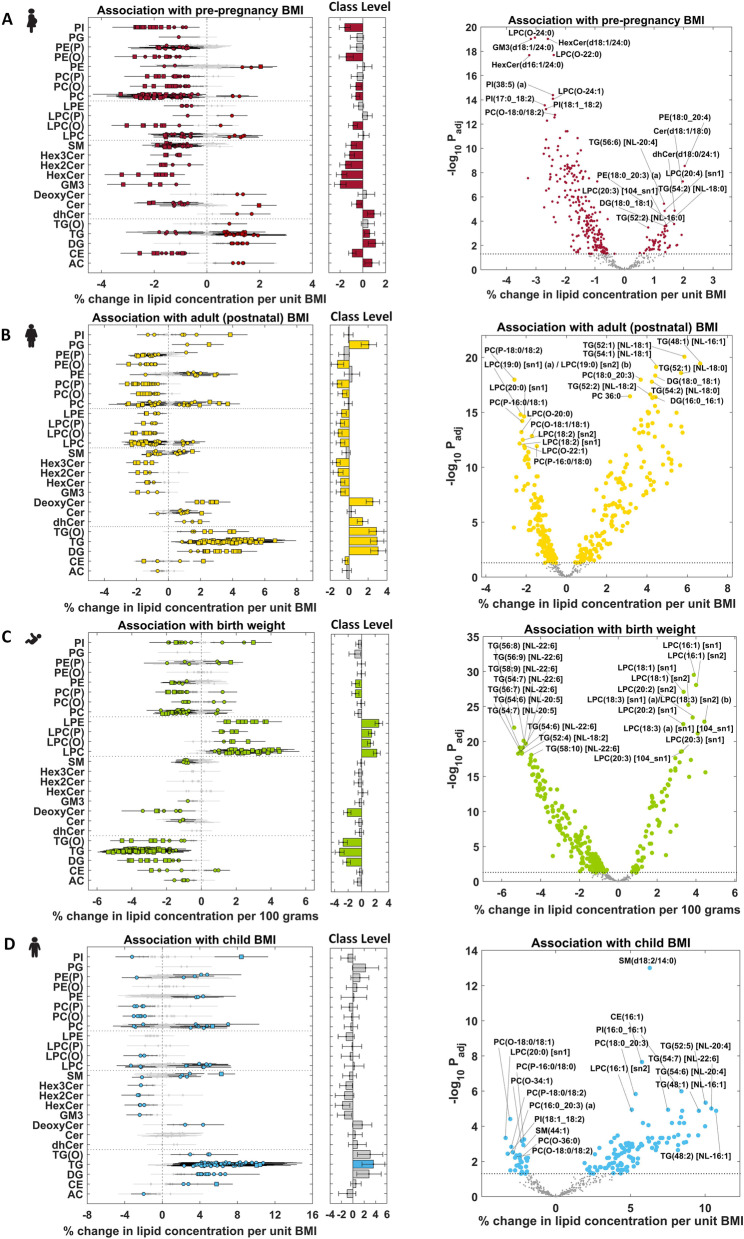
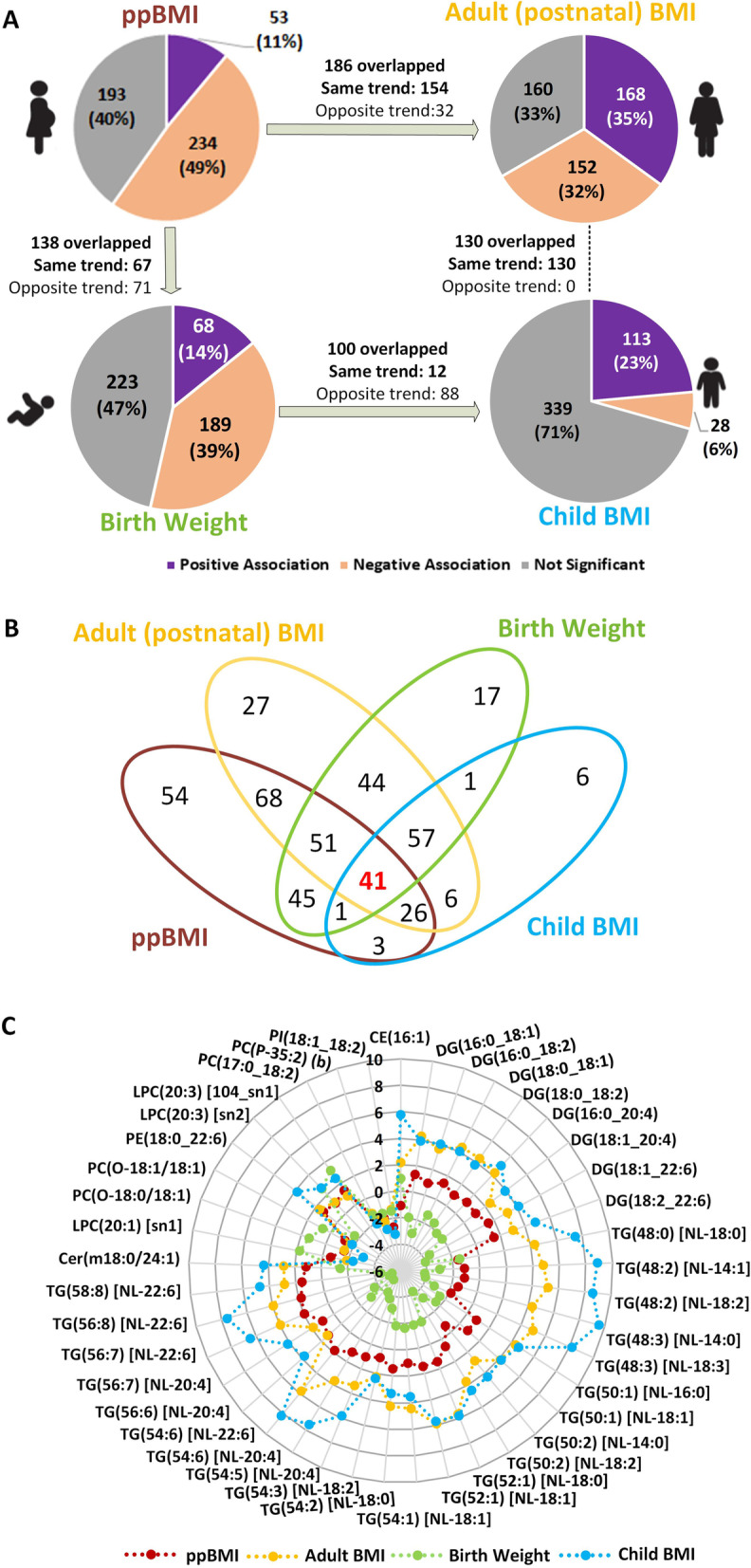
Levels of 36% of the profiled lipids were significantly higher (absolute fold change > 1.5 and P < 0.05) in antenatal maternal circulation as compared to the postnatal phase, with phosphatidylethanolamine levels changing the most. Compared to antenatal maternal lipids, cord blood showed lower concentrations of most lipid species (79%) except lysophospholipids and acylcarnitines. Changes in lipid concentrations from birth to 6 years of age were much higher in magnitude (logFC=-2.10 to 6.25) than the changes observed between a 6-year-old child and an adult (postnatal mother) (logFC=-0.68 to 1.18). Associations of cord blood lipidomic profiles with birth weight displayed distinct trends compared to the lipidomic profiles associated with child BMI at 6 years. Comparison of the results between the child and adult BMI identified similarities in association with consistent trends (R=0.75). However, large number of lipids were associated with BMI in adults (67%) compared to the children (29%). Pre-pregnancy BMI was specifically associated with decrease in the levels of phospholipids, sphingomyelin, and several triacylglycerol species in pregnancy.
In summary, our study provides a detailed landscape of the in utero lipid environment provided by the gestating mother to the growing fetus, and the magnitude of changes in plasma lipidomic profiles from birth to early childhood. We identified the effects of adiposity on the circulating lipid levels in pregnant and non-pregnant women as well as offspring at birth and at 6 years of age. Additionally, the pediatric vs maternal overlap of the circulating lipid phenotype of obesity risk provides intergenerational insights and early opportunities to track and intervene the onset of metabolic adversities.
This birth cohort is a prospective observational study, which was registered on 1 July 2010 under the identifier NCT01174875 .
脂质在健康和疾病中起着至关重要的作用,但母体及其后代在幼儿期循环水平的变化及其与肥胖的关系仍未得到很好的描述。
在亚洲队列 GUSTO(新加坡成长为健康结局)中,对 2491 个血浆样本进行了基于 LC-MS/MS 的 480 种脂质种类的定量分析。这 4 个时间点包括母亲在妊娠 26-28 周(n=752)和产后 4-5 年(n=650)以及他们的孩子在出生时(n=751)和 6 岁时(n=338)采集的样本。线性回归模型用于识别妊娠和发育年龄特异性血浆脂质组特征变化,并研究其与肥胖风险的关系。一个独立的出生队列(n=1935),即 Barwon 婴儿研究(BIS),包括白种人来源的母婴对子,用于验证。
与产后阶段相比,产前母体循环中 36%的脂质水平(绝对倍数变化>1.5,P<0.05)显著升高,其中磷脂酰乙醇胺的变化最大。与产前母体脂质相比,脐血中大多数脂质种类(79%)的浓度较低,除了溶血磷脂和酰基辅酶 A。从出生到 6 岁的脂质浓度变化幅度(logFC=-2.10 至 6.25)比从 6 岁儿童到成人(产后母亲)(logFC=-0.68 至 1.18)观察到的变化大得多。与脐血脂质组特征与出生体重相关的关联与与 6 岁儿童 BMI 相关的脂质组特征显示出明显的趋势。与儿童和成人 BMI 的结果进行比较,识别出一致性趋势的相似性(R=0.75)。然而,与儿童相比,大量脂质与成人 BMI 相关(67%比 29%)。孕前 BMI 与妊娠期间磷脂、神经鞘磷脂和几种三酰甘油种类水平的降低有关。
总之,我们的研究提供了母体在妊娠期间向生长中的胎儿提供的宫内脂质环境的详细情况,以及从出生到幼儿期血浆脂质组特征的变化幅度。我们确定了肥胖对孕妇和非孕妇以及出生时和 6 岁时的后代循环脂质水平的影响。此外,肥胖风险的循环脂质表型在儿科和产妇之间的重叠为跟踪和干预代谢不良的发生提供了代际见解和早期机会。
本队列研究是一项前瞻性观察性研究,于 2010 年 7 月 1 日注册,标识符为 NCT01174875。