Arsalan Muhammad, Saddique Imram, Baoji Miao, Awais Azka, Khan Ilyas, Shamseldin Mohamed A, Mehrez Sadok
Henan International Joint Laboratory of Nano-Photoelectric Magnetic Materials, Henan University of Technology, Zhengzhou, China.
Office of Research Innovation and Commercialization, University of Management and Technology, Lahore, Pakistan.
Front Chem. 2022 Jul 6;10:932985. doi: 10.3389/fchem.2022.932985. eCollection 2022.
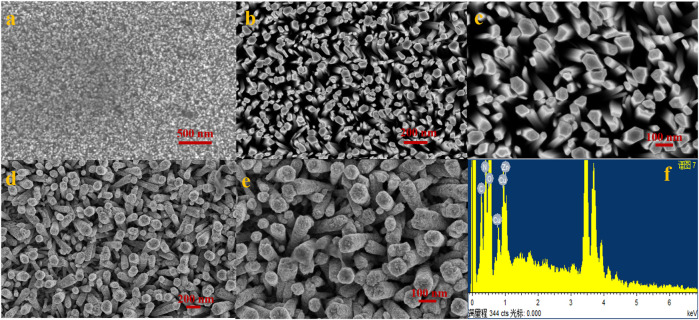
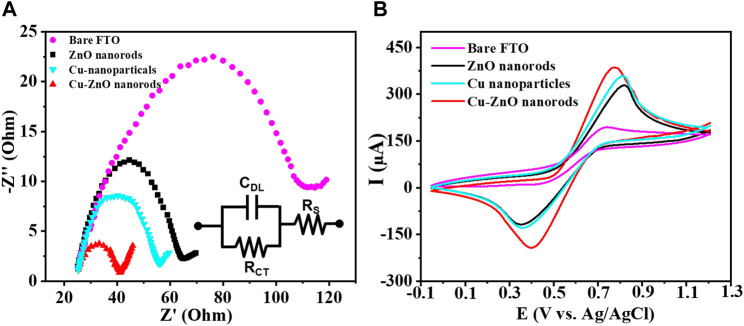
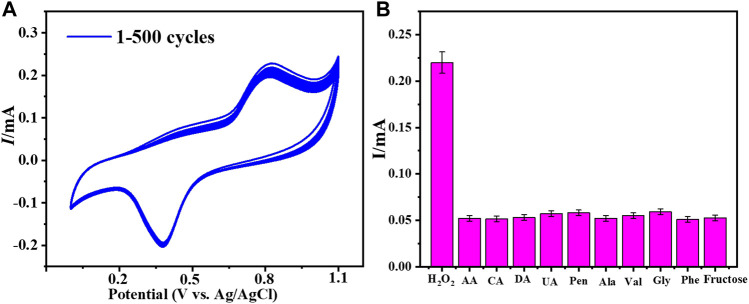
We aimed to synthesize sensitive electrochemical sensors for hydrogen peroxide sensing by using zinc oxide nanorods grown on a fluorine-doped tin oxide electrode by using the facial hydrothermal method. It was essential to keep the surface morphology of the material (nanorods structure); due to its large surface area, the concerned material has enhanced detection ability toward the analyte. The work presents a non-enzymatic HO sensor using vertically grown zinc oxide nanorods on the electrode (FTO) surfaces with Cu nanoparticles deposited on zinc oxide nanorods to enhance the activity. Scanning electron microscopy (SEM), X-ray photoelectron spectroscopy (XPS), energy-dispersive X-Ray (EDX), X-ray diffraction (XRD), and electrochemical methods were used to characterize copper-zinc oxide nanorods. In addition to the high surface area, the hexagonal Cu-ZnO nanorods exhibited enhanced electrochemical features of HO oxidation. Nanorods made from Cu-ZnO exhibit highly efficient sensitivity of 3415 μAmMcm low detection limits (LODs) of 0.16 μM and extremely wide linear ranges (0.001-11 mM). In addition, copper-zinc oxide nanorods demonstrated decent reproducibility, repeatability, stability, and selectivity after being used for HO sensing in water samples with an RSD value of 3.83%. Cu nanoparticles decorated on ZnO nanorods demonstrate excellent potential for the detection of hydrogen peroxide, providing a new way to prepare hydrogen peroxide detecting devices.
我们旨在通过水热法在氟掺杂氧化锡电极上生长氧化锌纳米棒,以合成用于过氧化氢传感的灵敏电化学传感器。保持材料的表面形态(纳米棒结构)至关重要;由于其大表面积,相关材料对分析物具有增强的检测能力。这项工作展示了一种非酶促过氧化氢传感器,该传感器在电极(FTO)表面使用垂直生长的氧化锌纳米棒,并在氧化锌纳米棒上沉积铜纳米颗粒以增强活性。使用扫描电子显微镜(SEM)、X射线光电子能谱(XPS)、能量色散X射线(EDX)、X射线衍射(XRD)和电化学方法对铜-氧化锌纳米棒进行表征。除了高表面积外,六方晶系的铜-氧化锌纳米棒还展现出增强的过氧化氢氧化电化学特性。由铜-氧化锌制成的纳米棒表现出3415 μAmMcm的高效灵敏度、0.16 μM的低检测限(LOD)和极宽的线性范围(0.001 - 11 mM)。此外,铜-氧化锌纳米棒在用于水样中的过氧化氢传感后,表现出良好的重现性、重复性、稳定性和选择性,相对标准偏差(RSD)值为3.83%。装饰在氧化锌纳米棒上的铜纳米颗粒在检测过氧化氢方面展现出优异的潜力,为制备过氧化氢检测装置提供了一种新方法。