Department of Medical Microbiology, School of Laboratory Medicine and Medical Science, University of KwaZulu-Natal, Durban, South Africa.
Centre for the AIDS Programme of Research in South Africa (CAPRISA), Durban, South Africa.
Front Cell Infect Microbiol. 2022 Jul 7;12:927131. doi: 10.3389/fcimb.2022.927131. eCollection 2022.
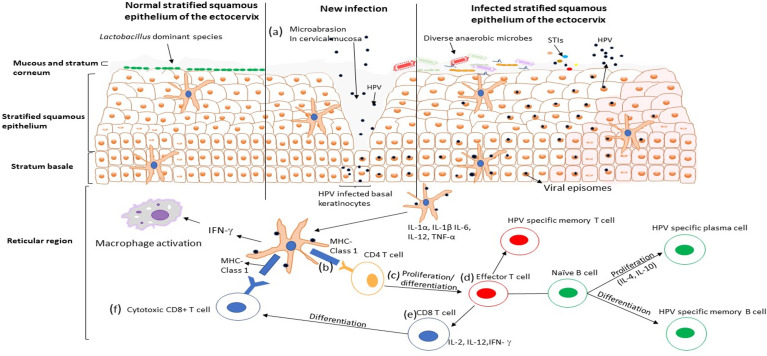
Cervical cancer disproportionately affects women of reproductive age, with 80% of cases occurring in low- and middle-income countries. Persistent infection with high-risk human papillomavirus (HPV) genotypes has been described as the most common non-systemic biological risk factor for the development of cervical cancer. The mucosal immune system plays a significant role in controlling HPV infection by acting as the first line of host defense at the mucosal surface. However, the virus can evade host immunity using various mechanisms, including inhibition of the antiviral immune response necessary for HPV clearance. Pro-inflammatory cytokines and the vaginal microbiome coordinate cell-mediated immune responses and play a pivotal role in modulating immunity. Recently, diverse vaginal microbiome (associated with bacterial vaginosis) and genital inflammation have emerged as potential drivers of high-risk HPV positivity and disease severity in women. The potential role of these risk factors on HPV recurrence and persistence remains unclear. This article reviews the role of cellular or cytokine response and vaginal microbiome dysbiosis in the clearance, persistence, and recurrence of HPV infection.
宫颈癌在育龄妇女中发病率较高,其中 80%的病例发生在中低收入国家。持续性高危型人乳头瘤病毒(HPV)感染被认为是宫颈癌发展的最常见非系统性生物学危险因素。黏膜免疫系统通过在黏膜表面作为宿主防御的第一道防线,在控制 HPV 感染方面发挥着重要作用。然而,病毒可以通过多种机制逃避宿主免疫,包括抑制清除 HPV 所需的抗病毒免疫反应。促炎细胞因子和阴道微生物群协调细胞介导的免疫反应,并在调节免疫方面发挥关键作用。最近,阴道微生物群的多样性(与细菌性阴道病相关)和生殖器炎症已成为高危 HPV 阳性和疾病严重程度的潜在驱动因素。这些危险因素在 HPV 复发和持续存在中的作用尚不清楚。本文综述了细胞或细胞因子反应以及阴道微生物群失调在 HPV 感染清除、持续存在和复发中的作用。