Zhang Chi, Ye Yixuan, Zhao Hongyu
Department of Biostatistics, Yale School of Public Health, New Haven, CT, United States.
Program of Computational Biology and Bioinformatics, Yale University, New Haven, CT, United States.
Front Genet. 2022 Jul 8;13:892950. doi: 10.3389/fgene.2022.892950. eCollection 2022.
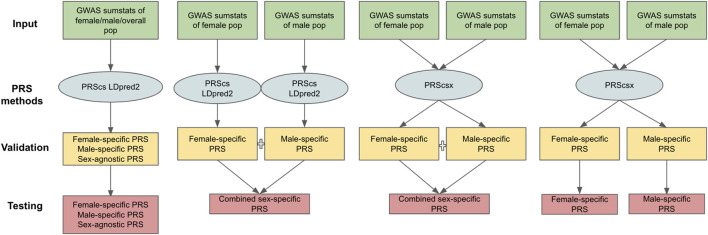
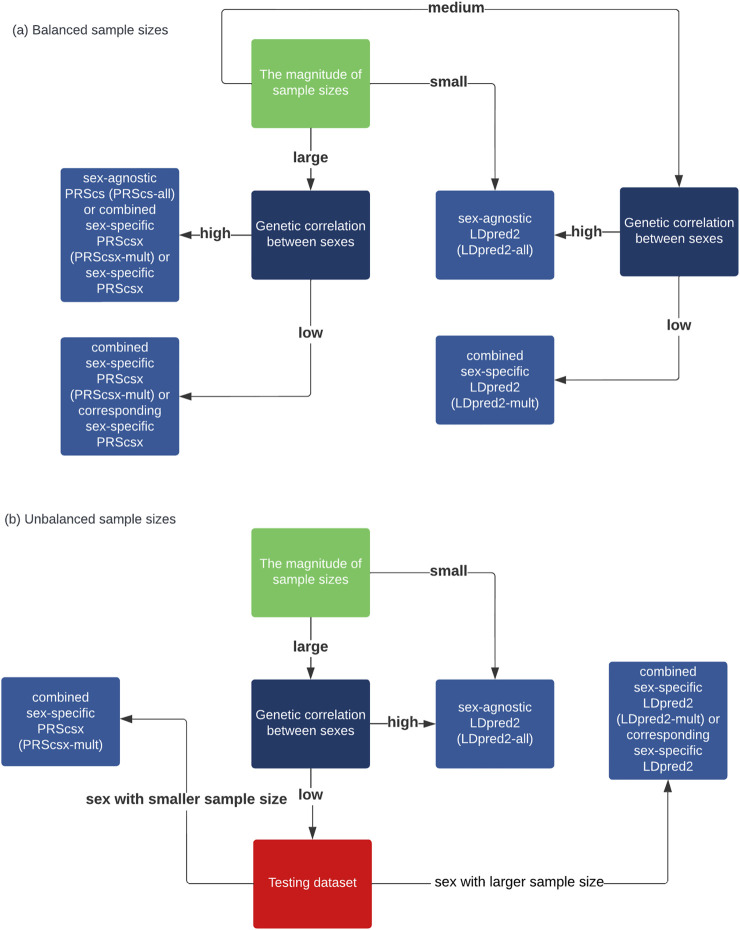
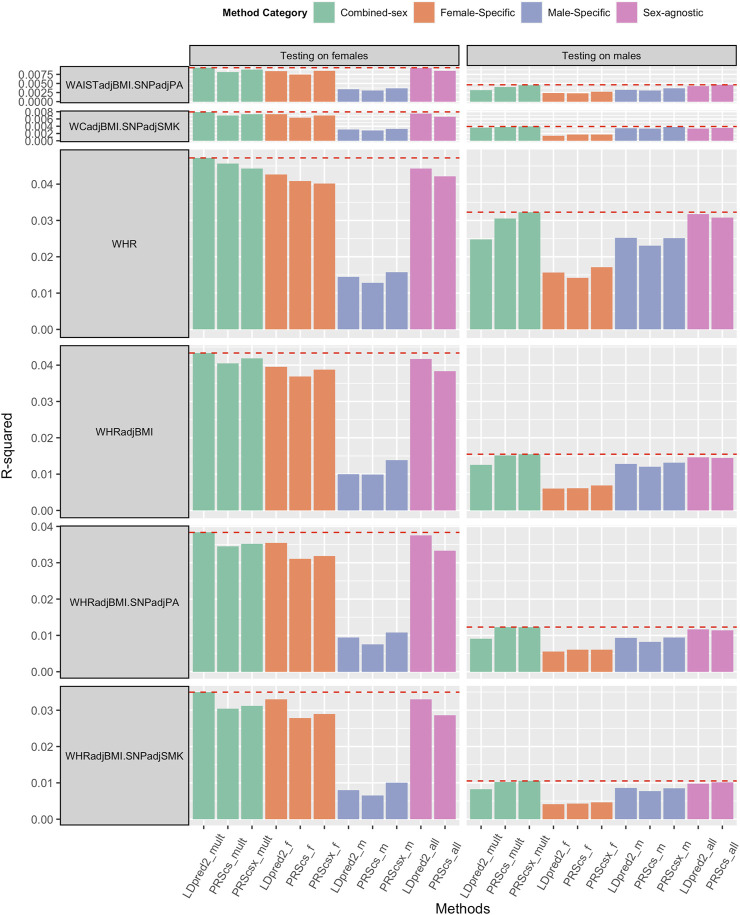
The polygenic risk score (PRS) is calculated as the weighted sum of an individual's genotypes and their estimated effect sizes, which is often used to estimate an individual's genetic susceptibility to complex traits and disorders. It is well known that some complex human traits or disorders have sex differences in trait distributions, disease onset, progression, and treatment response, although the underlying mechanisms causing these sex differences remain largely unknown. PRSs for these traits are often based on Genome-Wide Association Studies (GWAS) data with both male and female samples included, ignoring sex differences. In this study, we present a benchmark study using both simulations with various combinations of genetic correlation and sample size ratios between sexes and real data to investigate whether combining sex-specific PRSs can outperform sex-agnostic PRSs on traits showing sex differences. We consider two types of PRS models in our study: single-population PRS models (PRScs, LDpred2) and multiple-population PRS models (PRScsx). For each trait or disorder, the candidate PRSs were calculated based on sex-specific GWAS data and sex-agnostic GWAS data. The simulation results show that applying LDpred2 or PRScsx to sex-specific GWAS data and then combining sex-specific PRSs leads to the highest prediction accuracy when the genetic correlation between sexes is low and the sample sizes for both sexes are balanced and large. Otherwise, the PRS generated by applying LDpred2 or PRScs to sex-agnostic GWAS data is more appropriate. If the sample sizes between sexes are not too small and very unbalanced, combining LDpred2-based sex-specific PRSs to predict on the sex with a larger sample size and combining PRScsx-based sex-specific PRSs to predict on the sex with a smaller size are the preferred strategies. For real data, we considered 19 traits from Genetic Investigation of ANthropometric Traits (GIANT) consortium studies and UK Biobank with both sex-specific GWAS data and sex-agnostic GWAS data. We found that for waist-to-hip ratio (WHR) related traits, accounting for sex differences and incorporating information from the opposite sex could help improve PRS prediction accuracy. Taken together, our findings in this study provide guidance on how to calculate the best PRS for sex-differentiated traits or disorders, especially as the sample size of GWASs grows in the future.
多基因风险评分(PRS)是个体基因型与其估计效应大小的加权总和,常用于估计个体对复杂性状和疾病的遗传易感性。众所周知,一些复杂的人类性状或疾病在性状分布、疾病发病、进展和治疗反应方面存在性别差异,尽管导致这些性别差异的潜在机制在很大程度上仍不清楚。这些性状的PRS通常基于包含男性和女性样本的全基因组关联研究(GWAS)数据,而忽略了性别差异。在本研究中,我们进行了一项基准研究,使用具有不同遗传相关性和性别样本量比例组合的模拟以及真实数据,以研究在显示性别差异的性状上,结合特定性别的PRS是否能优于不考虑性别的PRS。我们在研究中考虑了两种类型的PRS模型:单群体PRS模型(PRScs、LDpred2)和多群体PRS模型(PRScsx)。对于每个性状或疾病,基于特定性别的GWAS数据和不考虑性别的GWAS数据计算候选PRS。模拟结果表明,当性别间遗传相关性较低且两性样本量平衡且较大时,将LDpred2或PRScsx应用于特定性别的GWAS数据,然后结合特定性别的PRS可获得最高的预测准确性。否则,将LDpred2或PRScs应用于不考虑性别的GWAS数据所生成的PRS更合适。如果两性样本量不是太小且非常不平衡,结合基于LDpred2的特定性别的PRS对样本量较大的性别进行预测,以及结合基于PRScsx的特定性别的PRS对样本量较小的性别进行预测是首选策略。对于真实数据,我们考虑了来自人体测量性状遗传调查(GIANT)联盟研究和英国生物银行的19个性状,同时有特定性别的GWAS数据和不考虑性别的GWAS数据。我们发现,对于腰臀比(WHR)相关性状,考虑性别差异并纳入来自异性的信息有助于提高PRS预测准确性。综上所述,我们在本研究中的发现为如何计算针对性别分化性状或疾病的最佳PRS提供了指导,特别是随着未来GWAS样本量的增加。