Zewude Bewunetu, Siraw Getahun, Adem Yesuf
Department of Sociology, College of Social Sciences and Humanities, Wolaita Sodo University, Wolaita Sodo, Ethiopia.
Department of Sociology, College of Social Sciences and Humanities, Dilla University, Dilla, Ethiopia.
Pragmat Obs Res. 2022 Jul 15;13:59-73. doi: 10.2147/POR.S370513. eCollection 2022.
The purpose of the study was to identify the choice of mode of delivery and the factors associated with such preferences among pregnant women attending antenatal care services in Southern Ethiopia.
Using an institutional-based cross-sectional survey, quantitative data were collected from randomly selected pregnant women in Southern Ethiopia. A semi-structured questionnaire was distributed to pregnant women who had been attending antenatal healthcare services in purposively selected public and private healthcare facilities in Shashemene town. The completed cases were inserted into SPSS version 26 in which both descriptive and inferential statistical techniques were used to analyze the data.
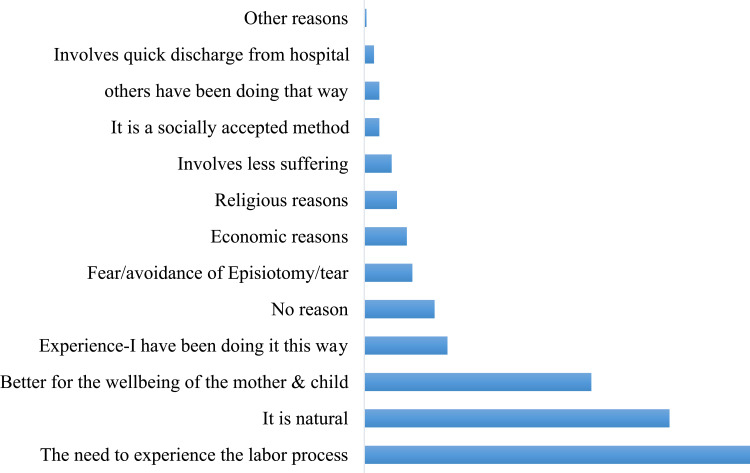
It was found that 75.4% of respondents replied that they prefer vaginal delivery while 24.6% had chosen cesarean section. Personal conviction motivated by the need to experience the labor process, the belief in it being a natural method, the perception that it is better for the wellbeing of both the mother and the child, previous experience of delivery by vaginal method, fear or the need to avoid episiotomy, and economic concerns have been mentioned as reasons for the choice of vaginal delivery. Moreover, respondents' choice of the mode of delivery is significantly associated with religion, age, number of children, pregnancy experience, previous mode of delivery, self-rated social class status, autonomy to decide about mode of delivery, and type of healthcare organization of antenatal care attendance.
Although vaginal delivery has remained the most preferred mode of delivery among most pregnant women, about a quarter of pregnant women have reported that they prefer to deliver by cesarean section, a prevalence rate which is higher than the national average, indicating that the choice of cesarean section is still increasing among women.
本研究的目的是确定埃塞俄比亚南部接受产前护理服务的孕妇的分娩方式选择以及与这些偏好相关的因素。
采用基于机构的横断面调查,从埃塞俄比亚南部随机选择的孕妇中收集定量数据。向在沙舍梅内镇有目的地选择的公立和私立医疗机构接受产前保健服务的孕妇发放了一份半结构化问卷。将完整的案例录入SPSS 26版本,使用描述性和推断性统计技术对数据进行分析。
发现75.4%的受访者表示他们更喜欢阴道分娩,而24.6%的人选择了剖宫产。因需要体验分娩过程而产生的个人信念、认为这是一种自然方式、认为这对母亲和孩子的健康都更好、以前有过阴道分娩经历、害怕或需要避免会阴切开术以及经济方面的考虑被提及为选择阴道分娩的原因。此外,受访者对分娩方式的选择与宗教、年龄、子女数量、怀孕经历、以前的分娩方式、自评社会阶层地位、决定分娩方式的自主权以及产前护理就诊的医疗机构类型显著相关。
尽管阴道分娩仍然是大多数孕妇最喜欢的分娩方式,但约四分之一的孕妇报告称她们更喜欢剖宫产,这一患病率高于全国平均水平,表明剖宫产在女性中的选择率仍在上升。