• 文献检索
  • 文档翻译
  • 深度研究
  • 学术资讯
  • Suppr Zotero 插件Zotero 插件
  • 邀请有礼
  • 套餐&价格
  • 历史记录
应用&插件
Suppr Zotero 插件Zotero 插件浏览器插件Mac 客户端Windows 客户端微信小程序
定价
高级版会员购买积分包购买API积分包
服务
文献检索文档翻译深度研究API 文档MCP 服务
关于我们
关于 Suppr公司介绍联系我们用户协议隐私条款
关注我们

Suppr 超能文献

核心技术专利:CN118964589B侵权必究
粤ICP备2023148730 号-1Suppr @ 2026

文献检索

告别复杂PubMed语法,用中文像聊天一样搜索,搜遍4000万医学文献。AI智能推荐,让科研检索更轻松。

立即免费搜索

文件翻译

保留排版,准确专业,支持PDF/Word/PPT等文件格式,支持 12+语言互译。

免费翻译文档

深度研究

AI帮你快速写综述,25分钟生成高质量综述,智能提取关键信息,辅助科研写作。

立即免费体验

老年人对社交机器人接受度评估量表的设计与开发:机器人时代量表

Design and Development of a Scale for Evaluating the Acceptance of Social Robotics for Older People: The Robot Era Inventory.

作者信息

Bevilacqua Roberta, Di Rosa Mirko, Riccardi Giovanni Renato, Pelliccioni Giuseppe, Lattanzio Fabrizia, Felici Elisa, Margaritini Arianna, Amabili Giulio, Maranesi Elvira

机构信息

Scientific Direction, IRCCS INRCA, Ancona, Italy.

Unit of Geriatric Pharmacoepidemiology, IRCCS INRCA, Ancona, Italy.

出版信息

Front Neurorobot. 2022 Jul 7;16:883106. doi: 10.3389/fnbot.2022.883106. eCollection 2022.

DOI:10.3389/fnbot.2022.883106
PMID:35874107
原文链接:https://pmc.ncbi.nlm.nih.gov/articles/PMC9302437/
Abstract

INTRODUCTION

Nowadays, several robots have been developed to provide not only companionship to older adults, but also to cooperate with them during health and lifestyle activities. Despite the undeniable wealth of socially assistive robots (SARs), there is an increasing need to customize the tools used for measuring their acceptance in real-life applications.

METHODS

Within the Robot-Era project, a scale was developed to understand the degree of acceptance of the robotic platform. A preliminary test with 21 participants was performed to assess the statistical validity of the Robot-Era Inventory (REI) scales.

RESULTS

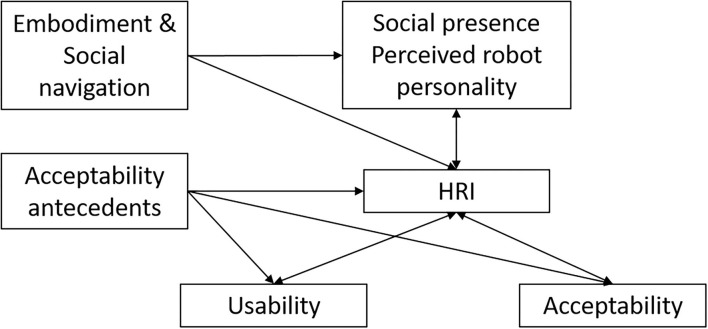
Based on the criteria observed in the literature, 41 items were developed and grouped in different scales (perceived robot personality, human-robot interaction, perceived benefit, ease of use, and perceived usefulness). The reliability of the Robot-Era Inventory scale was analyzed with Cronbach's alpha, with a mean value of 0.79 (range = 0.61-0.91). Furthermore, the preliminary validity of this scale has been tested by using the correlation analysis with a gold standard, the Unified Theory of Acceptance and Use of Technology (UTAUT) model.

DISCUSSION

The Robot-Era Inventory represents a useful tool that can be easily personalized and included in the assessment of any SARs that cooperate with older people in real environment applications.

摘要

引言

如今,已开发出多种机器人,它们不仅能陪伴老年人,还能在健康和生活方式活动中与他们合作。尽管社会辅助机器人(SAR)数量众多,但在实际应用中,越来越需要定制用于衡量其接受度的工具。

方法

在“机器人时代”项目中,开发了一个量表以了解对机器人平台的接受程度。对21名参与者进行了初步测试,以评估“机器人时代量表”(REI)的统计有效性。

结果

根据文献中观察到的标准,开发了41个项目,并将其分为不同量表(感知机器人个性、人机交互、感知益处、易用性和感知有用性)。使用克朗巴哈系数分析了“机器人时代量表”的信度,均值为0.79(范围=0.61-0.91)。此外,通过与黄金标准技术接受与使用统一理论(UTAUT)模型进行相关性分析,测试了该量表的初步效度。

讨论

“机器人时代量表”是一种有用的工具,可轻松实现个性化,并可纳入对任何在实际环境应用中与老年人合作的社会辅助机器人的评估。
https://cdn.ncbi.nlm.nih.gov/pmc/blobs/126b/9302437/44a49098bbc5/fnbot-16-883106-g0001.jpg

相似文献

1
Design and Development of a Scale for Evaluating the Acceptance of Social Robotics for Older People: The Robot Era Inventory.老年人对社交机器人接受度评估量表的设计与开发:机器人时代量表
Front Neurorobot. 2022 Jul 7;16:883106. doi: 10.3389/fnbot.2022.883106. eCollection 2022.
2
Development of a metric to evaluate the ergonomic principles of assistive systems, based on the DIN 92419.基于 DIN 92419 开发一种评估助行系统人机工程学原理的度量标准。
Ergonomics. 2023 Jun;66(6):821-848. doi: 10.1080/00140139.2022.2127920. Epub 2022 Sep 30.
3
Robotic Services Acceptance in Smart Environments With Older Adults: User Satisfaction and Acceptability Study.智能环境中老年人对机器人服务的接受度:用户满意度与可接受性研究。
J Med Internet Res. 2018 Sep 21;20(9):e264. doi: 10.2196/jmir.9460.
4
Identifying Features that Enhance Older Adults' Acceptance of Robots: A Mixed Methods Study.识别特征,提高老年人对机器人的接受度:混合方法研究。
Gerontology. 2019;65(4):441-450. doi: 10.1159/000494881. Epub 2019 Mar 7.
5
Acceptance of an assistive robot in older adults: a mixed-method study of human-robot interaction over a 1-month period in the Living Lab setting.老年人对辅助机器人的接受度:在生活实验室环境中进行为期 1 个月的人机交互混合方法研究。
Clin Interv Aging. 2014 May 8;9:801-11. doi: 10.2147/CIA.S56435. eCollection 2014.
6
Socially Assistive Robots: Measuring Older Adults' Perceptions.社交辅助机器人:衡量老年人的认知
J Gerontol Nurs. 2017 Dec 1;43(12):35-43. doi: 10.3928/00989134-20170707-04. Epub 2017 Jul 13.
7
Acceptance and Attitudes Toward a Human-like Socially Assistive Robot by Older Adults.老年人对类人社交辅助机器人的接受度和态度
Assist Technol. 2014 Fall;26(3):140-50. doi: 10.1080/10400435.2013.869703.
8
A robot goes to rehab: a novel gamified system for long-term stroke rehabilitation using a socially assistive robot-methodology and usability testing.机器人用于康复治疗:一种使用社交辅助机器人的新型游戏化长期中风康复系统——方法与可用性测试
J Neuroeng Rehabil. 2021 Jul 28;18(1):122. doi: 10.1186/s12984-021-00915-2.
9
Changes in technology acceptance among older people with dementia: the role of social robot engagement.老年人认知障碍者技术接受度的变化:社交机器人参与的作用。
Int J Med Inform. 2020 Sep;141:104241. doi: 10.1016/j.ijmedinf.2020.104241. Epub 2020 Jul 30.
10
[Should assistive robots have a "personality"? : Potential of simplified robot personalities].辅助机器人应该拥有“个性”吗?:简化机器人个性的潜力
Z Gerontol Geriatr. 2016 Jun;49(4):298-302. doi: 10.1007/s00391-016-1068-3. Epub 2016 May 31.

引用本文的文献

1
Evaluating transdisciplinary methods: a new scale for measuring knowledge integration.评估跨学科方法:一种衡量知识整合的新量表。
Humanit Soc Sci Commun. 2025;12(1):1395. doi: 10.1057/s41599-025-05634-w. Epub 2025 Aug 26.
2
Framing the Human-Centered Artificial Intelligence Concepts and Methods: Scoping Review.构建以人为本的人工智能概念与方法:范围综述
JMIR Hum Factors. 2025 May 28;12:e67350. doi: 10.2196/67350.
3
Instruments for Measuring Psychological Dimensions in Human-Robot Interaction: Systematic Review of Psychometric Properties.

本文引用的文献

1
Exploring Barriers to and Enablers of the Adoption of Information and Communication Technology for the Care of Older Adults With Chronic Diseases: Scoping Review.探索采用信息通信技术照顾慢性病老年人的障碍与促进因素:范围综述
JMIR Aging. 2022 Jan 7;5(1):e25251. doi: 10.2196/25251.
2
Communication in Human-Robot Interaction.人机交互中的沟通
Curr Robot Rep. 2020;1(4):279-285. doi: 10.1007/s43154-020-00026-1. Epub 2020 Aug 27.
3
A Systematic Review of Human and Robot Personality in Health Care Human-Robot Interaction.医疗保健人机交互中人类与机器人个性的系统评价
用于测量人机交互中心理维度的工具:心理测量特性的系统评价。
J Med Internet Res. 2024 Jun 5;26:e55597. doi: 10.2196/55597.
Front Robot AI. 2021 Sep 17;8:748246. doi: 10.3389/frobt.2021.748246. eCollection 2021.
4
Development and Usability Validation of a Social Robot Platform for Physical and Cognitive Stimulation in Elder Care Facilities.老年护理机构中用于身体和认知刺激的社交机器人平台的开发与可用性验证
Healthcare (Basel). 2021 Aug 19;9(8):1067. doi: 10.3390/healthcare9081067.
5
A Systematic Review of Social Presence: Definition, Antecedents, and Implications.社会临场感的系统综述:定义、影响因素及启示
Front Robot AI. 2018 Oct 15;5:114. doi: 10.3389/frobt.2018.00114. eCollection 2018.
6
Coaching Through Technology: A Systematic Review into Efficacy and Effectiveness for the Ageing Population.技术指导:老龄化人群功效和有效性的系统评价。
Int J Environ Res Public Health. 2020 Aug 15;17(16):5930. doi: 10.3390/ijerph17165930.
7
The Role of Psychological Factors in Older Adults' Readiness to Use eHealth Technology: Cross-Sectional Questionnaire Study.心理因素在老年人使用电子健康技术意愿中的作用:横断面问卷调查研究
J Med Internet Res. 2020 May 28;22(5):e14670. doi: 10.2196/14670.
8
Enablers and barriers to the implementation of socially assistive humanoid robots in health and social care: a systematic review.促进和阻碍社交辅助人形机器人在医疗和社会保健领域应用的因素:系统评价。
BMJ Open. 2020 Jan 9;10(1):e033096. doi: 10.1136/bmjopen-2019-033096.
9
Technology Acceptance Models in Health Informatics: TAM and UTAUT.健康信息学中的技术接受模型:技术接受模型(TAM)和统一技术接受与使用模型(UTAUT)
Stud Health Technol Inform. 2019 Jul 30;263:64-71. doi: 10.3233/SHTI190111.
10
Digital technology and nursing care: a scoping review on acceptance, effectiveness and efficiency studies of informal and formal care technologies.数字技术与护理:非正式和正式护理技术的接受度、有效性和效率研究的范围综述。
BMC Health Serv Res. 2019 Jun 20;19(1):400. doi: 10.1186/s12913-019-4238-3.