Department of Pediatrics, Division of Infectious Diseases and Immunology, Guerin Children's at Cedars-Sinai Medical Center, Los Angeles, CA, United States.
Infectious and Immunologic Diseases Research Center (IIDRC) and Department of Biomedical Sciences, Cedars-Sinai Medical Center, Los Angeles, CA, United States.
Front Immunol. 2022 Jul 7;13:941009. doi: 10.3389/fimmu.2022.941009. eCollection 2022.
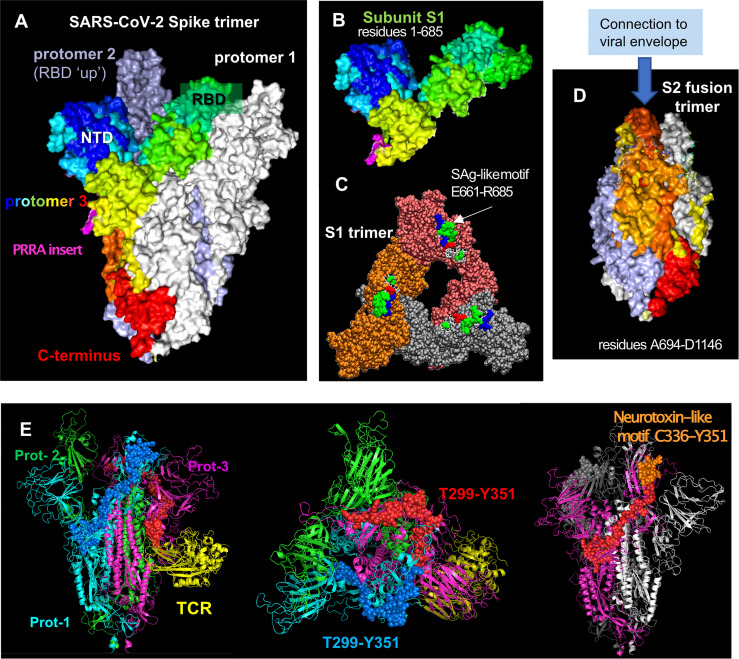
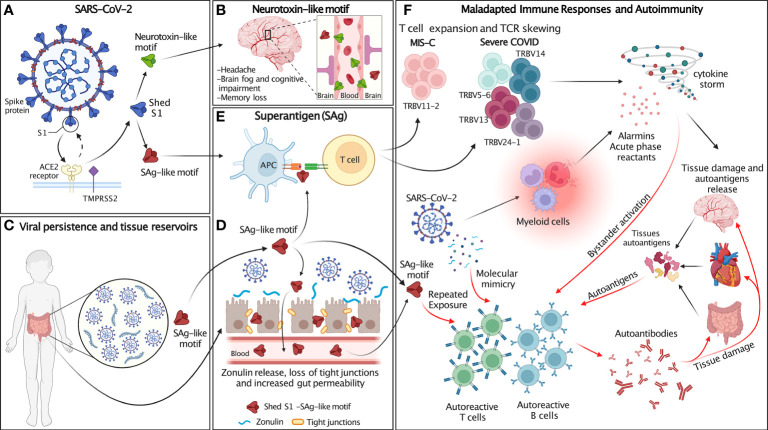
Multisystem inflammatory syndrome in children (MIS-C) is a febrile pediatric inflammatory disease that may develop weeks after initial SARS-CoV-2 infection or exposure. MIS-C involves systemic hyperinflammation and multiorgan involvement, including severe cardiovascular, gastrointestinal (GI) and neurological symptoms. Some clinical attributes of MIS-C-such as persistent fever, rashes, conjunctivitis and oral mucosa changes (red fissured lips and strawberry tongue)-overlap with features of Kawasaki disease (KD). In addition, MIS-C shares striking clinical similarities with toxic shock syndrome (TSS), which is triggered by bacterial superantigens (SAgs). The remarkable similarities between MIS-C and TSS prompted a search for SAg-like structures in the SARS-CoV-2 virus and the discovery of a unique SAg-like motif highly similar to a Staphylococcal enterotoxin B (SEB) fragment in the SARS-CoV-2 spike 1 (S1) glycoprotein. Computational studies suggest that the SAg-like motif has a high affinity for binding T-cell receptors (TCRs) and MHC Class II proteins. Immunosequencing of peripheral blood samples from MIS-C patients revealed a profound expansion of TCR β variable gene 11-2 (TRBV11-2), which correlates with MIS-C severity and serum cytokine levels, consistent with a SAg-triggered immune response. Computational sequence analysis of SARS-CoV-2 spike further identified conserved neurotoxin-like motifs which may alter neuronal cell function and contribute to neurological symptoms in COVID-19 and MIS-C patients. Additionally, autoantibodies are detected during MIS-C, which may indicate development of post-SARS-CoV-2 autoreactive and autoimmune responses. Finally, prolonged persistence of SARS-CoV-2 RNA in the gut, increased gut permeability and elevated levels of circulating S1 have been observed in children with MIS-C. Accordingly, we hypothesize that continuous and prolonged exposure to the viral SAg-like and neurotoxin-like motifs in SARS-CoV-2 spike may promote autoimmunity leading to the development of post-acute COVID-19 syndromes, including MIS-C and long COVID, as well as the neurological complications resulting from SARS-CoV-2 infection.
儿童多系统炎症综合征(MIS-C)是一种发热性儿科炎症性疾病,可能在初始 SARS-CoV-2 感染或暴露后数周发生。MIS-C 涉及全身炎症过度活跃和多器官受累,包括严重的心血管、胃肠道(GI)和神经系统症状。MIS-C 的一些临床特征,如持续发热、皮疹、结膜炎和口腔黏膜变化(红色裂唇和草莓舌),与川崎病(KD)的特征重叠。此外,MIS-C 与中毒性休克综合征(TSS)具有惊人的临床相似性,后者由细菌超抗原(SAgs)引发。MIS-C 与 TSS 之间的显著相似性促使人们在 SARS-CoV-2 病毒中寻找类似 SAg 的结构,并发现了一种独特的 SAg 样基序,与 SARS-CoV-2 刺突 1(S1)糖蛋白中的葡萄球菌肠毒素 B(SEB)片段高度相似。计算研究表明,SAg 样基序与 T 细胞受体(TCR)和 MHC Ⅱ类蛋白具有高亲和力。对 MIS-C 患者外周血样本的免疫测序显示,TCR β 可变基因 11-2(TRBV11-2)显著扩增,这与 MIS-C 的严重程度和血清细胞因子水平相关,提示存在 SAg 触发的免疫反应。对 SARS-CoV-2 刺突的计算序列分析进一步鉴定了保守的神经毒素样基序,这些基序可能改变神经元细胞功能,并导致 COVID-19 和 MIS-C 患者的神经系统症状。此外,在 MIS-C 期间检测到自身抗体,这可能表明发生了 SARS-CoV-2 后自身反应性和自身免疫反应。最后,在 MIS-C 患儿中观察到 SARS-CoV-2 RNA 在肠道中的持续和长期存在、肠道通透性增加和循环 S1 水平升高。因此,我们假设 SARS-CoV-2 刺突中的病毒 SAg 样和神经毒素样基序的持续和长期暴露可能促进自身免疫,导致急性 COVID-19 后综合征的发展,包括 MIS-C 和长 COVID,以及 SARS-CoV-2 感染引起的神经系统并发症。