Xu Hailing, Ge Shilun, Yuan Feng
Academic Affairs Office, Jiangsu University of Science and Technology, Zhenjiang 212003, China.
School of Economics and Management, Jiangsu University of Science and Technology, Zhenjiang 212003, China.
Behav Sci (Basel). 2022 Jul 10;12(7):225. doi: 10.3390/bs12070225.
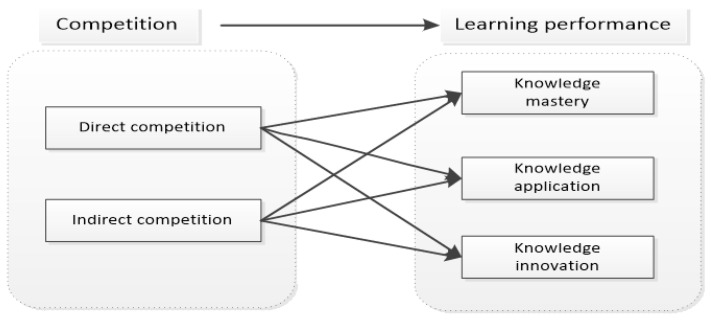
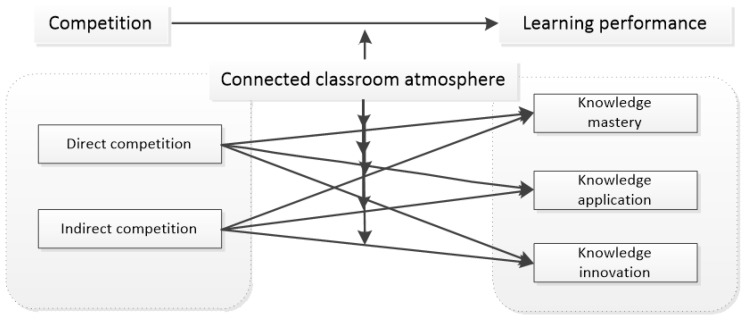
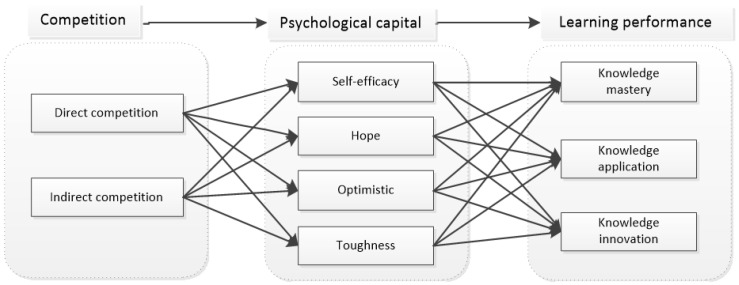
With the rapid development of information technology and the influence of the COVID-19 pandemic, online learning has become an important supplement to the teaching organization form of basic education and higher education. In order to increase user stickiness and improve learning performance, gamification elements are widely introduced into online learning situations. However, scholars have drawn different conclusions on the impact of game-based competition on online learning performance. This study is based on field theory and constructivist learning theory. Taking the online interaction of the curriculum platform as the situation, psychological capital as the intermediary variable and connected classroom atmosphere as the adjustment variable, this paper constructs an interaction model between game competition and online learning performance and discusses in depth the intermediary effect of psychological capital and the adjustment effect of a connected classroom atmosphere. The results show that game-based competition has a significant positive effect on learning performance, and the effect of direct competition is better than that of indirect competition; the self-efficacy dimension of psychological capital plays an intermediary role between direct competition and learning performance, and the resilience dimension plays an intermediary role between competition and learning performance; and a connected classroom atmosphere plays a regulating role in the dimensions of game competition, knowledge mastery and knowledge innovation.
随着信息技术的飞速发展以及新冠疫情的影响,在线学习已成为基础教育和高等教育教学组织形式的重要补充。为了提高用户粘性并提升学习效果,游戏化元素被广泛引入在线学习情境中。然而,学者们对于基于游戏的竞赛对在线学习效果的影响得出了不同结论。本研究基于场域理论和建构主义学习理论。以课程平台的在线互动为情境,以心理资本为中介变量,以连接课堂氛围为调节变量,构建了游戏竞赛与在线学习效果之间的互动模型,并深入探讨了心理资本的中介效应以及连接课堂氛围的调节效应。结果表明,基于游戏的竞赛对学习效果有显著的正向影响,直接竞赛的效果优于间接竞赛;心理资本的自我效能维度在直接竞赛与学习效果之间起中介作用,心理韧性维度在竞赛与学习效果之间起中介作用;连接课堂氛围在游戏竞赛、知识掌握和知识创新维度上起调节作用。