Stanford University, Stanford, CA, USA.
University California San Diego, San Diego, CA, USA.
Nat Commun. 2022 Jul 25;13(1):4276. doi: 10.1038/s41467-022-31254-y.
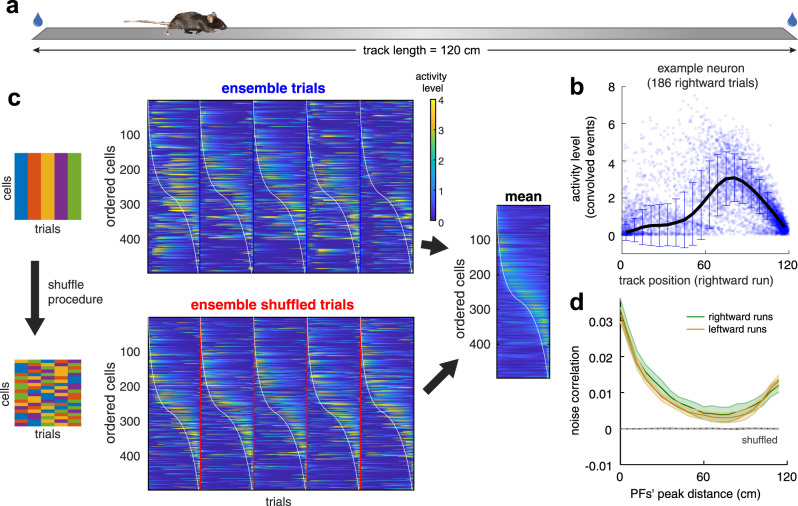
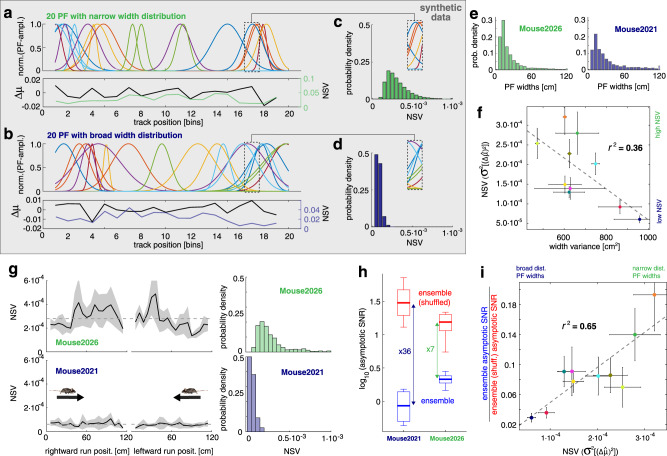
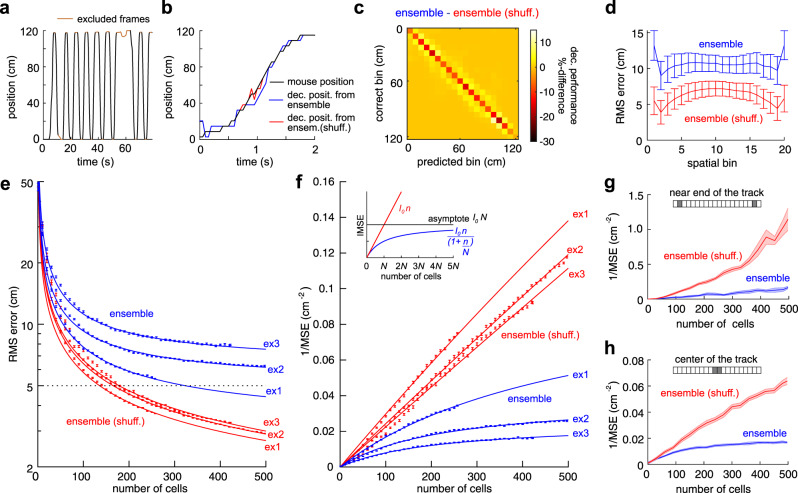
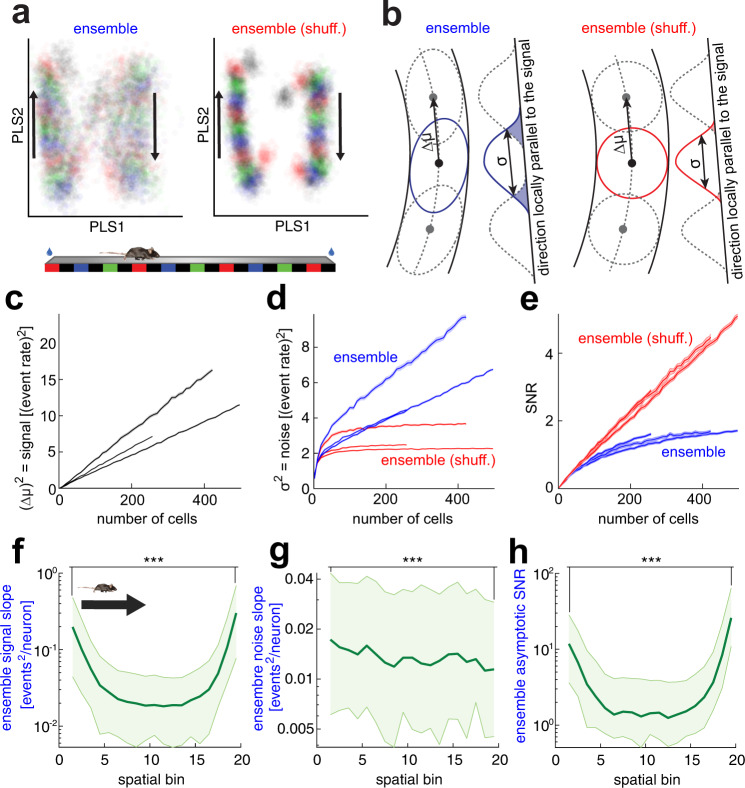
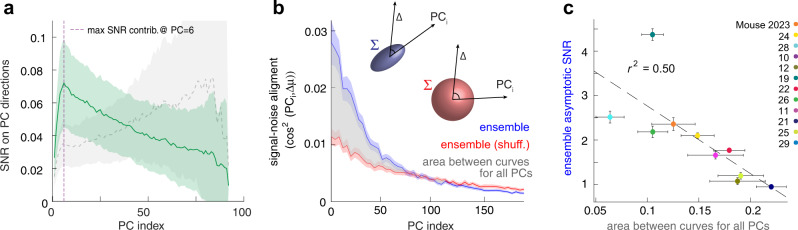
Neurons in the CA1 area of the mouse hippocampus encode the position of the animal in an environment. However, given the variability in individual neurons responses, the accuracy of this code is still poorly understood. It was proposed that downstream areas could achieve high spatial accuracy by integrating the activity of thousands of neurons, but theoretical studies point to shared fluctuations in the firing rate as a potential limitation. Using high-throughput calcium imaging in freely moving mice, we demonstrated the limiting factors in the accuracy of the CA1 spatial code. We found that noise correlations in the hippocampus bound the estimation error of spatial coding to ~10 cm (the size of a mouse). Maximal accuracy was obtained using approximately [300-1400] neurons, depending on the animal. These findings reveal intrinsic limits in the brain's representations of space and suggest that single neurons downstream of the hippocampus can extract maximal spatial information from several hundred inputs.
小鼠海马 CA1 区的神经元对动物在环境中的位置进行编码。然而,由于个体神经元反应的可变性,这种编码的准确性仍不清楚。有人提出,下游区域可以通过整合数千个神经元的活动来实现高空间精度,但理论研究指出,由于发射率的共享波动,这可能成为一个潜在的限制因素。通过在自由活动的小鼠中进行高通量钙成像,我们证明了 CA1 空间编码准确性的限制因素。我们发现,海马中的噪声相关性将空间编码的估计误差限制在约 10cm(一只老鼠的大小)以内。最大精度是通过使用大约[300-1400]个神经元获得的,具体取决于动物。这些发现揭示了大脑对空间的表示存在内在限制,并表明海马体下游的单个神经元可以从几百个输入中提取最大的空间信息。