Edmealem Afework, Ademe Sewunet, Gedamu Sisay
Department of Nursing, School of Nursing and Midwifery, Wollo University, Dessie, Ethiopia.
Int J Hypertens. 2022 Jul 16;2022:5962571. doi: 10.1155/2022/5962571. eCollection 2022.
Self-care adherence for hypertensive patients is a cornerstone for the control of it and prevention of its complications. However, there are inconsistent findings for self-care adherence of hypertensive patients in Ethiopia. Thus, this systematic review and meta-analysis was done to determine the pooled estimate self-care adherence.
This systematic review and meta-analysis was reported based on the Preferred Reporting Items for Systematic Review and Meta-Analysis guideline. An intensive search of online databases such as PubMed (MEDLINE), CINHAL, Google Scholar, and advanced Google search was made to access both published and unpublished articles that report self-care adherence among hypertensive patients in Ethiopia. The pooled estimate was done with STATA version 11 metan commands in a 95% confidence interval. The presence of heterogeneity and publication bias were detected by I and Egger's test, respectively. A random-effect model was obtained, and subgroup analysis was done for the management of heterogeneity.
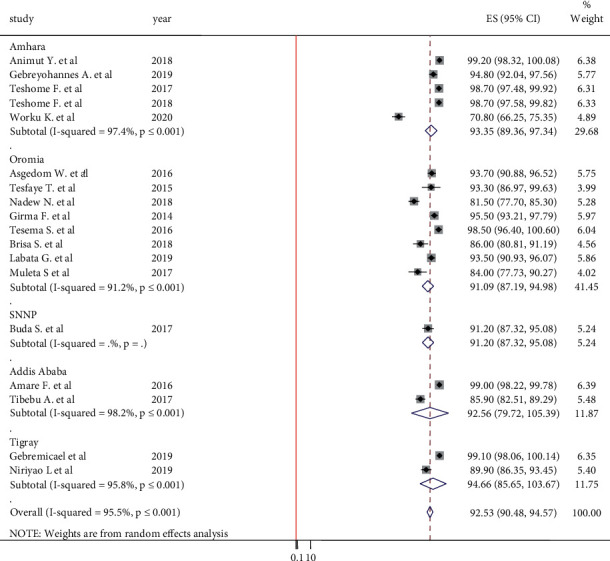
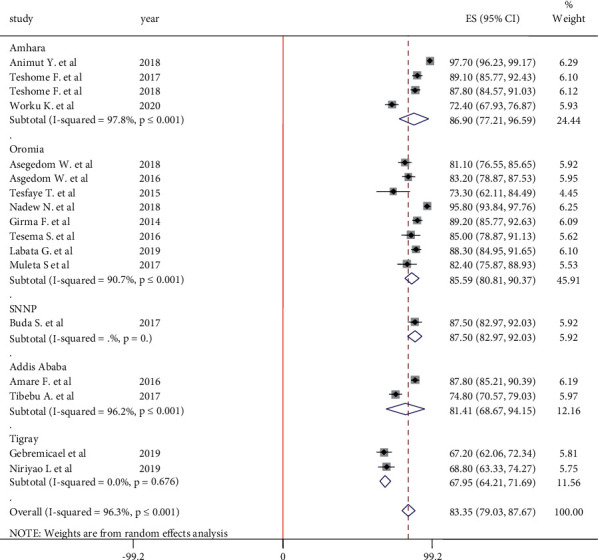
A total of 24 articles with a total of 7224 participants were included in the final systematic review and meta-analysis. The pooled estimate of overall self-care adherence among hypertensive patients was 36.98% (95% CI: 27.13-46.83). In subgroup analysis, the highest overall self-care adherence was observed in the Amhara region at 53% (95% CI: 46.54, 59.47). The pooled estimate of self-care dimensions such as medication adherence, low-salt diet, physical activity, smoking abstinence, alcohol abstinence, and weight management was 62.71%, 65.96%, 47.28%, 92.53%, 67.59%, and 52.54%, respectively.
The pooled estimate of good self-care adherence among hypertensive patients was low. From the dimensions of self-care, the lowest level was in physical activity and the highest level was in smoking abstinence. Comparing all regions, the lowest level of overall self-care adherence was observed in Addis Ababa, Tigray region, and South Nations and Nationalities of Ethiopia. Screening of adherence to self-care and health education should be provided to every patient during every visit.
高血压患者的自我护理依从性是控制血压及预防并发症的基石。然而,埃塞俄比亚高血压患者自我护理依从性的研究结果并不一致。因此,开展了这项系统评价和荟萃分析以确定自我护理依从性的合并估计值。
本系统评价和荟萃分析依据系统评价和荟萃分析的首选报告项目指南进行报告。对在线数据库如PubMed(MEDLINE)、CINHAL、谷歌学术以及谷歌高级搜索进行了全面检索,以获取已发表和未发表的关于埃塞俄比亚高血压患者自我护理依从性的文章。使用STATA 11版本的metan命令在95%置信区间内进行合并估计。分别通过I检验和Egger检验检测异质性和发表偏倚的存在。获得随机效应模型,并进行亚组分析以处理异质性。
最终的系统评价和荟萃分析共纳入24篇文章,总计7224名参与者。高血压患者总体自我护理依从性的合并估计值为36.98%(95%置信区间:27.13 - 46.83)。在亚组分析中,阿姆哈拉地区的总体自我护理依从性最高,为53%(95%置信区间:46.54, 59.47)。自我护理各维度的合并估计值,如药物依从性、低盐饮食、体育活动、戒烟、戒酒和体重管理,分别为62.71%、65.96%、47.28%、92.53%、67.59%和52.54%。
高血压患者良好自我护理依从性的合并估计值较低。从自我护理维度来看,体育活动方面的依从性最低,戒烟方面的依从性最高。在所有地区中,亚的斯亚贝巴、提格雷地区以及埃塞俄比亚的南方民族和民族地区的总体自我护理依从性最低。每次就诊时都应为每位患者进行自我护理依从性筛查并提供健康教育。