Singh Samradhi, Sharma Poonam, Pal Namrata, Kumawat Manoj, Shubham Swasti, Sarma Devojit Kumar, Tiwari Rajnarayan R, Kumar Manoj, Nagpal Ravinder
National Institute for Research in Environmental Health, Bhopal 462030, India.
Department of Nutrition and Integrative Physiology, Florida State University, Tallahassee, FL 32302, USA.
Microorganisms. 2022 Jul 19;10(7):1457. doi: 10.3390/microorganisms10071457.
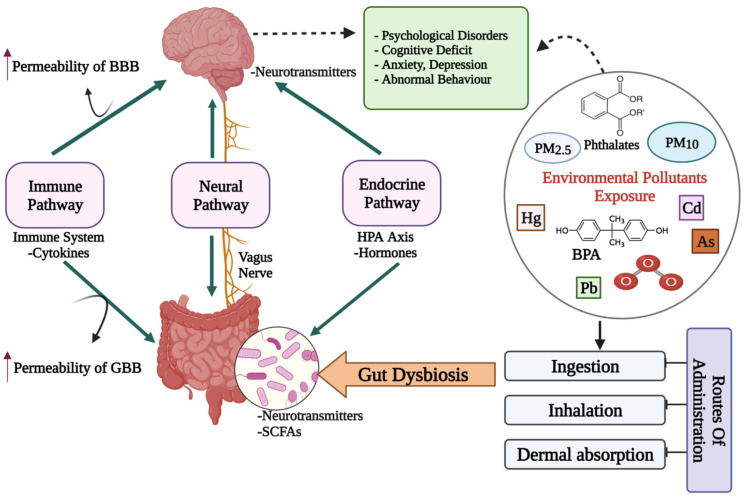
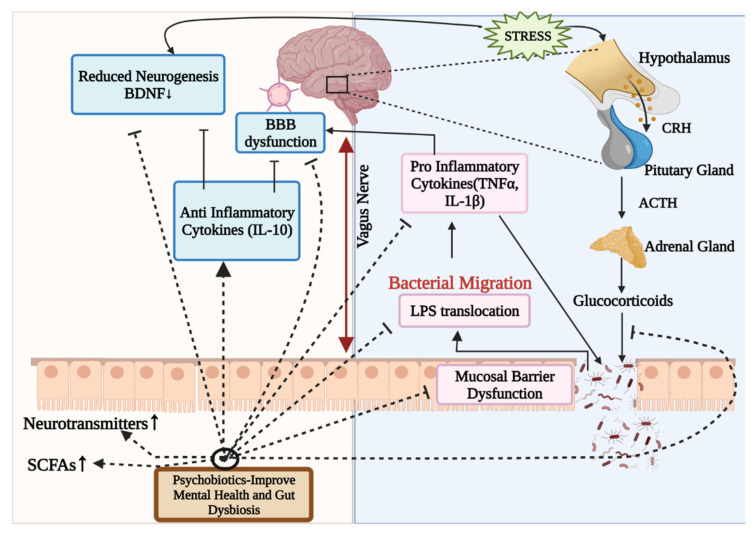
Over the last few years, the microbiome has emerged as a high-priority research area to discover missing links between brain health and gut dysbiosis. Emerging evidence suggests that the commensal gut microbiome is an important regulator of the gut-brain axis and plays a critical role in brain physiology. Engaging microbiome-generated metabolites such as short-chain fatty acids, the immune system, the enteric nervous system, the endocrine system (including the HPA axis), tryptophan metabolism or the vagus nerve plays a crucial role in communication between the gut microbes and the brain. Humans are exposed to a wide range of pollutants in everyday life that impact our intestinal microbiota and manipulate the bidirectional communication between the gut and the brain, resulting in predisposition to psychiatric or neurological disorders. However, the interaction between xenobiotics, microbiota and neurotoxicity has yet to be completely investigated. Although research into the precise processes of the microbiota-gut-brain axis is growing rapidly, comprehending the implications of environmental contaminants remains challenging. In these milieus, we herein discuss how various environmental pollutants such as phthalates, heavy metals, Bisphenol A and particulate matter may alter the intricate microbiota-gut-brain axis thereby impacting our neurological and overall mental health.
在过去几年中,微生物群已成为一个高度优先的研究领域,用于发现大脑健康与肠道菌群失调之间缺失的联系。新出现的证据表明,共生肠道微生物群是肠-脑轴的重要调节因子,在大脑生理学中起着关键作用。涉及微生物群产生的代谢产物,如短链脂肪酸、免疫系统、肠神经系统、内分泌系统(包括下丘脑-垂体-肾上腺轴)、色氨酸代谢或迷走神经,在肠道微生物与大脑之间的通讯中起着至关重要的作用。人类在日常生活中接触到各种各样的污染物,这些污染物会影响我们的肠道微生物群,并操纵肠道与大脑之间的双向通讯,从而导致易患精神或神经疾病。然而,外源性物质、微生物群和神经毒性之间的相互作用尚未得到充分研究。尽管对微生物群-肠-脑轴精确过程的研究正在迅速发展,但理解环境污染物的影响仍然具有挑战性。在这些环境中,我们在此讨论各种环境污染物,如邻苯二甲酸盐、重金属、双酚A和颗粒物,如何改变复杂的微生物群-肠-脑轴,从而影响我们的神经和整体心理健康。