
用于高效促进多重耐药菌感染伤口愈合的硫化铜铁纳米颗粒光热调控纳米酶
Photothermal Regulated Nanozyme of CuFeS Nanoparticles for Efficiently Promoting Wound Healing Infected by Multidrug Resistant Bacteria.
作者信息
Liu Zezhong, Liu Zengxu, Zhao Zhen, Li Danxia, Zhang Pengfei, Zhang Yanfang, Liu Xiangyong, Ding Xiaoteng, Xu Yuanhong
机构信息
Institute of Biomedical Engineering, College of Life Sciences, Qingdao University, 308 Ningxia Road, Qingdao 266071, China.
出版信息
Nanomaterials (Basel). 2022 Jul 19;12(14):2469. doi: 10.3390/nano12142469.
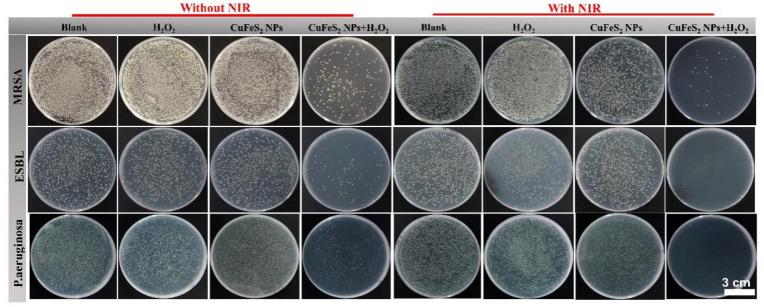
Peroxidase-mediated chemokinetic therapy (CDT) can effectively resist bacteria; however, factors such as the high dosage of drugs seriously limit the antibacterial effect. Herein, CuFeS nanoparticles (NPs) nanozyme antibacterial system with the photothermal effect and peroxidase-like catalytic activity are proposed as a combined antibacterial agent with biosafety, high-efficiency, and broad-spectrum antibacterial ability. In addition, the as-obtained CuFeS NPs with a low doses of Cu and Fe can change the permeability of bacterial cell membranes and break the antioxidant balance by consuming intracellular glutathione (GSH), which results in more conducive ROS production. Meanwhile, the photothermal heating can regulate the CuFeS NPs close to their optimal reaction temperature (60 °C) to release more hydroxyl radical in low concentrations of HO (100 µM). The proposed CuFeS NPs-based antibacterial system achieve more than 99% inactivation efficiency of methicillin-resistant Staphylococcus aureus (10 CFU mL MRSA), hyperspectral bacteria β-Escherichia coli (10 CFU mL ESBL) and Pseudomonas aeruginosa (10 CFU mL PA), even at low concentration (2 μg mL), which is superior to those of the conventional CuO NPs at 4 mg mL reported in the literature. In vivo experiments further confirm that CuFeS NPs can effectively treat wounds infected by MRSA and promote the wound healing. This study demonstrates that excellent antibacterial ability and good biocompatibility make CuFeS NPs a potential anti-infection nanozyme with broad application prospects.
过氧化物酶介导的化学动力学疗法(CDT)能有效抗菌;然而,药物高剂量等因素严重限制了抗菌效果。在此,提出具有光热效应和类过氧化物酶催化活性的硫化铜铁纳米颗粒(NPs)纳米酶抗菌体系作为一种具有生物安全性、高效性和广谱抗菌能力的联合抗菌剂。此外,所制备的低剂量铜和铁的硫化铜铁纳米颗粒可改变细菌细胞膜通透性,并通过消耗细胞内谷胱甘肽(GSH)打破抗氧化平衡,从而更有利于活性氧的产生。同时,光热加热可将硫化铜铁纳米颗粒调节至接近其最佳反应温度(60℃),以在低浓度过氧化氢(100μM)下释放更多羟基自由基。所提出的基于硫化铜铁纳米颗粒的抗菌体系即使在低浓度(2μg/mL)下,对耐甲氧西林金黄色葡萄球菌(10⁶CFU/mL MRSA)、超光谱细菌β-大肠杆菌(10⁶CFU/mL ESBL)和铜绿假单胞菌(10⁶CFU/mL PA)的灭活效率也超过99%,优于文献报道的4mg/mL常规氧化铜纳米颗粒。体内实验进一步证实,硫化铜铁纳米颗粒可有效治疗耐甲氧西林金黄色葡萄球菌感染的伤口并促进伤口愈合。本研究表明,优异的抗菌能力和良好的生物相容性使硫化铜铁纳米颗粒成为一种具有广阔应用前景的潜在抗感染纳米酶。




 Zotero 插件