Engineering Sciences Department, Universidad Andres Bello, Santiago, Chile.
Research Center for Integrated Disaster Risk Management ANID/FONDAP/15110017, Santiago, Chile.
Int J Public Health. 2022 Apr 13;67:1604290. doi: 10.3389/ijph.2022.1604290. eCollection 2022.
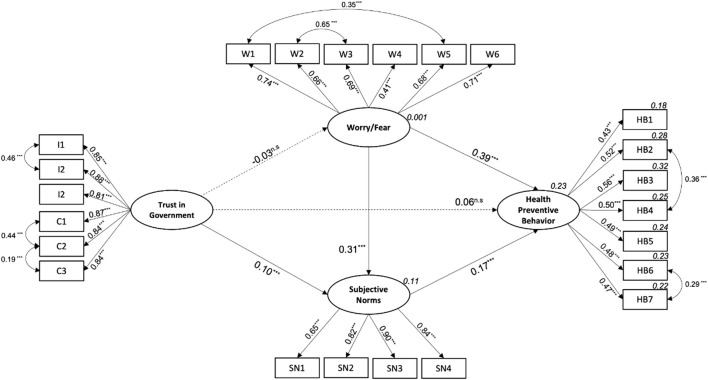
The purpose of this study was to determine the influence of government trust on young adults' adoption of health behaviors to prevent infection with the SARS-CoV-2 virus. We tested the hypothesis that government trust would directly and indirectly (through worry/fear and subjective norms) influence the adoption of health-protective behaviors. A sample of 1,136 university students completed a web survey after Chile's first wave of infections. The results indicate that low government trust only indirectly (through subjective norms) influenced health-protective behaviors. Conversely, worry/fear was the primary motivating factor for adopting health-protective behaviors in young adults, followed by subjective norms. In scenarios where people perceive low government trust, emotions and social norms are the motivational factors with the most significant predictive power on the adoption of health-protective behaviors.
本研究旨在确定政府信任对年轻人采取健康行为以预防感染 SARS-CoV-2 病毒的影响。我们检验了以下假设:政府信任将直接和间接(通过担忧/恐惧和主观规范)影响健康保护行为的采用。在智利第一波感染后,1136 名大学生完成了一项网络调查。结果表明,低政府信任仅通过主观规范间接(通过主观规范)影响健康保护行为。相反,担忧/恐惧是年轻人采取健康保护行为的主要动机因素,其次是主观规范。在人们认为政府信任度低的情况下,情绪和社会规范是对健康保护行为的采用具有最大预测力的动机因素。