Department of Radiation Oncology, National Cancer Center/National Clinical Research Center for Cancer/Cancer Hospital, Chinese Academy of Medical Sciences and Peking Union Medical College, Beijing, China.
Department of VIP Medical Services, National Cancer Center/National Clinical Research Center for Cancer/Cancer Hospital, Chinese Academy of Medical Sciences and Peking Union Medical College, Beijing, China.
Thorac Cancer. 2022 Sep;13(17):2515-2523. doi: 10.1111/1759-7714.14588. Epub 2022 Jul 26.
The best pattern of neoadjuvant therapy for resectable locoregional esophageal cancer has not been determined. Our study evaluated the efficacy and postoperative events of different treatments using the Bayesian network meta-analysis.
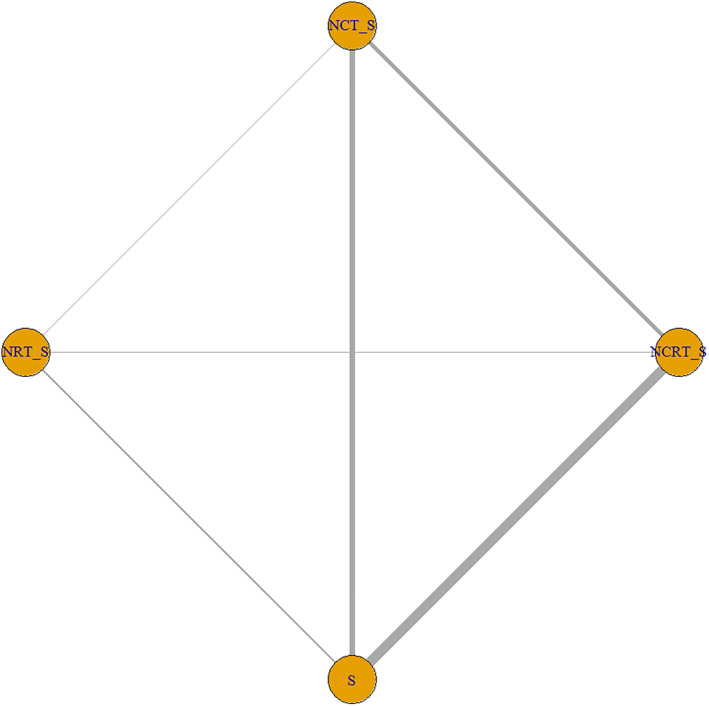
We systematically tracked randomized clinical trials from the Medline, EMBASE, and Cochrane Library databases. The following treatments were included: neoadjuvant chemoradiation followed by surgery (NCRT + S), neoadjuvant chemotherapy followed by surgery (NCT + S), neoadjuvant radiotherapy followed by surgery (NRT + S), and surgery alone (S). The Revised Cochrane risk-of-bias tools were used to assess the quality of included trials. Overall survival (OS) and progression-free survival or disease-free survival (PFS/DFS) were assessed through hazard ratios (HR). Locoregional recurrence, distant metastasis, postoperative mortality, and postoperative morbidity were assessed through odds ratios (OR). These outcomes were compared between different treatments through Bayesian network meta-analysis.
Twenty trials with 4384 patients were included. Compared with S, only NCRT + S could significantly improve OS for patients with esophageal cancer (HR = 0.78, 95% confidence interval [CI] 0.68-0.88). NCRT + S and NCT + S significantly improved PFS/DFS compared with S (NCRT + S vs. S, HR = 0.72, 95% CI 0.63-0.81; NCT + S vs. S, HR = 0.81, 95% CI 0.69-0.97). NCRT + S significantly reduced both locoregional recurrence (OR = 0.67, 95% CI 0.51-0.88) and distant metastasis (OR = 0.63, 95% CI 0.45-0.90) compared with S. There were no differences in postoperative morbidity between the four treatments. However, NCRT + S also increased postoperative mortality compared with S (OR = 1.77, 95% CI 1.09-2.82) and NCT + S (OR = 1.96, 95% CI 1.11-3.51).
NCRT + S is the most efficient neoadjuvant treatment for resectable locoregional esophageal cancer. However, NCRT + S increases the risk of postoperative mortality but not morbidity.
可切除局部区域食管癌的新辅助治疗最佳模式尚未确定。本研究采用贝叶斯网络荟萃分析评估了不同治疗方法的疗效和术后事件。
我们系统地从 Medline、EMBASE 和 Cochrane Library 数据库中跟踪随机临床试验。纳入的治疗方法包括:新辅助放化疗后手术(NCRT+S)、新辅助化疗后手术(NCT+S)、新辅助放疗后手术(NRT+S)和单纯手术(S)。使用修订后的 Cochrane 偏倚风险工具评估纳入试验的质量。通过风险比(HR)评估总生存率(OS)和无进展生存率或无病生存率(PFS/DFS)。通过比值比(OR)评估局部区域复发、远处转移、术后死亡率和术后发病率。通过贝叶斯网络荟萃分析比较不同治疗方法之间的这些结果。
纳入了 20 项试验,共 4384 例患者。与 S 相比,只有 NCRT+S 可显著改善食管癌患者的 OS(HR=0.78,95%置信区间 [CI] 0.68-0.88)。与 S 相比,NCRT+S 和 NCT+S 可显著改善 PFS/DFS(NCRT+S 与 S 相比,HR=0.72,95%CI 0.63-0.81;NCT+S 与 S 相比,HR=0.81,95%CI 0.69-0.97)。与 S 相比,NCRT+S 显著降低局部区域复发(OR=0.67,95%CI 0.51-0.88)和远处转移(OR=0.63,95%CI 0.45-0.90)的风险。四组治疗方法的术后发病率无差异。然而,与 S 和 NCT+S 相比,NCRT+S 还增加了术后死亡率(OR=1.77,95%CI 1.09-2.82)和 NCT+S(OR=1.96,95%CI 1.11-3.51)。
NCRT+S 是治疗可切除局部区域食管癌最有效的新辅助治疗方法。然而,NCRT+S 增加了术后死亡率的风险,但不会增加发病率。