Hospital Universitario Miguel Servet, IIS Aragón, Zaragoza, Spain.
Instituto de Investigación Sanitaria de Aragón (IIS Aragón), Zaragoza, Spain.
Thyroid. 2022 Dec;32(12):1488-1499. doi: 10.1089/thy.2022.0025. Epub 2022 Sep 14.
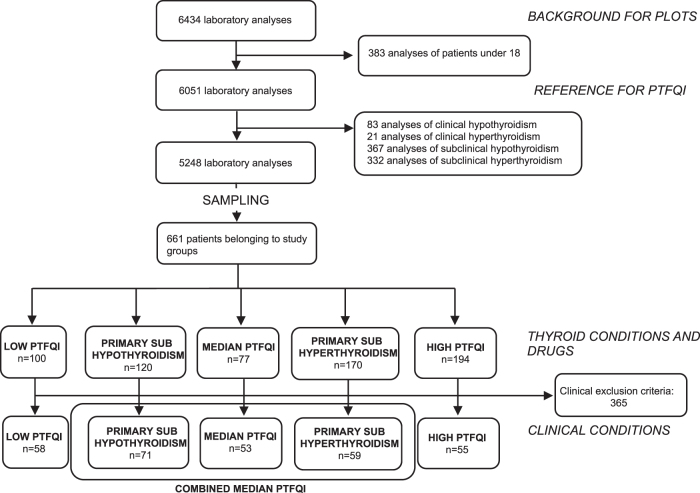
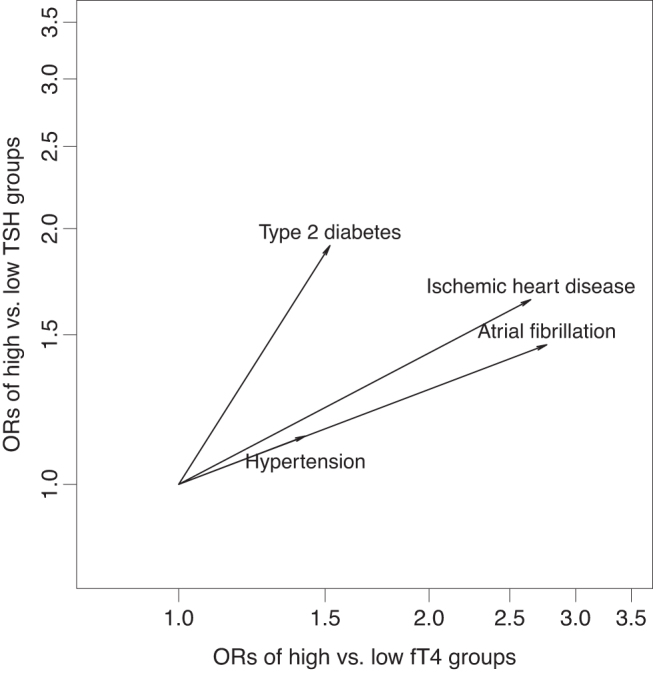
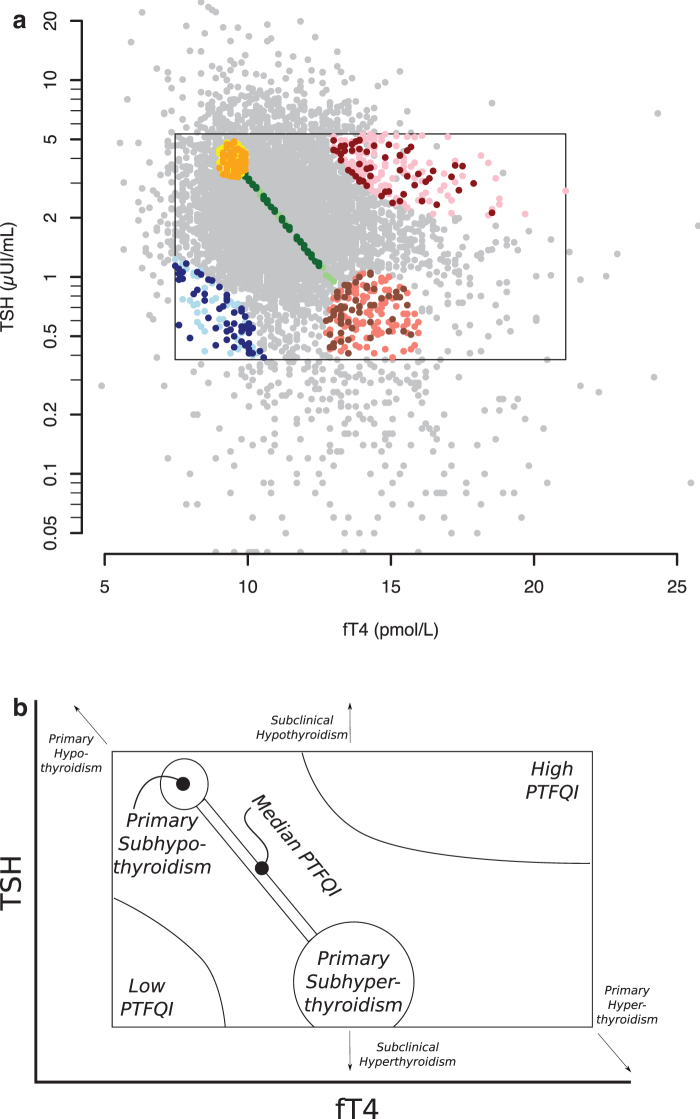
The usual inverse correlation between thyrotropin (TSH) and thyroid hormone disappears in syndromes of central resistance to thyroid hormone, where both are high. TSH and thyroid hormone are also simultaneously high when there is an elevation of the set point of the thyroid regulation axis. This can be estimated with indices, such as the Parametric Thyroid Feedback Quantile-based Index (PTFQI), which was designed for the general population. The PTFQI is positively associated with diabetes prevalence, but association with other pathologies has not been yet explored. The aim of this project was to explore the potential relationship of the PTFQI with metabolic and cardiovascular disease in a sample of ambulatory adult patients from Spain. A cross-sectional study was carried out among the patients who underwent thyroid hormones measurement (6434 measurements from September to November 2018 in a central laboratory in Spain). We retrospectively reviewed clinical records of a subgroup of adults aged >18 years with normal TSH and free thyroxine (fT4) belonging to groups that represent extreme PTFQI ( = 661). Individuals with known conditions interfering the thyroid axis were excluded (remaining = 296). Logistic and linear regression models adjusted for age and sex were used to calculate odds ratio (OR) of diseases and differences of clinical parameters, and 95% confidence intervals [CI]. Across levels with higher PTFQI, there was an increase in the prevalence of type 2 diabetes (High vs. Low PTFQI OR: 2.88 [CI: 1.14-7.86], -Trend = 0.02), ischemic heart disease (16.4% vs. 0%, unadjusted Haldane-Anscombe corrected OR: 23.90 [CI: 1.36-21.48], adjusted -Trend = 0.04), atrial fibrillation (OR: 8.13 [CI: 1.33-158.20], -Trend = 0.05), and hypertension (OR: 3.19 [CI: 1.14-9.94], -Trend = 0.05). While the prevalence of type 2 diabetes was similarly associated with TSH and fT4, ischemic heart disease, atrial fibrillation, and hypertension were more strongly associated with the differences in fT4 values. Type 2 diabetes, ischemic heart disease, atrial fibrillation, and hypertension may be associated with a higher central regulation set point for thyroid hormone. These findings should be confirmed in other populations.
促甲状腺激素(TSH)与甲状腺激素之间通常呈负相关,但在甲状腺激素抵抗综合征中两者均升高。当甲状腺调节轴的设定点升高时,TSH 和甲状腺激素也同时升高。这可以通过参数来估计,例如为一般人群设计的基于甲状腺反馈定量的参数指数(PTFQI)。PTFQI 与糖尿病患病率呈正相关,但与其他病理的相关性尚未得到探索。本项目旨在研究 PTFQI 与西班牙门诊成年患者的代谢和心血管疾病的潜在关系。
在西班牙的一个中央实验室于 2018 年 9 月至 11 月期间进行了甲状腺激素测量的患者中进行了横断面研究。我们回顾性地审查了属于 PTFQI 极端值组( = 661)的年龄大于 18 岁的正常 TSH 和游离甲状腺素(fT4)的成年人的临床记录。排除了已知影响甲状腺轴的疾病(剩余 = 296)。使用调整年龄和性别的逻辑和线性回归模型来计算疾病的比值比(OR)和临床参数的差异,置信区间 [CI]为 95%。随着 PTFQI 水平的升高,2 型糖尿病的患病率增加(高 PTFQI 比低 PTFQI 的 OR:2.88 [CI:1.14-7.86],趋势检验 = 0.02)、缺血性心脏病(16.4%比 0%,未校正的 Haldane-Anscombe 校正 OR:23.90 [CI:1.36-21.48],调整后的趋势检验 = 0.04)、心房颤动(OR:8.13 [CI:1.33-158.20],趋势检验 = 0.05)和高血压(OR:3.19 [CI:1.14-9.94],趋势检验 = 0.05)。虽然 2 型糖尿病的患病率与 TSH 和 fT4 同样相关,但缺血性心脏病、心房颤动和高血压与 fT4 值的差异更密切相关。2 型糖尿病、缺血性心脏病、心房颤动和高血压可能与甲状腺激素的中枢调节设定点较高有关。这些发现应在其他人群中得到证实。