Usmani Amir, Pipal Dharmendra K, Bagla Harsh, Verma Vijay, Kumar Pawan, Yadav Seema, Garima Garima, Rani Vibha, Pipal Rajendra K
General Surgery, Dr. Sampurnanand Medical College, Jodhpur, IND.
General, Colorectal and Minimal Access Surgery, All India Institute of Medical Sciences, Gorakhpur, Gorakhpur, IND.
Cureus. 2022 Jun 21;14(6):e26161. doi: 10.7759/cureus.26161. eCollection 2022 Jun.
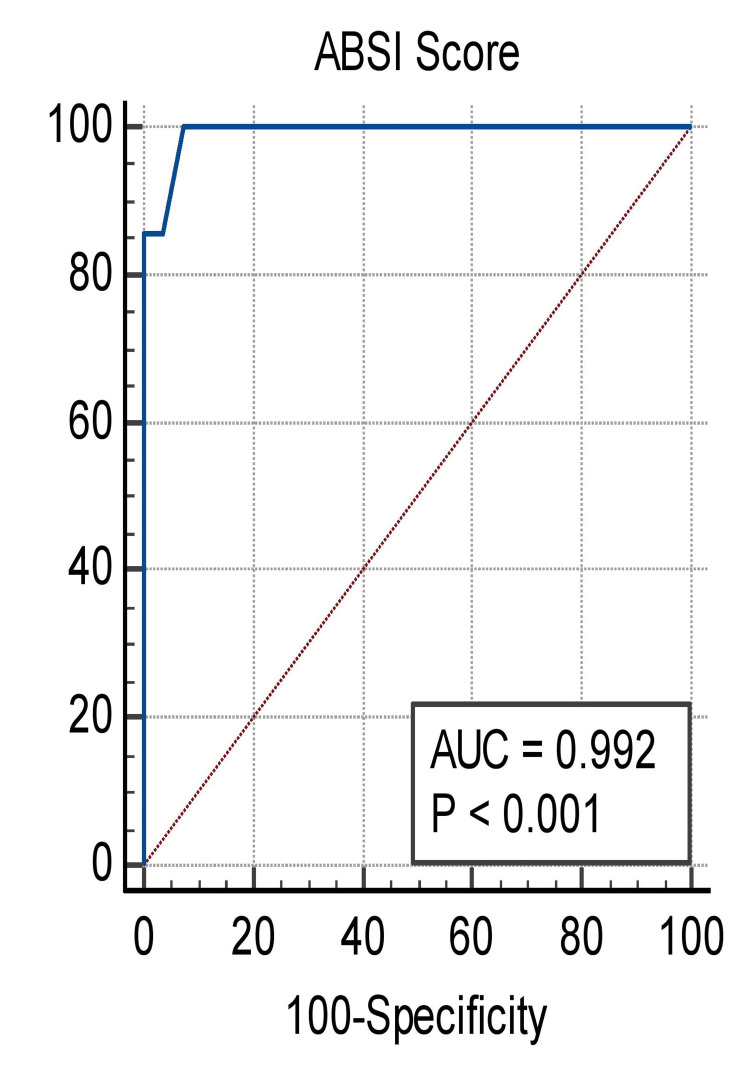
Background Burn injuries are highly variable and dynamic. The outcome of patients is influenced by various factors and requires prompt therapeutic interventions, including fluid resuscitation, for a favorable result. Although having varying shortcomings, many scoring indexes are developed and validated in Western countries to predict mortality in a burn patient. The Abbreviated Burn Severity Index (ABSI) estimates survival expectancy in a burn patient via various negative prognostic factors. This study describes the pattern of burn injuries to validate the ABSI as an outcome predictor in burnt patients. Methodology From January to December 2018, 100 patients participated in this observational research conducted in the Department of Surgery at Mahatma Gandhi Hospital's Burn Ward, a part of Dr. Sampurnanand Medical College, Jodhpur. Risk factors for death from a burn were patients' age and gender, the depth of the burn, the inhalation burn, and the total burned body surface area (TBSA). The area under the receiver operating curve (AUROC) was used to determine how well it could predict burn deaths. Results This study included 100 patients (69 men and 31 women, with a ratio of 2.22:1). In total, 73 patients survived, and 27 died (a mortality rate of 27%). The fatality rate increased with increased burn surface area, reaching 100% in patients with >80% burns (p < 0.0001). Additionally, those with an ABSI of >11 expressed 100% mortality rate (p < 0.0001). Conclusions In this study, older age, high burned surface area, concomitant inhalational burns, full-thickness burns, and a higher ABSI were found to be significant predictors of mortality.
烧伤损伤具有高度的变异性和动态性。患者的预后受多种因素影响,需要及时进行包括液体复苏在内的治疗干预,以获得良好的结果。尽管存在各种缺点,但西方国家已开发并验证了许多评分指标来预测烧伤患者的死亡率。简化烧伤严重程度指数(ABSI)通过各种负面预后因素来估计烧伤患者的生存预期。本研究描述了烧伤损伤模式,以验证ABSI作为烧伤患者预后预测指标的有效性。
2018年1月至12月,100名患者参与了在焦特布尔桑普尔南德医学院附属圣雄甘地医院外科烧伤病房进行的这项观察性研究。烧伤死亡的危险因素包括患者的年龄、性别、烧伤深度、吸入性烧伤和烧伤总面积(TBSA)。采用受试者工作特征曲线下面积(AUROC)来确定其预测烧伤死亡的能力。
本研究纳入100例患者(69例男性和31例女性,比例为2.22:1)。共有73例患者存活,27例死亡(死亡率为27%)。死亡率随烧伤面积增加而升高,烧伤面积>80%的患者死亡率达100%(p<0.0001)。此外,ABSI>11的患者死亡率为100%(p<0.0001)。
在本研究中,发现年龄较大、烧伤面积大、伴有吸入性烧伤、全层烧伤和较高的ABSI是死亡率的重要预测因素。