Yeo Hyeon Ji, Lim Soo-Yeon, Park Chang Ha, Kim Cha Young, Sathasivam Ramaraj, Kim Jae Kwang, Park Sang Un
Biological Resource Center, Korea Research Institute of Bioscience and Biotechnology (KRIBB), 181 Ipsin-gil, Jeongeup 56212, Korea.
Department of Crop Science, Chungnam National University, 99 Daehak-ro, Yuseong-gu, Daejeon 34134, Korea.
Antioxidants (Basel). 2022 Jul 25;11(8):1443. doi: 10.3390/antiox11081443.
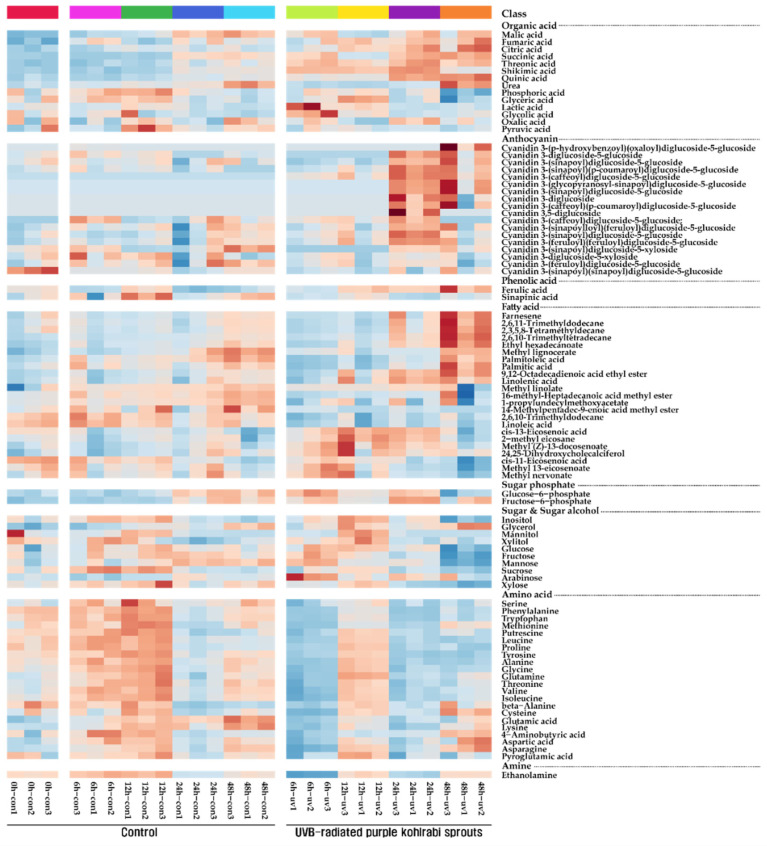
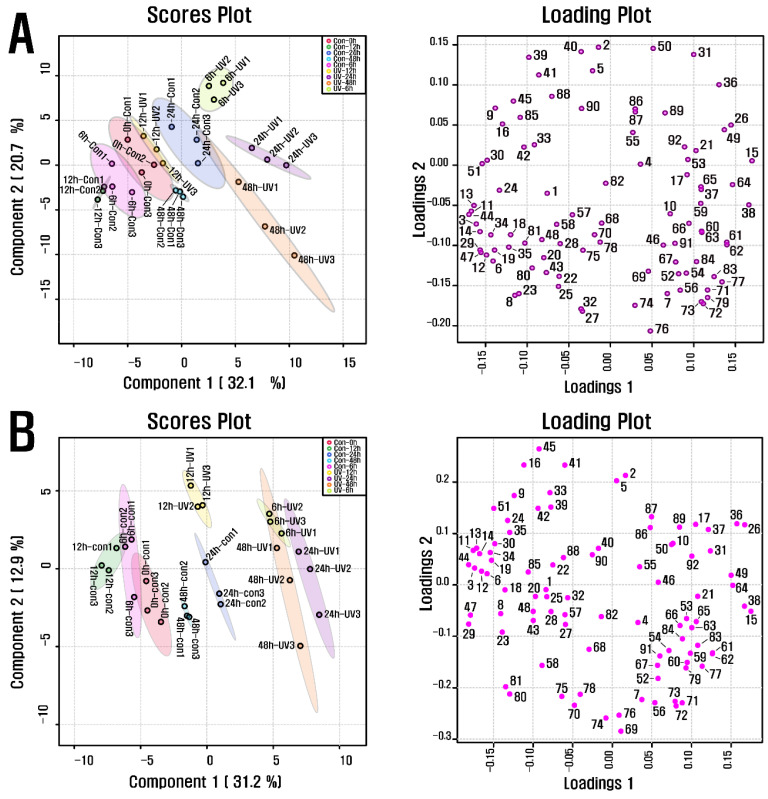
Various metabolites act as plant defense molecules due to their antioxidant abilities. This study aimed to investigate the influence of UVB irradiation on the accumulation of metabolites, including primary metabolites (sugar, sugar alcohols, amino acids, organic acids, and an amine) and secondary metabolites (anthocyanins, fatty acids, and phenolic acids), and its synergistic antioxidant ability, in purple kohlrabi sprouts. Metabolite analyses revealed a total of 92 metabolites in the sprouts. Specifically, the levels of most amino acids increased after 24 h of UVB treatment, and then slightly decreased in the kohlrabi sprouts. The levels of most sugars and sugar alcohols increased after 24 h of UVB treatment and then decreased. The levels of TCA cycle intermediates and phenolic acids gradually increased during the UVB treatment. Furthermore, the levels of some fatty acids gradually increased during the UVB treatment, and the levels of the other fatty acids increased after 6 h of UVB treatment and then decreased. In particular, the levels of most anthocyanins, known to be strong antioxidants, gradually increased after 24 h of UVB treatment. In the in vitro ABTS scavenging assay, UVB-treated purple kohlrabi sprouts showed increased scavenging ability. This may be attributed to the increased accumulation of metabolites acting as antioxidants, in response to UVB treatment. This study confirmed that UVB irradiation induced the alteration of primary and secondary metabolism in the kohlrabi sprouts.
由于其抗氧化能力,各种代谢物可作为植物防御分子。本研究旨在探讨UVB照射对紫色羽衣甘蓝芽苗菜中代谢物积累的影响,这些代谢物包括初级代谢物(糖、糖醇、氨基酸、有机酸和一种胺)和次级代谢物(花青素、脂肪酸和酚酸),以及其协同抗氧化能力。代谢物分析显示芽苗菜中共有92种代谢物。具体而言,UVB处理24小时后,大多数氨基酸水平升高,然后在羽衣甘蓝芽苗菜中略有下降。大多数糖和糖醇的水平在UVB处理24小时后升高,然后下降。UVB处理期间,三羧酸循环中间体和酚酸的水平逐渐升高。此外,一些脂肪酸的水平在UVB处理期间逐渐升高,而其他脂肪酸的水平在UVB处理6小时后升高,然后下降。特别是,大多数已知为强抗氧化剂的花青素水平在UVB处理24小时后逐渐升高。在体外ABTS清除试验中,经UVB处理的紫色羽衣甘蓝芽苗菜显示出增强的清除能力。这可能归因于作为抗氧化剂的代谢物积累增加,以响应UVB处理。本研究证实,UVB照射诱导了羽衣甘蓝芽苗菜中初级和次级代谢的改变。