Department of Pathology, Case Western Reserve University School of Medicine, Cleveland, Ohio, United States of America.
PLoS Biol. 2022 Jul 27;20(7):e3001738. doi: 10.1371/journal.pbio.3001738. eCollection 2022 Jul.
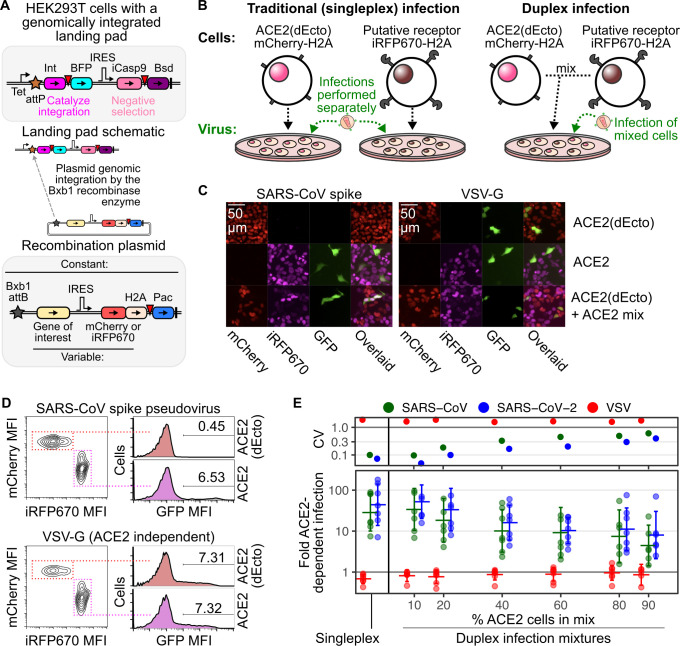
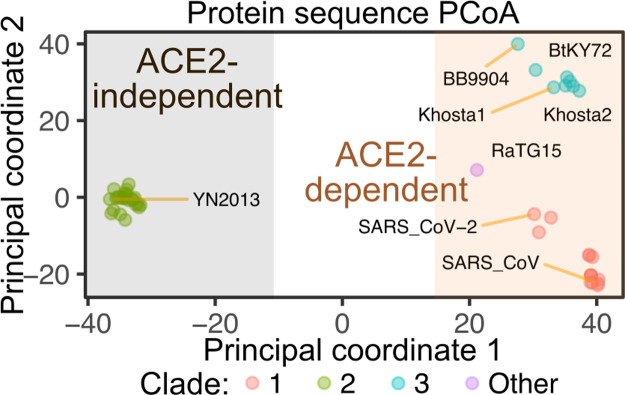
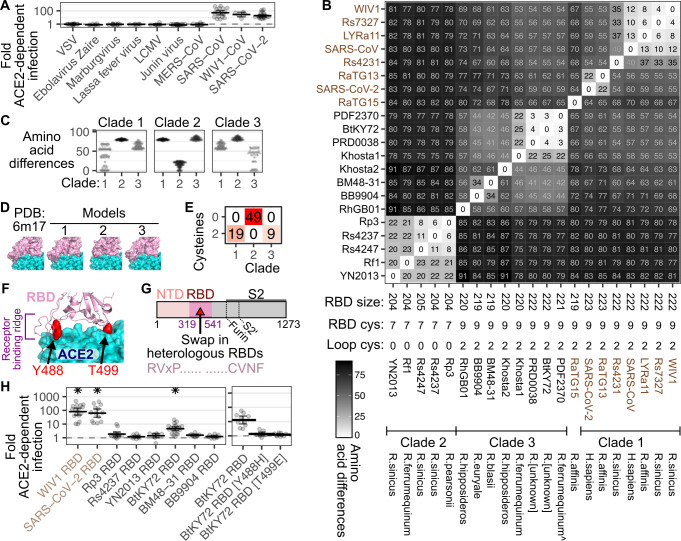
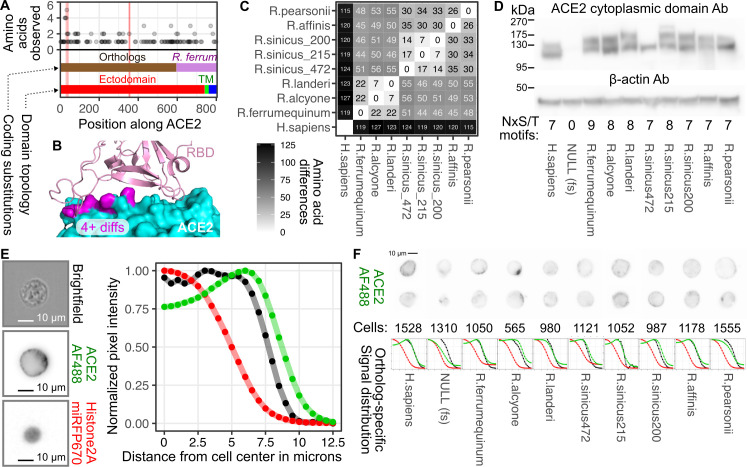
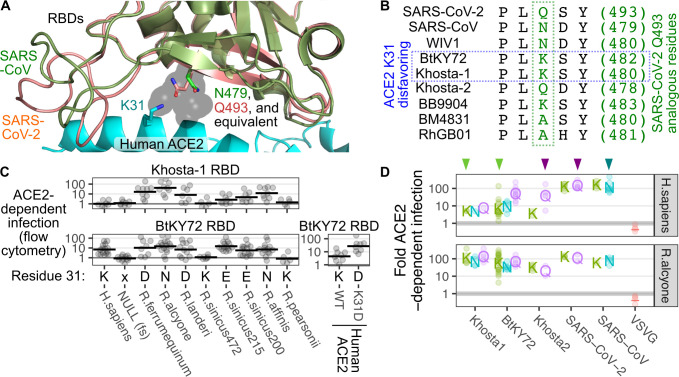
Viral spillover from animal reservoirs can trigger public health crises and cripple the world economy. Knowing which viruses are primed for zoonotic transmission can focus surveillance efforts and mitigation strategies for future pandemics. Successful engagement of receptor protein orthologs is necessary during cross-species transmission. The clade 1 sarbecoviruses including Severe Acute Respiratory Syndrome-related Coronavirus (SARS-CoV) and SARS-CoV-2 enter cells via engagement of angiotensin converting enzyme-2 (ACE2), while the receptor for clade 2 and clade 3 remains largely uncharacterized. We developed a mixed cell pseudotyped virus infection assay to determine whether various clades 2 and 3 sarbecovirus spike proteins can enter HEK 293T cells expressing human or Rhinolophus horseshoe bat ACE2 proteins. The receptor binding domains from BtKY72 and Khosta-2 used human ACE2 for entry, while BtKY72 and Khosta-1 exhibited widespread use of diverse rhinolophid ACE2s. A lysine at ACE2 position 31 appeared to be a major determinant of the inability of these RBDs to use a certain ACE2 sequence. The ACE2 protein from Rhinolophus alcyone engaged all known clade 3 and clade 1 receptor binding domains. We observed little use of Rhinolophus ACE2 orthologs by the clade 2 viruses, supporting the likely use of a separate, unknown receptor. Our results suggest that clade 3 sarbecoviruses from Africa and Europe use Rhinolophus ACE2 for entry, and their spike proteins appear primed to contribute to zoonosis under the right conditions.
病毒从动物宿主溢出可能引发公共卫生危机并削弱世界经济。了解哪些病毒有可能引发人畜共患病传播,可以集中精力进行监测,并为未来的大流行制定缓解策略。在跨物种传播过程中,成功结合受体蛋白的同源物是必要的。包括严重急性呼吸系统综合征相关冠状病毒(SARS-CoV)和 SARS-CoV-2 在内的第 1 组沙贝冠状病毒通过与血管紧张素转换酶-2(ACE2)结合进入细胞,而第 2 组和第 3 组的受体在很大程度上仍未被阐明。我们开发了一种混合细胞假型病毒感染测定法,以确定各种第 2 组和第 3 组沙贝冠状病毒刺突蛋白是否可以进入表达人或菊头蝠 ACE2 蛋白的 HEK 293T 细胞。BtKY72 和 Khosta-2 的受体结合域使用人 ACE2 进行进入,而 BtKY72 和 Khosta-1 则广泛使用不同菊头蝠的 ACE2。ACE2 蛋白上位置 31 的赖氨酸似乎是这些 RBD 无法使用特定 ACE2 序列的主要决定因素。菊头蝠 ACE2 蛋白结合了所有已知的第 3 组和第 1 组受体结合域。我们观察到第 2 组病毒很少使用菊头蝠 ACE2 同源物,这支持了可能使用单独未知受体的假设。我们的结果表明,来自非洲和欧洲的第 3 组沙贝冠状病毒使用菊头蝠 ACE2 进入,并且它们的刺突蛋白似乎在适当的条件下准备引发人畜共患病。