School of Bioscience and Biotechnology, Tokyo University of Technology 1404-1 Katakura, Hachioji 192-0982, Tokyo, Japan.
Molecules. 2022 Jul 26;27(15):4774. doi: 10.3390/molecules27154774.
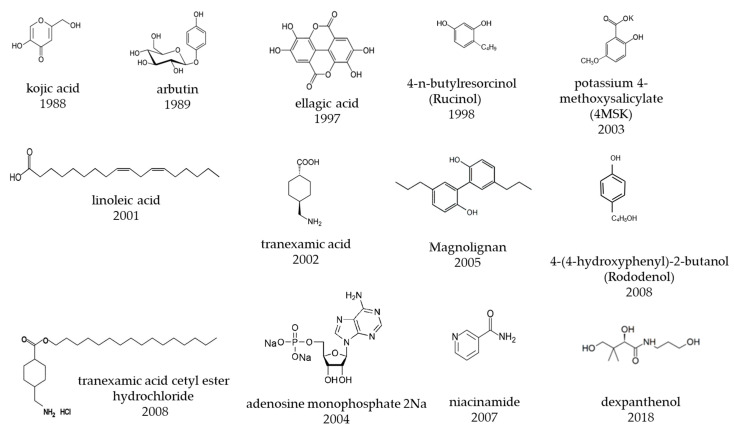
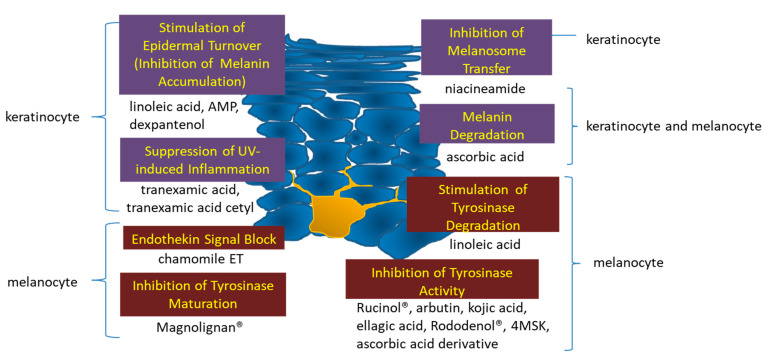
Japanese pharmaceutical cosmetics, often referred to as quasi-drugs, contain skin-lightening active ingredients formulated to prevent sun-induced pigment spots and freckles. Their mechanisms of action include suppressing melanin production in melanocytes and promoting epidermal growth to eliminate melanin more rapidly. For example, arbutin and rucinol are representative skin-lightening active ingredients that inhibit melanin production, and disodium adenosine monophosphate and dexpanthenol are skin-lightening active ingredients that inhibit melanin accumulation in the epidermis. In contrast, oral administration of vitamin C and tranexamic acid in pharmaceutical products can lighten freckles and melasma, and these products are more effective than quasi-drugs. On the basis of their clinical effectiveness, skin-lightening active ingredients can be divided into four categories according to their effectiveness and adverse effects. This review discusses academic research and development regarding skin-lightening ingredients in Japan.
日本的药妆品,通常被称为准药品,含有美白活性成分,旨在预防日晒引起的色素斑和雀斑。其作用机制包括抑制黑素细胞中的黑色素生成,并促进表皮生长以更快地消除黑色素。例如,熊果苷和曲酸是代表性的抑制黑色素生成的美白活性成分,而腺嘌呤核苷单磷酸二钠和泛醇是抑制黑色素在表皮中积累的美白活性成分。相比之下,医药产品中口服维生素 C 和氨甲环酸可以淡化雀斑和黄褐斑,这些产品比准药品更有效。根据其临床效果,美白活性成分可以根据其有效性和不良反应分为四类。本文综述了日本美白成分的学术研究进展。