Phan Tin, Brozak Samantha, Pell Bruce, Gitter Anna, Mena Kristina D, Kuang Yang, Wu Fuqing
Theoretical Biology and Biophysics Group, Los Alamos National Laboratory, New Mexico, USA.
School of Mathematical and Statistical Sciences, Arizona State University, Arizona, USA.
medRxiv. 2022 Jul 18:2022.07.17.22277721. doi: 10.1101/2022.07.17.22277721.
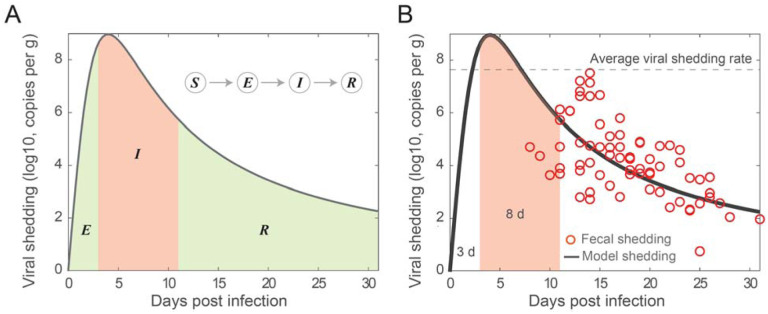
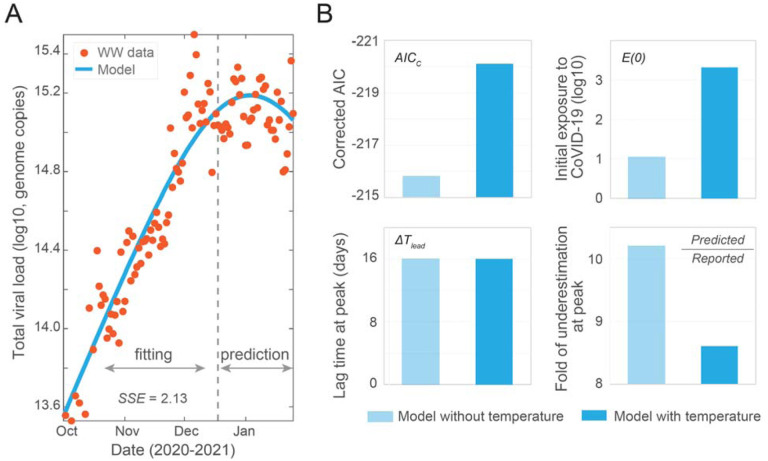
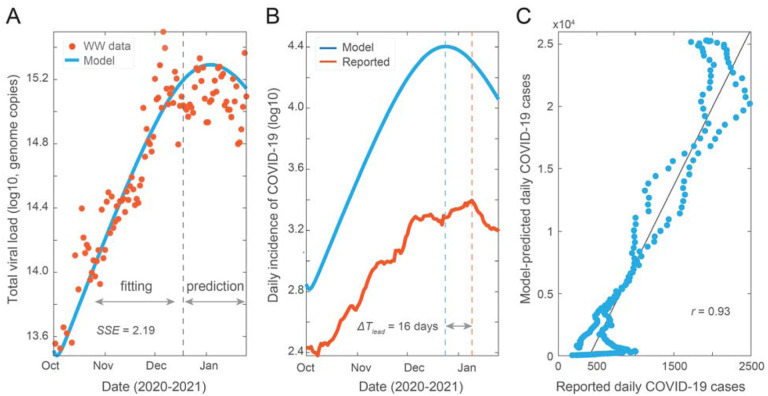
Wastewater-based surveillance (WBS) has been widely used as a public health tool to monitor SARS-CoV-2 transmission. However, epidemiological inference from WBS data remains understudied and limits its application. In this study, we have established a quantitative framework to estimate COVID-19 prevalence and predict SARS-CoV-2 transmission through integrating WBS data into an SEIR-V model. We conceptually divide the individual-level viral shedding course into exposed, infectious, and recovery phases as an analogy to the compartments in population-level SEIR model. We demonstrated that the temperature effect on viral losses in the sewer can be straightforwardly incorporated in our framework. Using WBS data from the second wave of the pandemic (Oct 02, 2020 â€" Jan 25, 2021) in the Great Boston area, we showed that the SEIR-V model successfully recapitulates the temporal dynamics of viral load in wastewater and predicts the true number of cases peaked earlier and higher than the number of reported cases by 16 days and 8.6 folds ( = 0.93), respectively. This work showcases a simple, yet effective method to bridge WBS and quantitative epidemiological modeling to estimate the prevalence and transmission of SARS-CoV-2 in the sewershed, which could facilitate the application of wastewater surveillance of infectious diseases for epidemiological inference and inform public health actions.
基于废水的监测(WBS)已被广泛用作监测严重急性呼吸综合征冠状病毒2(SARS-CoV-2)传播的公共卫生工具。然而,从WBS数据进行的流行病学推断仍未得到充分研究,限制了其应用。在本研究中,我们建立了一个定量框架,通过将WBS数据整合到SEIR-V模型中来估计2019冠状病毒病(COVID-19)的流行率并预测SARS-CoV-2的传播。我们从概念上将个体层面的病毒脱落过程分为暴露、感染和恢复阶段,类似于人群层面SEIR模型中的 compartments。我们证明了温度对下水道中病毒损失的影响可以直接纳入我们的框架。利用大波士顿地区第二波疫情(2020年10月2日至2021年1月25日)的WBS数据,我们表明SEIR-V模型成功地再现了废水中病毒载量的时间动态,并预测实际病例数达到峰值的时间比报告病例数早16天,峰值高出8.6倍( = 0.93)。这项工作展示了一种简单而有效的方法,可将WBS与定量流行病学建模联系起来,以估计下水道流域中SARS-CoV-2的流行率和传播情况,这有助于将传染病废水监测应用于流行病学推断并为公共卫生行动提供信息。