School of Computer and Big Data, Fuzhou University, Fujian 350108, China.
Department of Cardiology, Fujian Medical University Union Hospital, Fujian 350004, China.
Comput Intell Neurosci. 2022 Jul 18;2022:2389560. doi: 10.1155/2022/2389560. eCollection 2022.
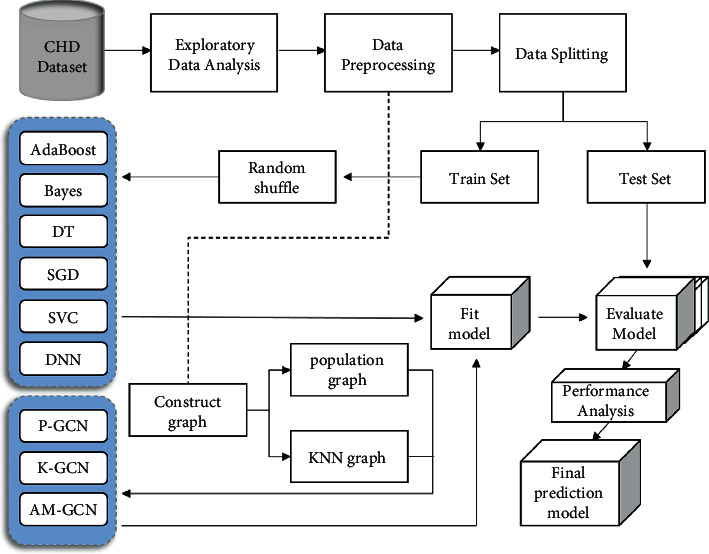
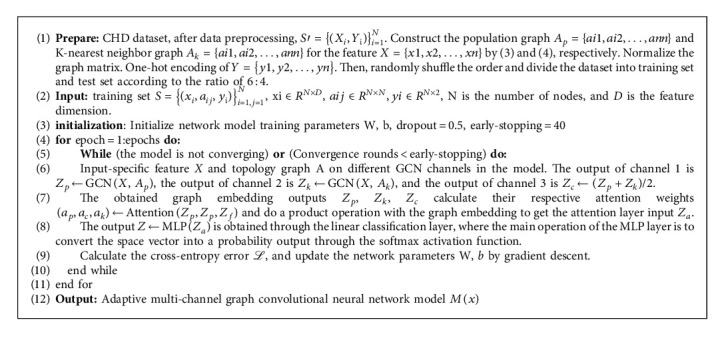
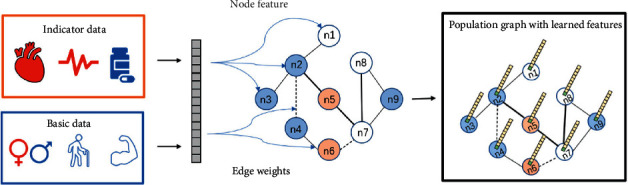
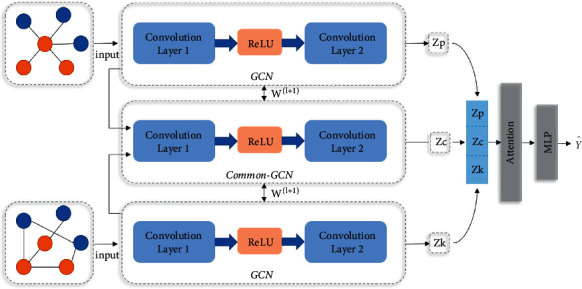
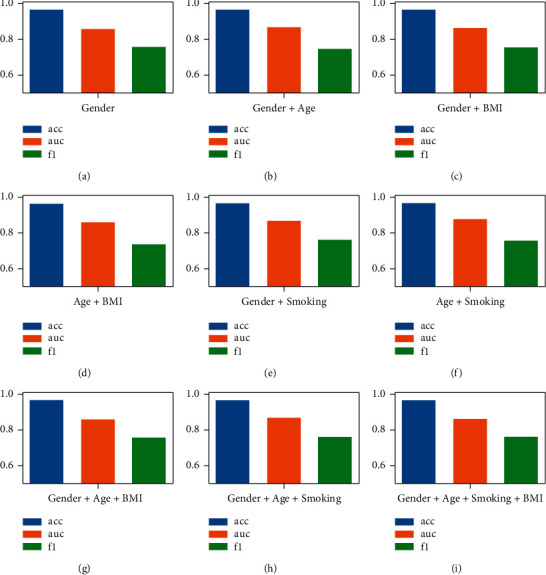
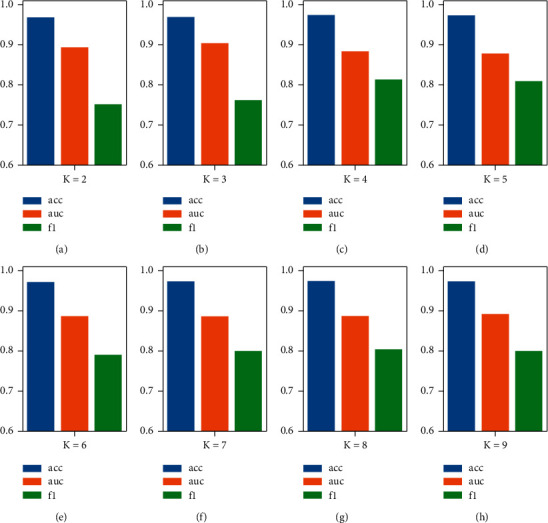
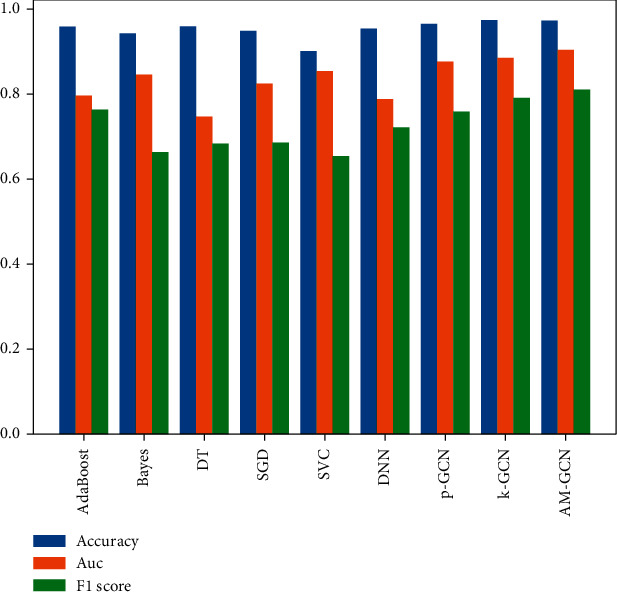
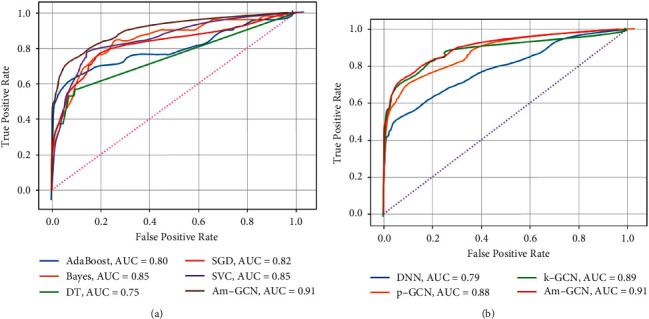
Coronary heart disease (CHD) has become one of the most serious public health issues due to its high morbidity and mortality rates. Most of the existing coronary heart disease risk prediction models manually extract features based on shallow machine learning methods. It only focuses on the differences between local patient features and ignores the interaction modeling between global patients. Its accuracy is still insufficient for individualized patient management strategies. In this paper, we propose CHD prediction as a graph node classification task for the first time, where nodes can represent individuals in potentially diseased populations and graphs intuitively represent associations between populations. We used an adaptive multi-channel graph convolutional neural network (AM-GCN) model to extract graph embeddings from topology, node features, and their combinations through graph convolution. Then, the adaptive importance weights of the extracted embeddings are learned by using an attention mechanism. For different situations, we model the relationship of the CHD population with the population graph and the K-nearest neighbor graph method. Our experimental evaluation explored the impact of the independent components of the model on the CHD disease prediction performance and compared it to different baselines. The experimental results show that our new model exhibits the best experimental results on the CHD dataset, with a 1.3% improvement in accuracy, a 5.1% improvement in AUC, and a 4.6% improvement in F1-score compared to the nongraph model.
冠心病(CHD)由于其高发病率和死亡率,已成为最严重的公共卫生问题之一。现有的大多数冠心病风险预测模型都是基于浅层机器学习方法手动提取特征的。它仅关注局部患者特征之间的差异,而忽略了全局患者之间的交互建模。其准确性仍然不足以用于个体化的患者管理策略。在本文中,我们首次将冠心病预测作为图节点分类任务,其中节点可以代表潜在患病人群中的个体,而图直观地表示人群之间的关联。我们使用自适应多通道图卷积神经网络(AM-GCN)模型,通过图卷积从拓扑结构、节点特征及其组合中提取图嵌入。然后,使用注意力机制学习提取的嵌入的自适应重要性权重。对于不同的情况,我们使用 CHD 人群与人群图和 K-最近邻图方法的关系模型。我们的实验评估探讨了模型的独立组件对 CHD 疾病预测性能的影响,并与不同的基线进行了比较。实验结果表明,我们的新模型在 CHD 数据集上表现出了最好的实验结果,与非图模型相比,准确性提高了 1.3%,AUC 提高了 5.1%,F1 得分提高了 4.6%。