Research Service, VA New Jersey Health Care System, East Orange, NJ, USA.
Department of Pharmacology, Physiology & Neuroscience, New Jersey Medical School, Rutgers, The State University of New Jersey, Newark, NJ, USA.
Psychol Med. 2023 Jul;53(9):4245-4254. doi: 10.1017/S0033291722001003. Epub 2022 Jul 28.
Neurocognitive testing may advance the goal of predicting near-term suicide risk. The current study examined whether performance on a Go/No-go (GNG) task, and computational modeling to extract latent cognitive variables, could enhance prediction of suicide attempts within next 90 days, among individuals at high-risk for suicide.
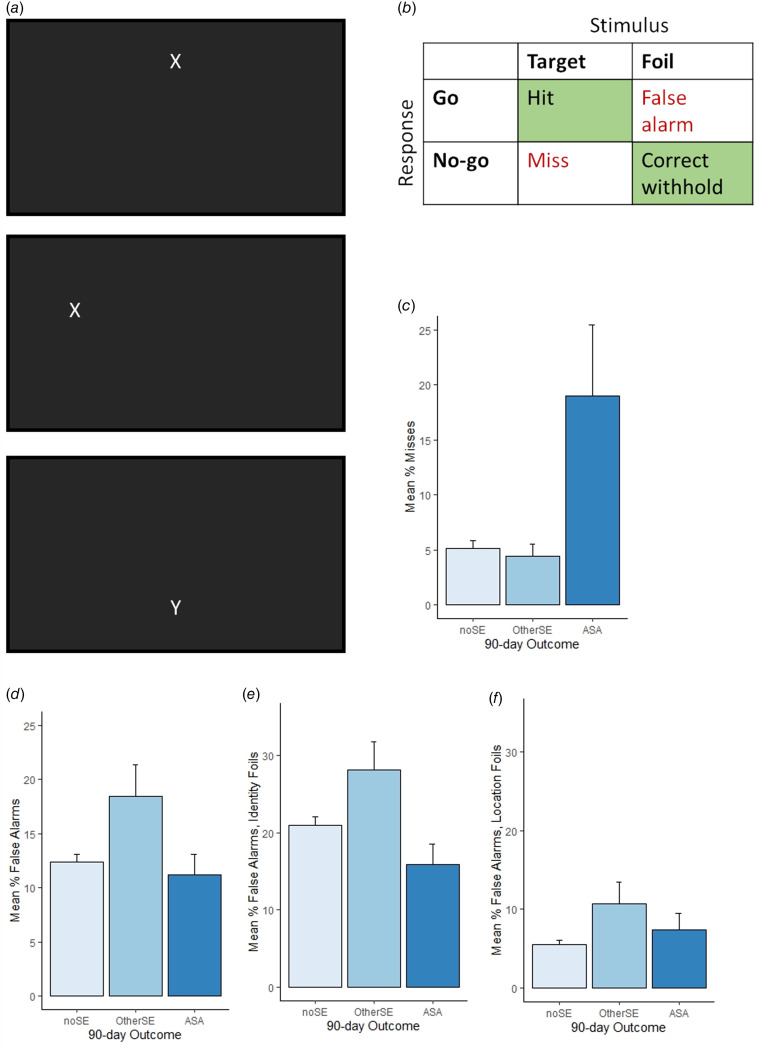
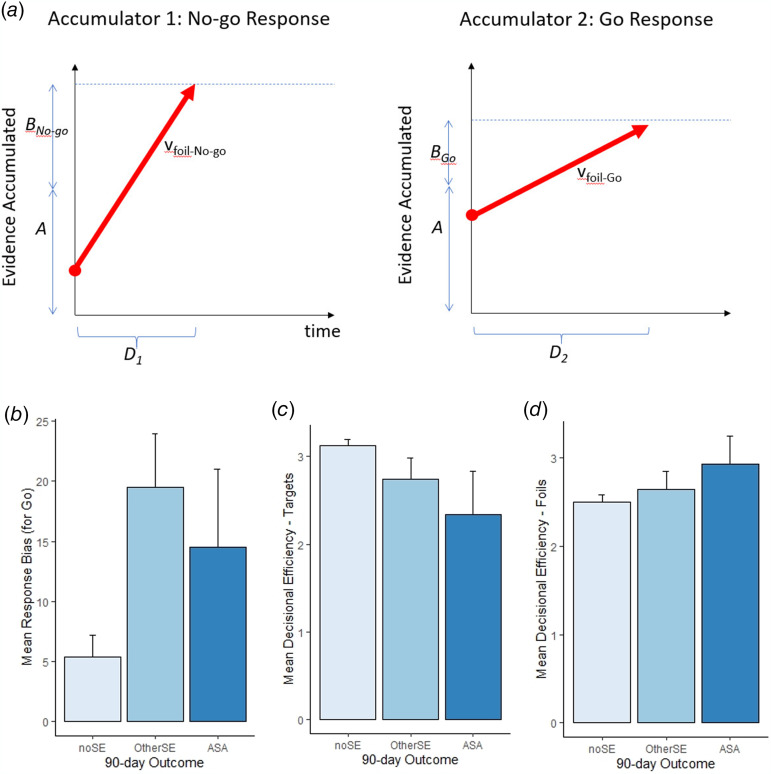
136 Veterans at high-risk for suicide previously completed a computer-based GNG task requiring rapid responding (Go) to target stimuli, while withholding responses (No-go) to infrequent foil stimuli; behavioral variables included false alarms to foils (failure to inhibit) and missed responses to targets. We conducted a secondary analysis of these data, with outcomes defined as actual suicide attempt (ASA), other suicide-related event (OtherSE) such as interrupted/aborted attempt or preparatory behavior, or neither (noSE), within 90-days after GNG testing, to examine whether GNG variables could improve ASA prediction over standard clinical variables. A computational model (linear ballistic accumulator, LBA) was also applied, to elucidate cognitive mechanisms underlying group differences.
On GNG, increased miss rate selectively predicted ASA, while increased false alarm rate predicted OtherSE (without ASA) within the 90-day follow-up window. In LBA modeling, ASA (but not OtherSE) was associated with decreases in decisional efficiency to targets, suggesting differences in the evidence accumulation process were specifically associated with upcoming ASA.
These findings suggest that GNG may improve prediction of near-term suicide risk, with distinct behavioral patterns in those who will attempt suicide within the next 90 days. Computational modeling suggests qualitative differences in cognition in individuals at near-term risk of suicide attempt.
神经认知测试可能有助于预测近期自杀风险。本研究旨在探讨个体在接受基于计算机的 Go/No-go(GNG)任务时的表现,以及通过提取潜在认知变量的计算模型,是否可以提高对未来 90 天内自杀企图的预测能力,这些个体具有较高的自杀风险。
136 名有自杀风险的退伍军人之前完成了一项基于计算机的 GNG 任务,要求他们对目标刺激做出快速反应(Go),同时对罕见的干扰刺激(No-go)不做出反应;行为变量包括对干扰刺激的错误警报(抑制失败)和对目标的漏报。我们对这些数据进行了二次分析,以实际的自杀企图(ASA)、其他与自杀相关的事件(OtherSE),如中断/未遂的尝试或准备行为,或两者都没有(noSE)作为结果,来检验 GNG 变量是否可以提高对 ASA 的预测能力,优于标准的临床变量。还应用了一种计算模型(线性弹道累加器,LBA),以阐明组间差异的认知机制。
在 GNG 上,增加漏报率选择性地预测了 ASA,而增加虚报率预测了未来 90 天内的 OtherSE(无 ASA)。在 LBA 建模中,ASA(但不是 OtherSE)与目标决策效率的降低有关,这表明在证据积累过程中的差异与即将发生的 ASA 特异性相关。
这些发现表明,GNG 可能会提高对近期自杀风险的预测能力,对于那些在未来 90 天内有自杀企图的人,存在着不同的行为模式。计算模型表明,在有近期自杀风险的个体中,认知方面存在定性差异。