Department of Family and Community Medicine and Behavioral Sciences, College of Medicine, University of Sharjah, Sharjah, United Arab Emirates.
Sharjah Institute of Medical Research, University of Sharjah, Sharjah, United Arab Emirates.
PLoS One. 2022 Jul 28;17(7):e0269204. doi: 10.1371/journal.pone.0269204. eCollection 2022.
Environmental factors can influence the epidemiological dynamics of COVID-19. To estimate the true impact of these factors on COVID-19, climate and disease data should be monitored and analyzed over an extended period of time. The Gulf Cooperation Council (GCC) countries are particularly lacking in such studies. This ecological study investigates the association between climate parameters and COVID-19 cases and deaths in the GCC.
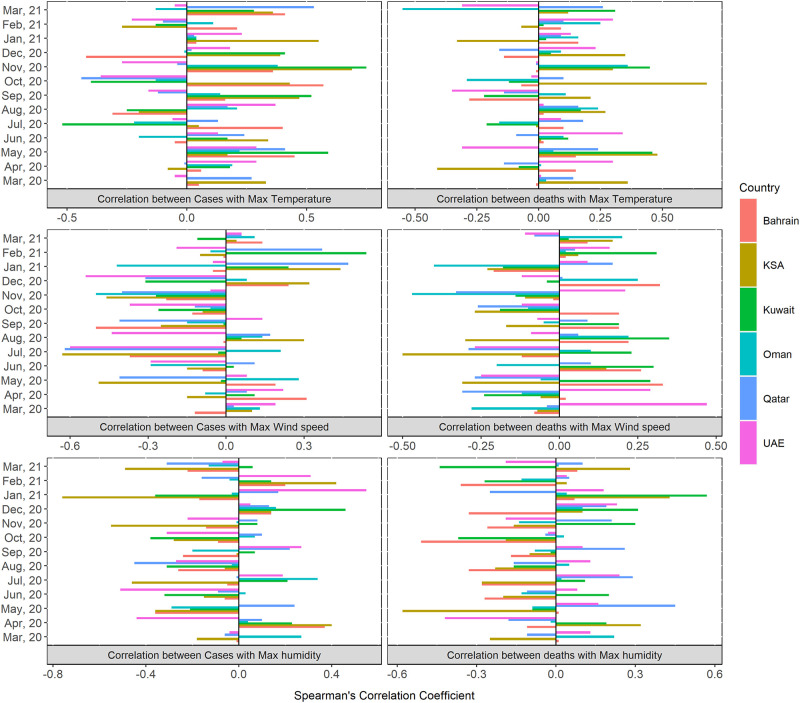
Data on temperature, wind-speed and humidity and COVID-19 cases and deaths from the six countries of the GCC were collected between 29/1/2020 and 30/3/2021. Using Spearman's correlation coefficient, we examined associations between climate parameters and COVID-19 cases and deaths by month, over four different time periods. A two-step cluster analysis was conducted to identify distinct clusters of data using climate parameters and linear regression analysis to determine which climate parameters predicted COVID-19 new cases and deaths.
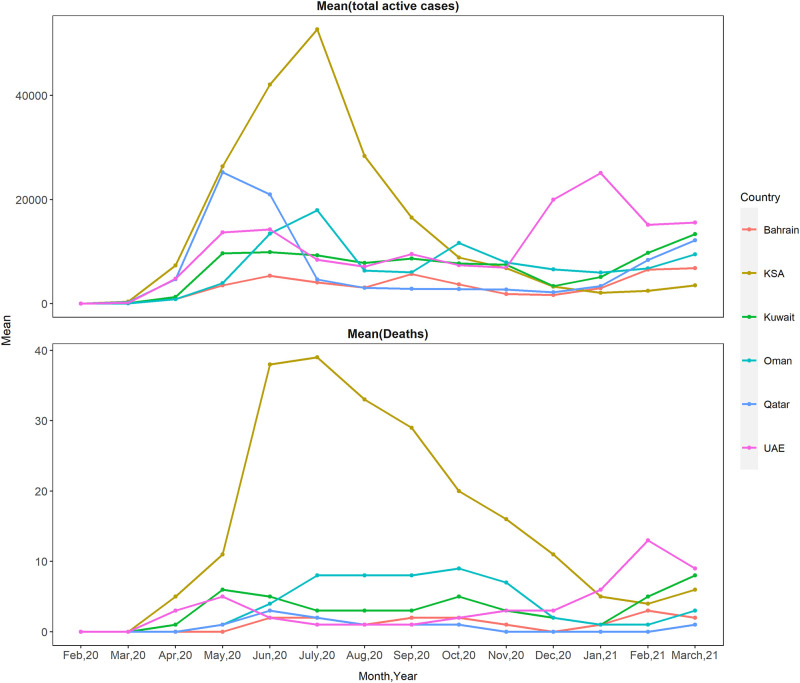
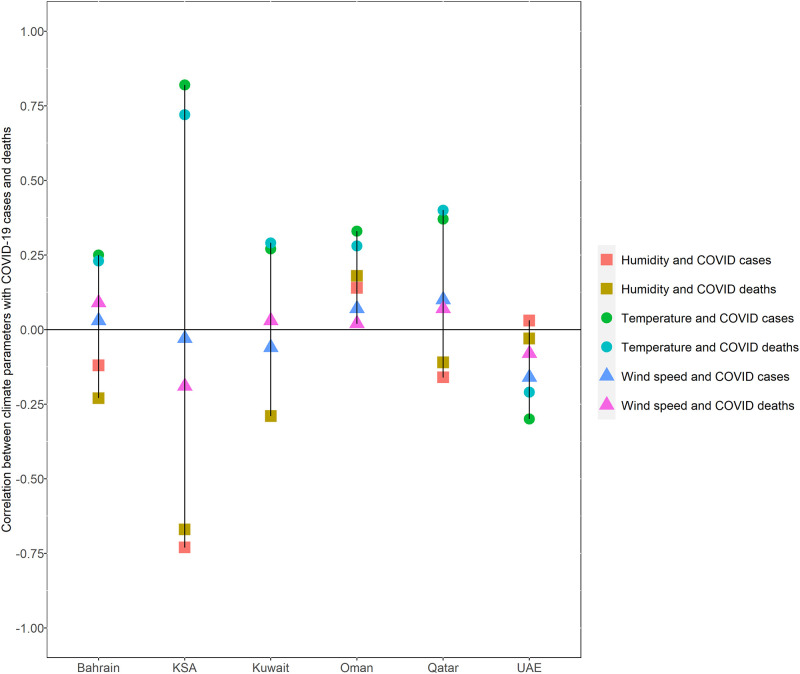
The United Arab Emirates (UAE) had the highest cumulative number of COVID-19 cases while Bahrain had the highest prevalence rate per 100,000. The Kingdom of Saudi Arabia (KSA) reported the highest cumulative number of deaths while Oman recorded the highest death rate per 100,000. All GCC countries, except the UAE, reported a positive correlation between temperature and cases and deaths. Wind speed was positively correlated with cases in Qatar, but negatively correlated with cases in the UAE and deaths in KSA. Humidity was positively correlated with cases and deaths in Oman, negatively correlated in Bahrain, Kuwait, Qatar and KSA but there was no correlation in the UAE. The most significant predictors in cluster analysis were temperature and humidity, while in the regression analysis, temperature, humidity and wind speed predicted new COVID-19 cases and deaths.
This study provides comprehensive epidemiological information on COVID-19 and climate parameters and preliminary evidence that climate may play a key role in the transmission of the COVID-19 virus. This study will assist decision makers in translating findings into specific guidelines and policies for the prevention and elimination of COVID-19 transmission and infection.
环境因素会影响 COVID-19 的流行病学动态。为了准确评估这些因素对 COVID-19 的影响,应该对气候和疾病数据进行长时间的监测和分析。海湾合作委员会(GCC)国家特别缺乏此类研究。本生态研究调查了气候参数与 GCC 国家 COVID-19 病例和死亡之间的关联。
我们收集了 2020 年 1 月 29 日至 2021 年 3 月 30 日期间 GCC 六国的温度、风速和湿度以及 COVID-19 病例和死亡数据。我们使用 Spearman 相关系数按月检查气候参数与 COVID-19 病例和死亡之间的关联,共分为四个不同时间段。采用两步聚类分析根据气候参数识别数据的不同聚类,并用线性回归分析确定哪些气候参数可预测 COVID-19 新发病例和死亡。
阿联酋(UAE)的 COVID-19 累计病例数最高,而巴林的每 10 万人发病率最高。沙特阿拉伯王国(KSA)报告的累计死亡人数最高,而阿曼的死亡率最高。除阿联酋外,所有 GCC 国家的温度与病例和死亡均呈正相关。卡塔尔的风速与病例呈正相关,而阿联酋的风速与病例呈负相关,沙特阿拉伯的风速与死亡呈负相关。阿曼的湿度与病例和死亡呈正相关,巴林、科威特、卡塔尔和沙特阿拉伯的湿度与病例和死亡呈负相关,而阿联酋的湿度与病例和死亡无关。聚类分析中最重要的预测因子是温度和湿度,而回归分析中,温度、湿度和风速预测了 COVID-19 新发病例和死亡。
本研究提供了 COVID-19 与气候参数的综合流行病学信息,并初步证明气候可能在 COVID-19 病毒传播中起关键作用。本研究将有助于决策者将研究结果转化为预防和消除 COVID-19 传播和感染的具体指南和政策。