Brooks James E, Morrison Megan M
Department of Counseling and Educational Psychology, Indiana University, Bloomington, IN, United States.
Department of Psychology, Tennessee State University, Nashville, TN, United States.
Front Psychol. 2022 Jul 12;13:923019. doi: 10.3389/fpsyg.2022.923019. eCollection 2022.
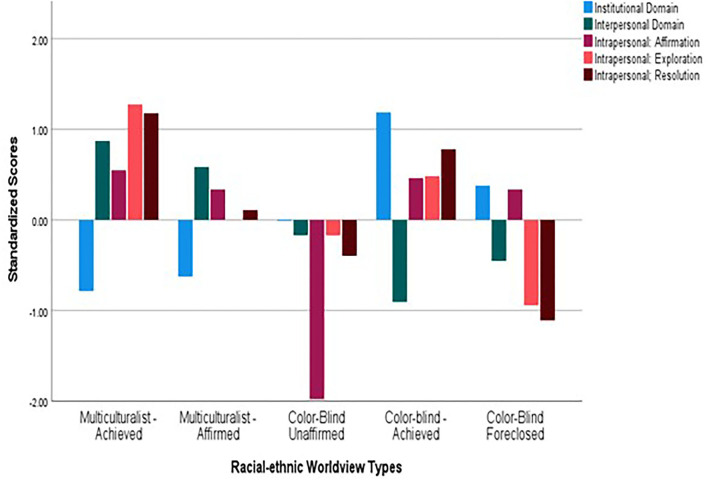
The current study explored the associations between relationship stigma, Racial-ethnic Worldview (REW; a construct developed as a comprehensive assessment of individual's perceptions of race and ethnicity), and relationship quality among those in interracial relationships (i. e., participants indicated their race was different than the race of their partner). One type of REW (Color-blind Achieved) was especially susceptible to the negative consequences of stigma from family members. Other significant differences in relationship quality and relationship stigma were found based on REW. Most notable is that individuals who acknowledge institutional racism, have positive intergroup attitudes, and a positive ethnic identity reported better relationship quality than those who denied institutional racism and/or had less positive attitudes toward their own ethnic group. These results demonstrate the utility of REW in contextualizing the experiences of individuals in interracial relationships as it relates to perceived stigma and relationship quality. The study offers a critical account of how individuals understanding of the racial and ethnic social context shapes relationship outcomes for those in interracial relationships in the United States.
当前的研究探讨了关系污名、种族-民族世界观(REW;一种作为对个体对种族和民族认知的综合评估而开发的结构)与跨种族关系中个体的关系质量之间的关联(即,参与者表示自己的种族与伴侣的种族不同)。一种REW类型(色盲成就型)特别容易受到来自家庭成员污名的负面影响。基于REW,还发现了关系质量和关系污名方面的其他显著差异。最值得注意的是,承认制度性种族主义、具有积极的群体间态度和积极的种族认同的个体,其关系质量比那些否认制度性种族主义和/或对自己种族群体态度不那么积极的个体更好。这些结果证明了REW在将跨种族关系中个体的经历与感知到的污名和关系质量联系起来时的实用性。该研究批判性地阐述了个体对种族和民族社会背景的理解如何塑造美国跨种族关系中个体的关系结果。