Department of Geography, Geoinformatics and Meteorology, University of Pretoria, Pretoria, Republic of South Africa.
Soil, Climate and Water Institute, Agricultural Research Council, Arcadia, Pretoria, Republic of South Africa.
PLoS Negl Trop Dis. 2022 Jul 29;16(7):e0010464. doi: 10.1371/journal.pntd.0010464. eCollection 2022 Jul.
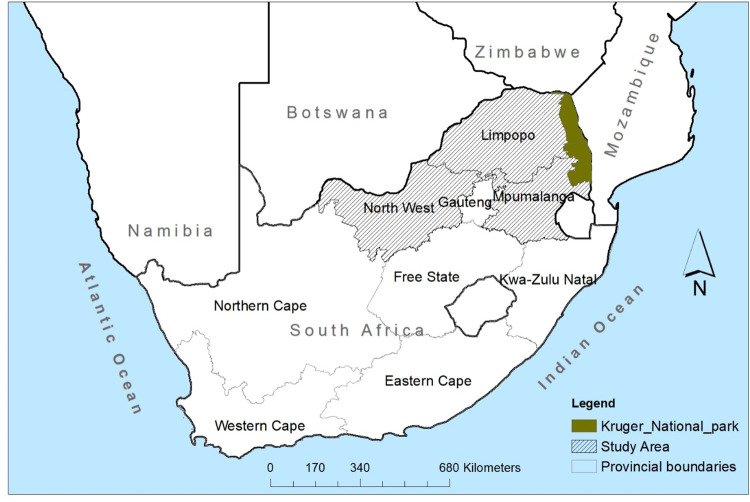
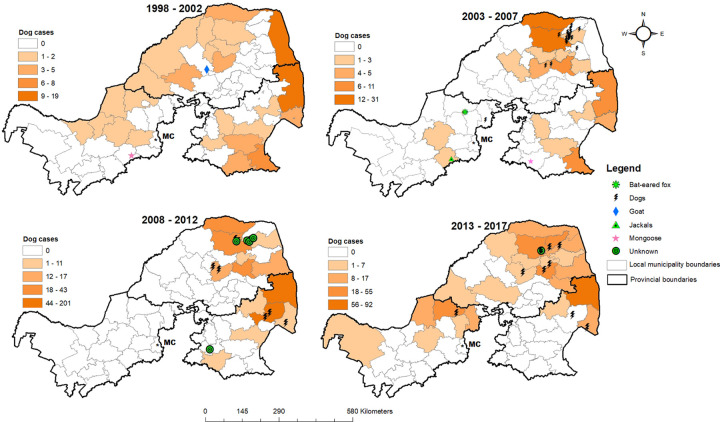
Rabies is a fatal zoonotic disease that is maintained in domestic dogs and wildlife populations in the Republic of South Africa. A retrospective study was conducted to improve understanding of the dynamics of rabies in humans, domestic dogs, and wildlife species, in relation to the ecology for three northern provinces of South Africa (Limpopo, Mpumalanga, and North-West) between 1998 and 2017.
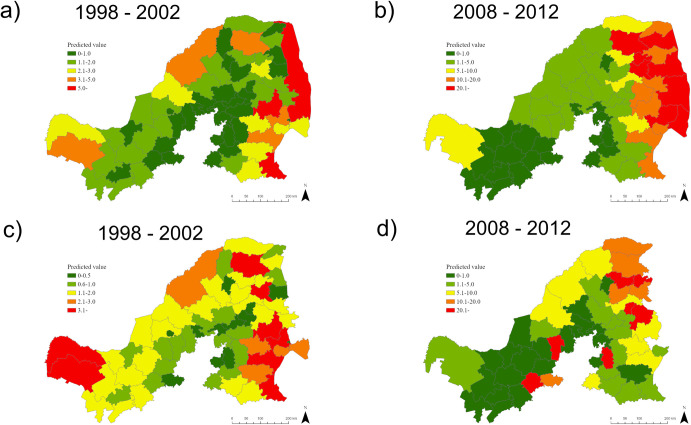
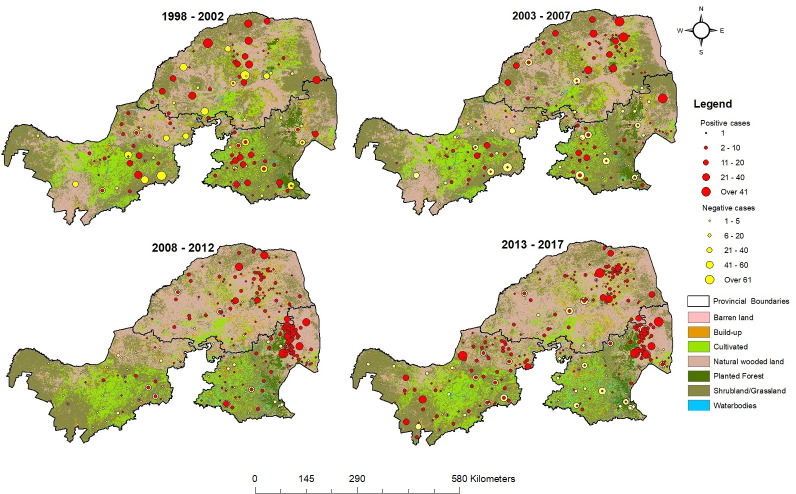
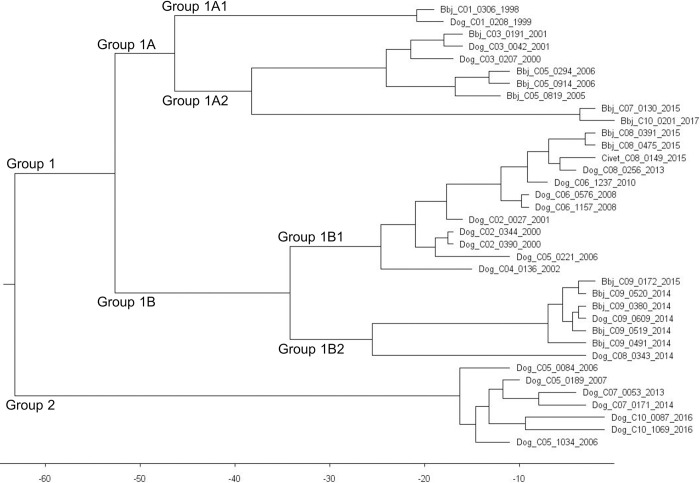
A descriptive epidemiology study was conducted for human and animal rabies. Dog rabies cases were analyzed using spatio-temporal scan statistics. The reproductive number (Rt) was estimated for the identified disease clusters. A phylogenetic tree was constructed based on the genome sequences of rabies viruses isolated from dogs, jackals, and an African civet, and Bayesian evolutionary analysis using a strict time clock model. Several ecological and socio-economic variables associated with dog rabies were modeled using univariate analyses with zero-inflated negative binomial regression and multivariable spatial analyses using the integrated nested Laplace approximation for two time periods: 1998-2002 and 2008-2012.
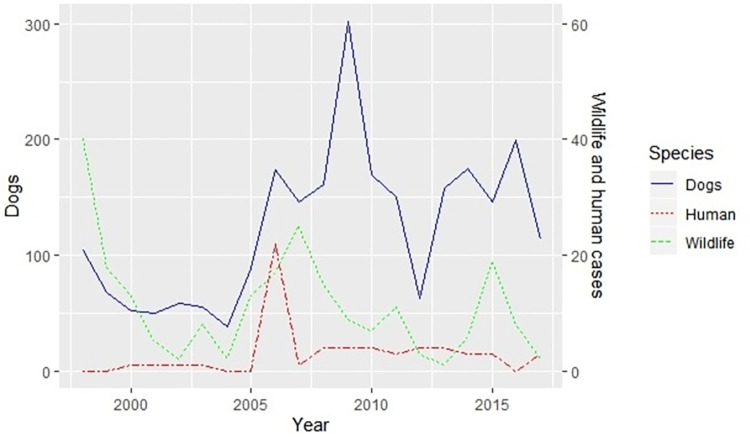
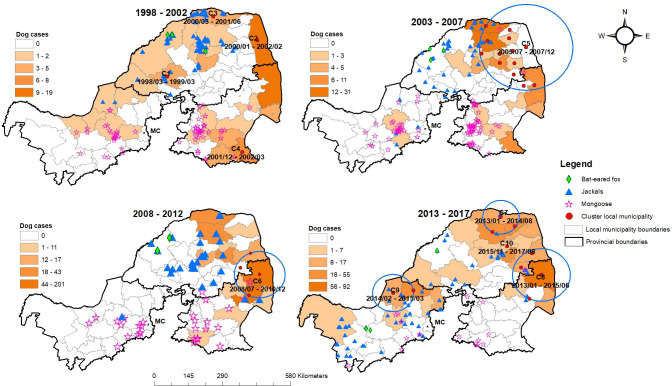
Human rabies cases increased in 2006 following an increase in dog rabies cases; however, the human cases declined in the next year while dog rabies cases fluctuated. Ten disease clusters of dog rabies were identified, and utilizing the phylogenetic tree, the dynamics of animal rabies over 20 years was elucidated. In 2006, a virus strain that re-emerged in eastern Limpopo Province caused the large and persistent dog rabies outbreaks in Limpopo and Mpumalanga Provinces. Several clusters included a rabies virus variant maintained in jackals in Limpopo Province, and the other variant in dogs widely distributed. The widely distributed variant maintained in jackal populations in North-West Province caused an outbreak in dogs in 2014. The Rt was high when the disease clusters were associated with either multiple virus strains or multiple animal species. High-risk areas included Limpopo and Mpumalanga Provinces characterized by woodlands and high temperatures and precipitation.
Canine rabies was maintained mainly in dog populations but was also associated with jackal species. Rural communities in Limpopo and Mpumalanga Provinces were at high risk of canine rabies originating from dogs.
狂犬病是一种致命的人畜共患病,在南非共和国的家犬和野生动物种群中持续存在。本回顾性研究旨在提高对 1998 年至 2017 年间南非北部三省(林波波省、姆普马兰加省和西北省)人类、家犬和野生动物狂犬病动态的认识,与生态学有关。
对人类和动物狂犬病进行描述性流行病学研究。使用时空扫描统计分析犬狂犬病病例。根据从犬、豺和非洲獛分离的狂犬病病毒的基因组序列构建了系统发育树,并使用严格的时间钟模型进行贝叶斯进化分析。使用零膨胀负二项回归的单变量分析和两个时间段的多变量空间分析(1998-2002 年和 2008-2012 年),对与犬狂犬病相关的几个生态和社会经济变量进行建模。
2006 年犬狂犬病病例增加后,人类狂犬病病例也随之增加;然而,次年人类病例减少,而犬狂犬病病例波动。发现了 10 个犬狂犬病疾病集群,利用系统发育树阐明了 20 多年来动物狂犬病的动态。2006 年,一种在林波波省东部重新出现的病毒株导致林波波省和姆普马兰加省发生大规模和持续的犬狂犬病暴发。一些集群包括林波波省豺中维持的狂犬病病毒变异株,以及广泛分布的其他变异株。在西北省广泛分布的在豺种群中维持的变异株导致 2014 年犬只暴发。当疾病集群与多种病毒株或多种动物物种相关时,Rt 较高。高风险地区包括林波波省和姆普马兰加省,这些地区以林地和高温高降水为特征。
犬狂犬病主要在家犬群体中维持,但也与豺物种有关。林波波省和姆普马兰加省的农村社区面临着由犬类传播的狂犬病高风险。