Key Laboratory of Bioactive Substances and Resources Utilization of Chinese Herbal Medicine, Ministry of Education and National Engineering Laboratory for Breeding of Endangered Medicinal Materials, Institute of Medicinal Plant Development, Chinese Academy of Medical Sciences and Peking Union Medical College, Beijing, 100193, China.
Institute of Sericulture, Chengde Medical University, Chengde, 067000, China.
BMC Plant Biol. 2022 Jul 29;22(1):379. doi: 10.1186/s12870-022-03761-z.
Flowering is a critical physiological change that interferes with not only biomass yield but also secondary metabolism, such as the biosynthesis of flavonoids, in rhizome/root plants. The continuous inflorescence removal (CIR) treatment is frequently conducted to weaken this effect. Fagopyrum dibotrys (D.Don) H.Hara (Golden buckwheat) is a kind of rhizome medicinal plant rich in flavonoids and is widely used for the treatment of lung diseases. The CIR treatment is usually conducted in F. dibotrys because of its excessive reproductive growth. To uncover the molecular mechanisms, comprehensive analysis was performed using metabolome and transcriptome data obtained from normally bloomed and the CIR treated plants.
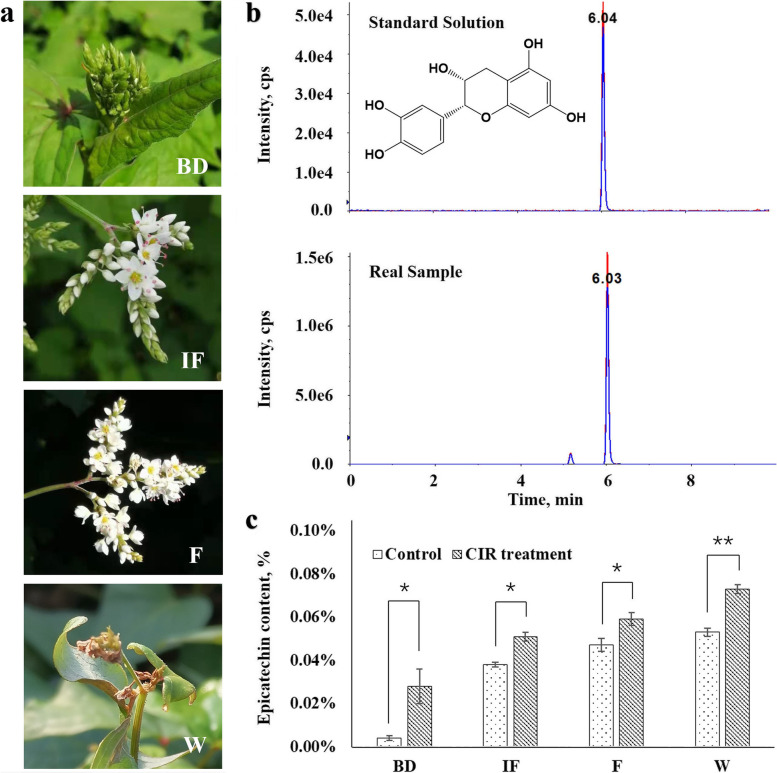
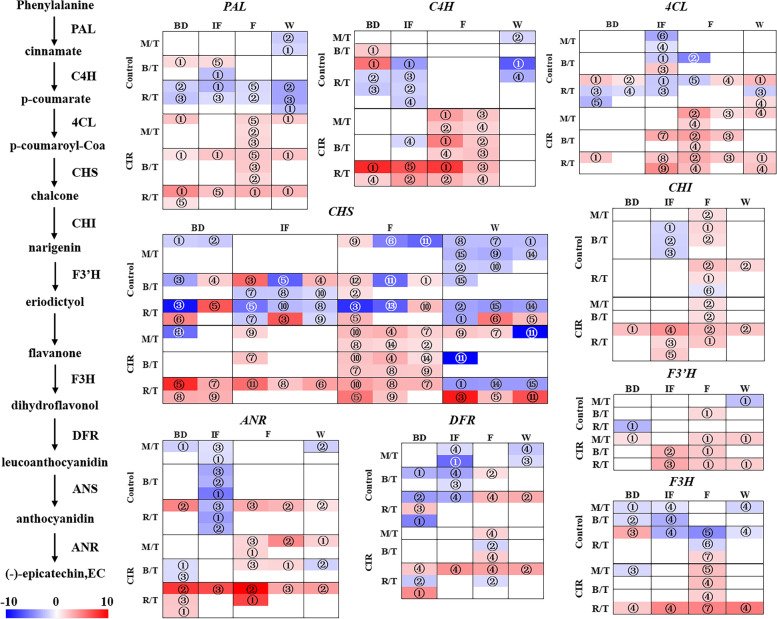
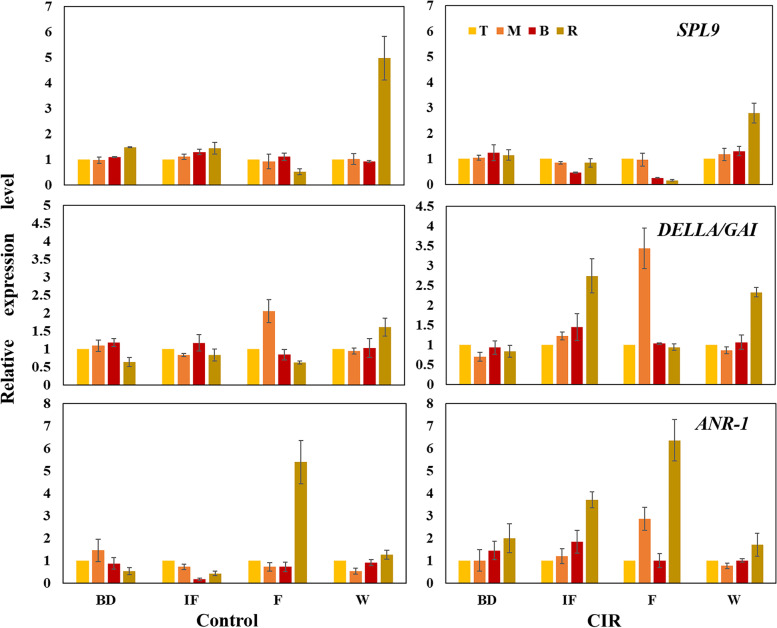
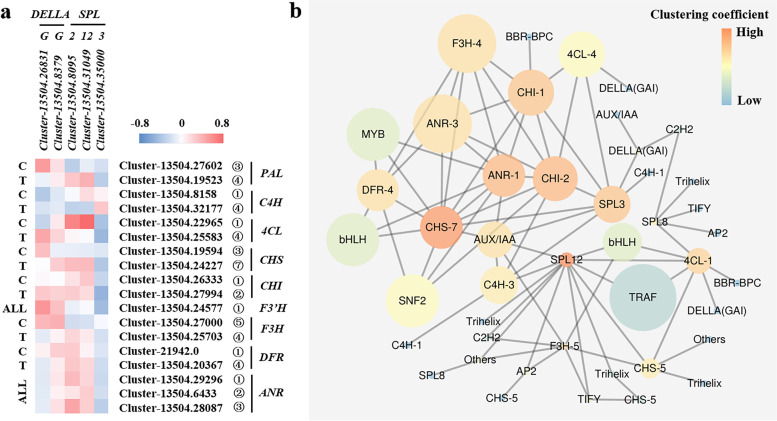
Metabolome results demonstrated that in the rhizomes of F. dibotrys, its bioactive compound called epicatechin has higher amount than most of the detected precursors. Compared with the normally bloomed plants, the level of epicatechin in the rhizomes of the CIR group increased by 25% at the withering stage. Based on 96 samples of the control and the CIR groups at 4 flowering stages for 4 tissues, RNA-Seq results revealed a 3 ~ 5 times upregulations of all the key enzyme genes involved in the biosynthesis of epicatechin in both time (from the bud stage to the withering stage) and spatial dimensions (from the top of branch to rhizome) under the CIR treatment compared to normal flowering. Integrated analysis of LC-MS/MS and transcriptome revealed the key roles of several key enzyme genes besides anthocyanidin reductase (ANR). A total of 93 transcription factors were identified to co-expressed with the genes in epicatechin biosynthetic pathway. The flowering activator SQUAMOSA promoter-binding protein like (SPLs) exhibited opposite spatiotemporal expression patterns to that of the epicatechin pathway genes; SPL3 could significantly co-express with all the key enzyme genes rather than the flowering repressor DELLA. Weighted gene co-expression network analysis (WGCNA) further confirmed the correlations among chalcone synthases (CHSs), chalcone isomerases (CHIs), ANRs, SPLs and other transcription factors.
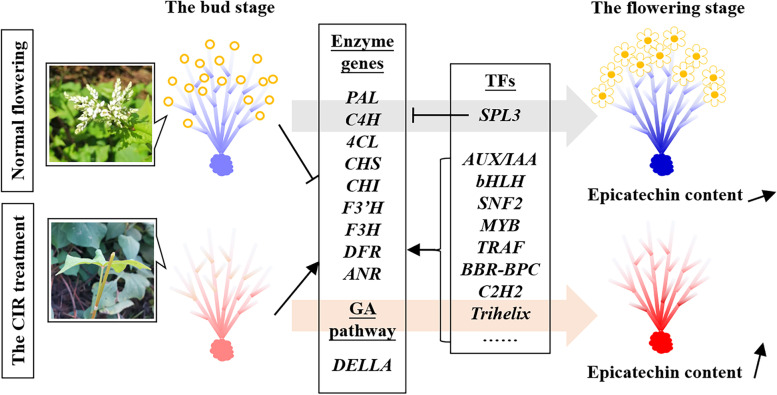
SPL3 might dominantly mediate the effect of normal flowering and the CIR treatment on the biosynthesis of epicatechin in rhizomes mainly through the negative regulations of its key enzyme genes including CHS, CHI and ANR.
开花是一种关键的生理变化,不仅会干扰生物量的产生,还会干扰次生代谢,如黄酮类化合物的生物合成,在根茎/根植物中。通常进行连续花序去除(CIR)处理以削弱这种效应。金荞麦(Fagopyrum dibotrys(D.Don)H.Hara)是一种富含黄酮类化合物的根茎药用植物,广泛用于治疗肺部疾病。由于其过度的生殖生长,通常在 F. dibotrys 中进行 CIR 处理。为了揭示分子机制,我们使用来自正常开花和 CIR 处理植物的代谢组学和转录组学数据进行了综合分析。
代谢组学结果表明,在金荞麦的根茎中,其生物活性化合物表儿茶素的含量高于大多数检测到的前体。与正常开花的植株相比,在 CIR 组的根茎中,表儿茶素的水平在枯萎阶段增加了 25%。基于 96 个对照和 CIR 组的 4 个开花阶段的 4 个组织的样本,RNA-Seq 结果表明,与正常开花相比,在 CIR 处理下,所有参与表儿茶素生物合成的关键酶基因在时间(从芽期到枯萎期)和空间(从枝顶到根茎)上均有 3-5 倍的上调。LC-MS/MS 和转录组的综合分析表明,除了花青素还原酶(ANR)之外,几个关键酶基因在 CIR 处理下也发挥了关键作用。共鉴定了 93 个转录因子与表儿茶素生物合成途径中的基因共表达。开花激活剂 SQUAMOSA 启动子结合蛋白样(SPL)的时空表达模式与表儿茶素途径基因相反;SPL3 可以与所有关键酶基因显著共表达,而不是与开花抑制物 DELLA。加权基因共表达网络分析(WGCNA)进一步证实了查尔酮合酶(CHSs)、查尔酮异构酶(CHIs)、ANRs、SPLs 和其他转录因子之间的相关性。
SPL3 可能通过其关键酶基因(包括 CHS、CHI 和 ANR)的负调控,主要通过对正常开花和 CIR 处理对根茎中表儿茶素生物合成的影响来介导。