Department of Radiology, Second Affiliated Hospital, School of Medicine, Zhejiang University, 88 Jiefang Road, Hangzhou, 310009, Zhejiang, People's Republic of China.
Institute of Pharmaceutics, College of Pharmaceutical Sciences, Zhejiang University, 866 Yuhangtang Road, Hangzhou, 310058, Zhejiang, People's Republic of China.
J Nanobiotechnology. 2022 Jul 30;20(1):351. doi: 10.1186/s12951-022-01565-9.
The efficacy of immune checkpoint blockade (ICB), in the treatment of hepatocellular carcinoma (HCC), is limited due to low levels of tumor-infiltrating T lymphocytes and deficient checkpoint blockade in this immunologically "cool" tumor. Thus, combination approaches are needed to increase the response rates of ICB and induce synergistic antitumor immunity.
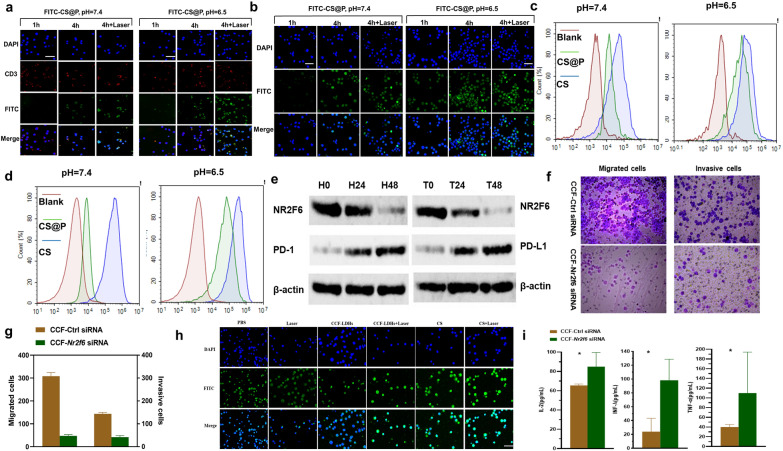
Herein, we designed a pH-sensitive multifunctional nanoplatform based on layered double hydroxides (LDHs) loaded with siRNA to block the intracellular immune checkpoint NR2F6, together with the asynchronous blockade surface receptor PD-L1 to induce strong synergistic antitumor immunity. Moreover, photothermal therapy (PTT) generated by LDHs after laser irradiation modified an immunologically "cold" microenvironment to potentiate Nr2f6-siRNA and anti-PD-L1 immunotherapy. Flow cytometry was performed to assess the immune responses initiated by the multifunctional nanoplatform.
Under the slightly acidic tumor extracellular environment, PEG detached and the re-exposed positively charged LDHs enhanced tumor accumulation and cell uptake. The accumulated siRNA suppressed the signal of dual protumor activity in both immune and H22 tumor cells by silencing the NR2F6 gene, which further reduced the tumor burden and enhanced systemic antitumor immunity. The responses include enhanced tumor infiltration by CD4 helper T cells, CD8 cytotoxic T cells, and mature dendritic cells; the significantly decreased level of immune suppressed regulator T cells. The therapeutic responses were also attributed to the production of IL-2, IFN-γ, and TNF-α. The prepared nanoparticles also exhibited potential magnetic resonance imaging (MRI) ability, which could serve to guide synergistic immunotherapy treatment.
In summary, the three combinations of PTT, NR2F6 gene ablation and anti-PD-L1 can promote a synergistic immune response to inhibit the progression of primary HCC tumors and prevent metastasis. This study can be considered a proof-of-concept for the targeting of surface and intracellular immune checkpoints to supplement the existing HCC immunotherapy treatments.
由于肿瘤浸润性 T 淋巴细胞水平低和免疫“冷”肿瘤中检查点阻断不足,免疫检查点阻断(ICB)在肝细胞癌(HCC)治疗中的疗效有限。因此,需要联合治疗方法来提高 ICB 的反应率并诱导协同抗肿瘤免疫。
在此,我们设计了一种基于负载 siRNA 的层状双氢氧化物(LDHs)的 pH 敏感多功能纳米平台,以阻断细胞内免疫检查点 NR2F6,并同时阻断表面受体 PD-L1,以诱导强烈的协同抗肿瘤免疫。此外,激光照射后 LDHs 产生的光热疗法(PTT)修饰了免疫“冷”微环境,增强了 Nr2f6-siRNA 和抗 PD-L1 免疫治疗的效果。通过流式细胞术评估多功能纳米平台引发的免疫反应。
在稍酸性的肿瘤细胞外环境下,PEG 脱落,重新暴露的带正电荷的 LDHs 增强了肿瘤的积累和细胞摄取。积累的 siRNA 通过沉默 NR2F6 基因抑制了双重促肿瘤活性在免疫和 H22 肿瘤细胞中的信号,从而进一步降低了肿瘤负担并增强了全身抗肿瘤免疫。反应包括 CD4 辅助 T 细胞、CD8 细胞毒性 T 细胞和成熟树突状细胞的肿瘤浸润增强,免疫抑制调节性 T 细胞的水平显著降低。治疗反应还归因于 IL-2、IFN-γ 和 TNF-α 的产生。所制备的纳米颗粒还表现出潜在的磁共振成像(MRI)能力,可用于指导协同免疫治疗。
总之,PTT、NR2F6 基因消融和抗 PD-L1 的三种组合可以促进协同免疫反应,抑制原发性 HCC 肿瘤的进展并预防转移。这项研究可以被认为是针对表面和细胞内免疫检查点的靶向治疗,以补充现有的 HCC 免疫治疗方法。