Institute for Physical Activity and Nutrition (IPAN), School of Exercise and Nutrition Sciences, Deakin University, Geelong, Australia.
Menzies Institute for Medical Research, University of Tasmania, Hobart, Tasmania, Australia.
Int J Behav Nutr Phys Act. 2022 Jul 30;19(1):98. doi: 10.1186/s12966-022-01339-4.
Distinct typologies of physical activity and screen-based sedentary behaviors are common during adolescence, but it is unknown how these change over time. This longitudinal study examined the stability of activity-related behavioral typologies over the transition out of secondary school.
Year 11 students (penultimate school year) completed a self-report survey (baseline), which was repeated 2 years later (follow-up) (75% female, mean baseline age: 16.9 ± 0.4 years). Latent transition analysis identified typologies of physical activity and screen time behaviors and explored changes in typology membership between baseline and follow-up among those with complete data and who were not attending secondary school at follow-up (n = 803).
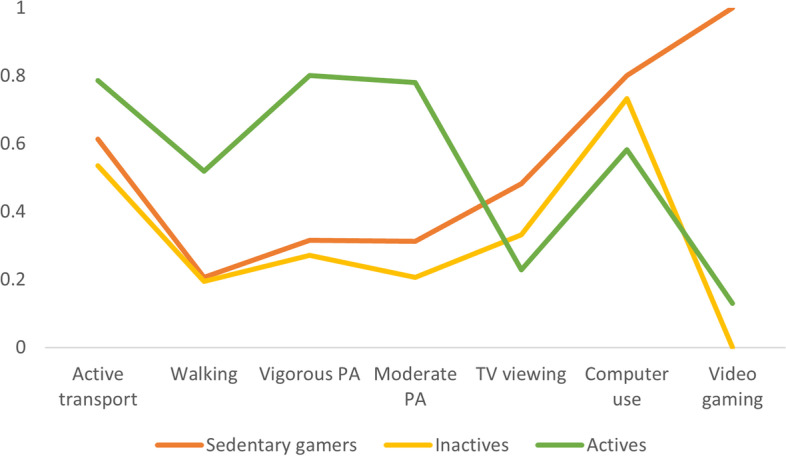
Three unique typologies were identified and labelled as: 1) Sedentary gamers (baseline: 17%; follow-up: 15%: high levels of screen behaviors, particularly video gaming); 2) Inactives (baseline: 46%; follow-up: 48%: low physical activities, average levels of screen behaviors); and 3) Actives (baseline: 37%; follow-up: 37%: high physical activities, low screen behaviors). Most participants remained in the same typology (83.2%), 8.5% transitioned to a typology with a more health-enhancing profile and 8.3% transitioned to a typology with a more detrimental behavioral profile.
The high proportion within the 'inactive' typology and the stability of typologies over the transition period suggests that public health interventions are required to improve activity-related behavior typologies before adolescents leave secondary school.
在青少年时期,身体活动和屏幕久坐行为通常存在不同的类型,但尚不清楚这些行为随时间如何变化。本纵向研究考察了从中等学校毕业过渡期间与活动相关的行为类型的稳定性。
11 年级学生(倒数第二年)完成了一份自我报告调查(基线),两年后(随访)再次进行(75%为女性,平均基线年龄:16.9±0.4 岁)。潜在转变分析确定了身体活动和屏幕时间行为的类型,并在随访时未就读中学且具有完整数据的人群中探索了基线和随访之间的类型变化(n=803)。
确定了三种独特的类型,并分别标记为:1)久坐游戏者(基线:17%;随访:15%:屏幕行为水平高,尤其是视频游戏);2)不活跃者(基线:46%;随访:48%:身体活动水平低,屏幕行为平均水平);和 3)活跃者(基线:37%;随访:37%:身体活动水平高,屏幕行为水平低)。大多数参与者保持在相同的类型(83.2%),8.5%转变为更有益于健康的类型,8.3%转变为更具危害性的行为类型。
“不活跃”类型中的高比例以及类型在过渡期间的稳定性表明,需要在青少年离开中学之前采取公共卫生干预措施来改善与活动相关的行为类型。