Centre for Exercise, Nutrition & Health Sciences, School for Policy Studies, University of Bristol, 8 Priory Road, Bristol, BS8 1TZ, UK.
MRC Integrative Epidemiology Unit at the University of Bristol, Oakfield House, Oakfield Grove, Bristol, BS8 2BN, UK.
Int J Behav Nutr Phys Act. 2018 Oct 23;15(1):103. doi: 10.1186/s12966-018-0735-8.
Physical activity is associated with improved physical and mental health among children. However, physical activity declines and sedentary time increases with age, and large proportions of older children do not meet the recommended hour per day of moderate-to-vigorous-intensity physical activity (MVPA). The aim of this paper is to identify profiles of children based on the complex relationship between physical activity and sedentary time at ages 6 and 9 and explore how those profiles are associated with other covariates and how they change over time.
Valid accelerometer data were collected for 1132 children aged 6 and 1121 at age 9, with 565 children with data at both ages. We calculated the proportions of total wear time spent in sedentary, light and MVPA activity on both weekdays and weekends. Latent profile (class) analysis was applied separately to the two age groups to identify activity profiles. We then used latent transition analysis to explore transitions between profiles at the two time points.
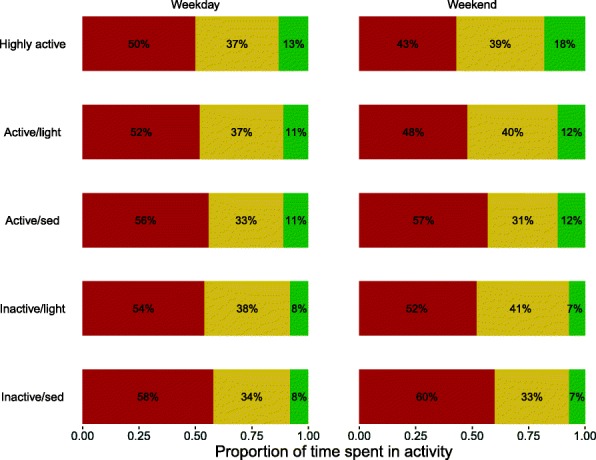
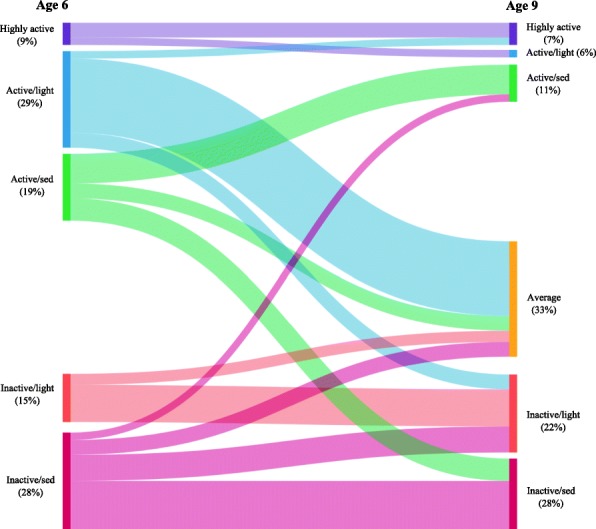
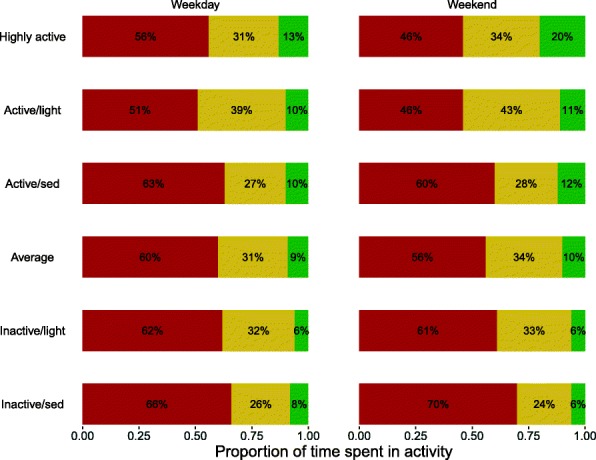
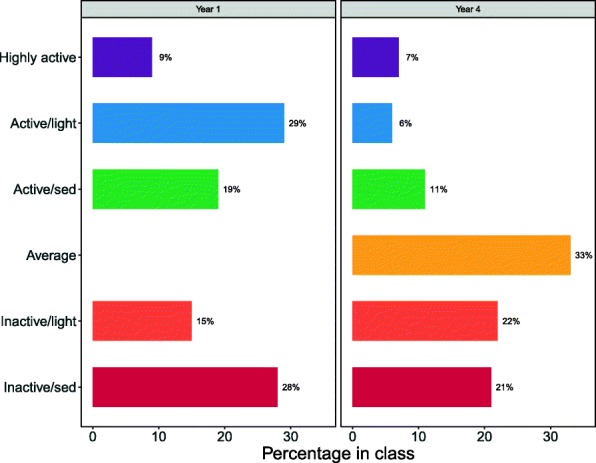
We identified five profiles of activity at age 6 and six profiles at age 9. Although profiles were not directly equivalent, five classes captured similar patterns at both ages and ranged from very active to inactive. At both ages, active profiles, where the majority achieved the recommended MVPA guidelines, were more likely to be active at weekends than on weekdays. There was substantial movement between classes, with strongest patterns of movement to classes with no change or a decrease in MVPA. Transition between classes was associated with sex, BMI z-score, screen-viewing and participation in out-of-school activities.
This paper is the first to apply latent profile analysis to the physical activity of UK children as they move through primary school. Profiles were identified at ages 6 and 9, reflecting different weekday and weekend patterns of physical activity and sedentary time. There was substantial movement between profiles between ages 6 and 9, mostly to no change or less active profiles. Weekend differences suggest that greater focus on how weekend activity contributes to an average of 60 min per day of MVPA across the week may be warranted.
身体活动与儿童身心健康的改善有关。然而,随着年龄的增长,身体活动减少,久坐时间增加,很大比例的大龄儿童无法达到每天推荐的 1 小时中等到剧烈强度的身体活动(MVPA)。本文旨在根据儿童在 6 岁和 9 岁时身体活动与久坐时间之间的复杂关系,确定其特征,并探讨这些特征与其他协变量的关系,以及它们随时间的变化情况。
对 1132 名 6 岁儿童和 1121 名 9 岁儿童进行了有效的加速度计数据采集,其中 565 名儿童在两个年龄段均有数据。我们计算了工作日和周末总佩戴时间中久坐、低强度和 MVPA 活动的比例。分别对两个年龄组进行潜在剖面(类)分析,以确定活动特征。然后,我们使用潜在转移分析来探索两个时间点之间的特征转移。
我们确定了 6 岁时的五种活动特征和 9 岁时的六种活动特征。尽管特征并不直接等同,但五个类别在两个年龄段都捕捉到了相似的模式,从非常活跃到不活跃。在两个年龄段,大多数达到推荐的 MVPA 指南的活跃特征,周末比工作日更活跃。在班级之间有大量的流动,最强的流动模式是向没有变化或 MVPA 减少的班级流动。班级之间的转变与性别、BMI z 分数、屏幕观看和课外参与活动有关。
本文首次将潜在剖面分析应用于英国儿童的身体活动,这些儿童在小学期间移动。在 6 岁和 9 岁时确定了特征,反映了不同的工作日和周末身体活动和久坐时间模式。在 6 岁和 9 岁之间有大量的特征转移,主要是向没有变化或不活跃的特征转移。周末的差异表明,可能需要更加关注周末活动如何有助于每周平均 60 分钟的 MVPA。