Department of Mathematics, Faculty of Mathematics and Natural Sciences, University of Oslo, Oslo, Norway.
Institute of Oral Biology, Faculty of Dentistry, University of Oslo, Blindern, P.O.B. 1052, 0316, Oslo, Norway.
BMC Cardiovasc Disord. 2022 Jul 31;22(1):344. doi: 10.1186/s12872-022-02791-7.
Little is known about the association between bacterial DNA in human blood and the risk of cardiovascular disease (CVD) mortality.
A case-cohort study was performed based on a 9 ½ year follow-up of the Oslo II study from 2000. Eligible for this analysis were men born in 1923 and from 1926 to 1932. The cases were men (n = 227) who had died from CVD, and the controls were randomly selected participants from the same cohort (n = 178). Analysis of the bacterial microbiome was performed on stored frozen blood samples for both cases and controls. Association analyses for CVD mortality were performed by Cox proportional hazard regression adapted to the case-cohort design. We used the Bonferroni correction due to the many bacterial genera that were identified.
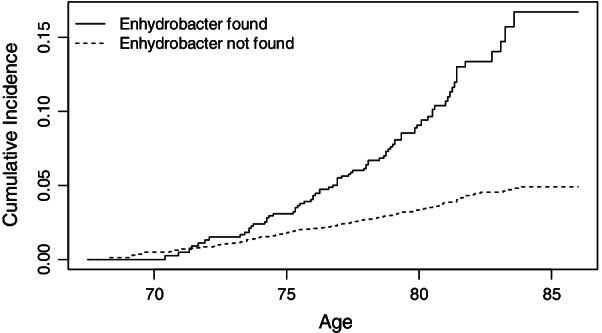
Bacterial DNA was identified in 372 (82%) of the blood samples and included 78 bacterial genera from six phyla. Three genera were significantly associated with CVD mortality. The genera Kocuria (adjusted hazard ratio (HR) 8.50, 95% confidence interval (CI) (4.05, 17.84)) and Enhydrobacter (HR 3.30 (2.01, 5.57)) indicate an association with CVD mortality with increasing levels. The genera Paracoccus (HR 0.29 (0.15, 0.57)) was inversely related. Significant predictors of CVD mortality were: the feeling of bad health; and the consumption of more than three cups of coffee per day. The following registered factors were borderline significant, namely: a history of heart failure; increased systolic blood pressure; and currently taking antihypertensive drugs now, versus previously.
The increasing levels of two bacterial genera Kocuria (skin and oral) and Enhydrobacter (skin) and low levels of Paracoccus (soil) were associated with CVD mortality independent of known risk factors for CVD.
关于血液中的细菌 DNA 与心血管疾病(CVD)死亡率之间的关联,人们知之甚少。
本研究基于 2000 年开展的为期 9 年半的奥斯陆 II 研究,进行了病例-队列研究。符合本分析条件的是出生于 1923 年和 1926 年至 1932 年的男性。病例组为死于 CVD 的男性(n=227),对照组为来自同一队列的随机选择的参与者(n=178)。对病例和对照组的储存冷冻血样进行细菌微生物组分析。采用适应病例-队列设计的 Cox 比例风险回归进行 CVD 死亡率的相关性分析。由于鉴定出了许多细菌属,因此我们使用了 Bonferroni 校正。
在 372 份(82%)血样中鉴定出了细菌 DNA,包括来自 6 个门的 78 个细菌属。有 3 个属与 CVD 死亡率显著相关。Kocuria(调整后的危险比(HR)8.50,95%置信区间(CI)(4.05,17.84))和 Enhydrobacter(HR 3.30(2.01,5.57))属与 CVD 死亡率呈正相关,随着水平的升高而增加。Paracoccus(HR 0.29(0.15,0.57))属则呈负相关。CVD 死亡率的显著预测因子为:健康状况不佳的感觉;以及每天饮用超过三杯咖啡。以下登记的因素具有边缘显著性,即:心力衰竭史;收缩压升高;以及目前正在服用降压药,而不是以前。
皮肤和口腔的细菌属 Kocuria(皮肤和口腔)和 Enhydrobacter(皮肤)水平升高,以及土壤的 Paracoccus(土壤)水平降低与 CVD 死亡率相关,独立于 CVD 的已知危险因素。