School of Nursing, University of Rochester, Rochester, NY, United States.
Department of Public Health Sciences, University of Rochester Medical Center, Rochester, NY, United States.
Front Immunol. 2022 Jul 15;13:902114. doi: 10.3389/fimmu.2022.902114. eCollection 2022.
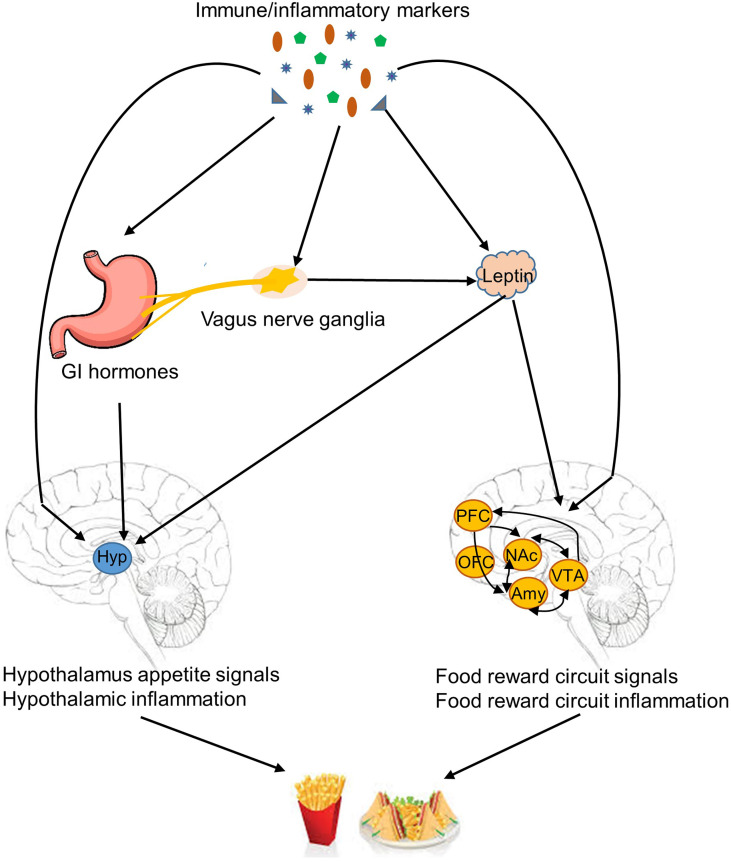
Eating behaviors contribute to disproportionate energy intake and are linked to the development of obesity. Animal studies support the role of inflammatory cytokines and chemokines in the regulation of obesity-related eating behaviors and offer a potential target to combat obesity through the modulation of inflammation. However, more complex eating behaviors are present in humans, and their relationships with immune/inflammation markers are unclear. The present study reviewed current literature to synthesize the evidence on the association of immune/inflammation markers with obesity-related eating behaviors in humans.
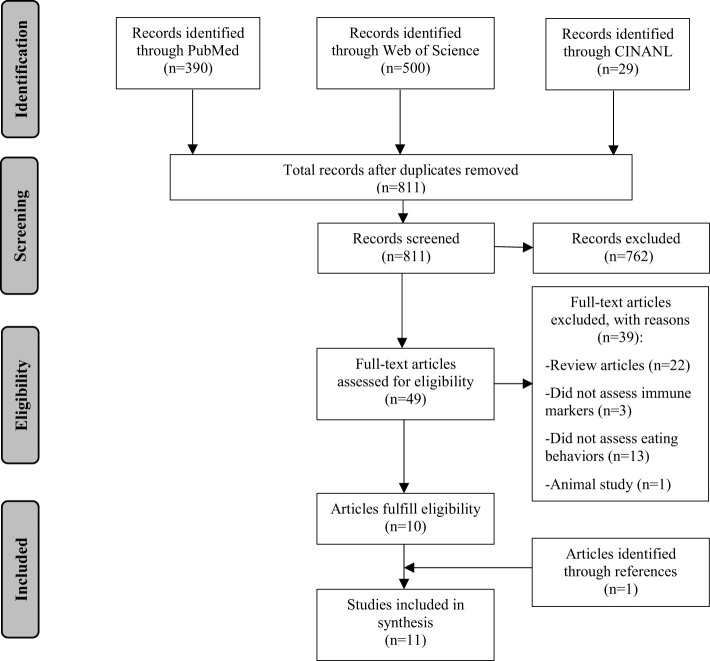
A systematic search of three electronic databases yielded 811 articles, of which 11 met the inclusion criteria.
The majority of the included studies (91%) were either case-control or cross-sectional studies. A variety of immune/inflammation markers and obesity-related eating behaviors have been assessed in the chosen studies. Three out of four studies identified a positive relationship between C-reactive protein (CRP)/high-sensitivity CRP and loss of control eating. Other inflammatory markers that potentially have a positive relationship with obesity-related eating behaviors include fractalkine and fibrinogen. Additionally, immune molecules, including interferon gamma (INF-γ), interleukin (IL)-7, IL-10, and α-melanocyte-stimulating hormone-reactive immunoglobulin G (α-MSH/IgG) immune complex, may have negative associations with obesity-related eating behaviors. However, most findings were identified by single studies.
Limited studies have been conducted in humans. Current evidence indicates a potential bi-directional relationship between inflammatory/immune markers and obesity-related eating behaviors. Additional studies with sophisticated research design and comprehensive theoretical models are warranted to further delineate the relationship between immune/inflammation markers and obesity-related eating behaviors.
饮食习惯导致能量摄入不均衡,与肥胖的发生有关。动物研究支持炎症细胞因子和趋化因子在调节肥胖相关饮食行为中的作用,并提供了通过调节炎症来对抗肥胖的潜在靶点。然而,人类存在更复杂的饮食行为,其与免疫/炎症标志物的关系尚不清楚。本研究综述了目前的文献,以综合人类免疫/炎症标志物与肥胖相关饮食行为之间关联的证据。
对三个电子数据库进行系统检索,共获得 811 篇文章,其中 11 篇符合纳入标准。
纳入研究中大多数(91%)为病例对照或横断面研究。所选研究评估了多种免疫/炎症标志物和肥胖相关的饮食行为。四项研究中有三项发现 C 反应蛋白(CRP)/高敏 CRP 与失控性进食之间存在正相关关系。其他可能与肥胖相关饮食行为呈正相关的炎症标志物包括 fractalkine 和纤维蛋白原。此外,免疫分子,包括干扰素γ(INF-γ)、白细胞介素(IL)-7、IL-10 和α-黑色素细胞刺激素反应性免疫球蛋白 G(α-MSH/IgG)免疫复合物,可能与肥胖相关饮食行为呈负相关。然而,大多数发现仅由单项研究确定。
目前在人类中进行的研究有限。现有证据表明,炎症/免疫标志物与肥胖相关饮食行为之间存在潜在的双向关系。需要进行更复杂的研究设计和综合理论模型的额外研究,以进一步阐明免疫/炎症标志物与肥胖相关饮食行为之间的关系。