Bui Duong T, Li Zhixiong, Kitov Pavel I, Han Ling, Kitova Elena N, Fortier Marlène, Fuselier Camille, Granger Joly de Boissel Philippine, Chatenet David, Doucet Nicolas, Tompkins Stephen M, St-Pierre Yves, Mahal Lara K, Klassen John S
Department of Chemistry, University of Alberta, Edmonton, Alberta T6G 2G2, Canada.
Centre Armand-Frappier Santé Biotechnologie, Institut National de la Recherche Scientifique (INRS), Université du Québec, Laval, Québec H7V 1B7, Canada.
ACS Cent Sci. 2022 Jul 27;8(7):963-974. doi: 10.1021/acscentsci.2c00215. Epub 2022 Jul 6.
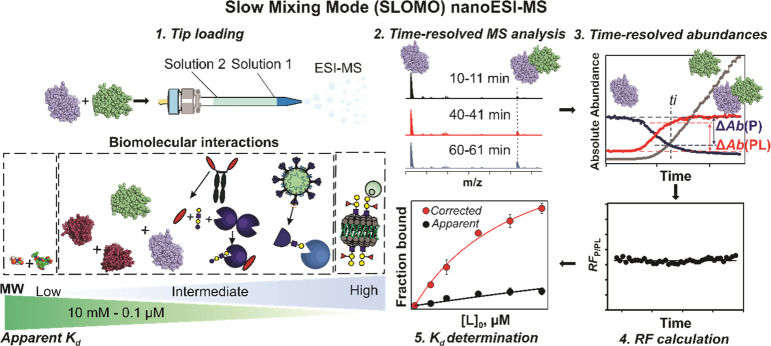
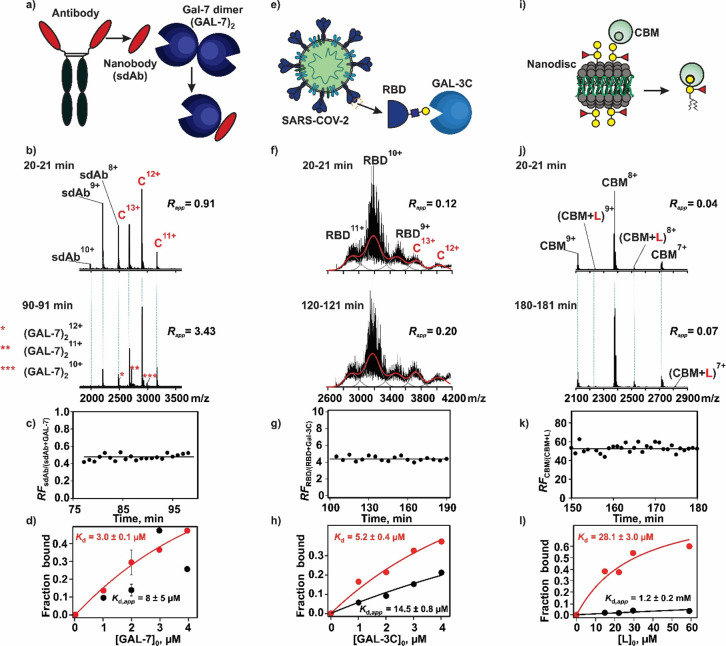
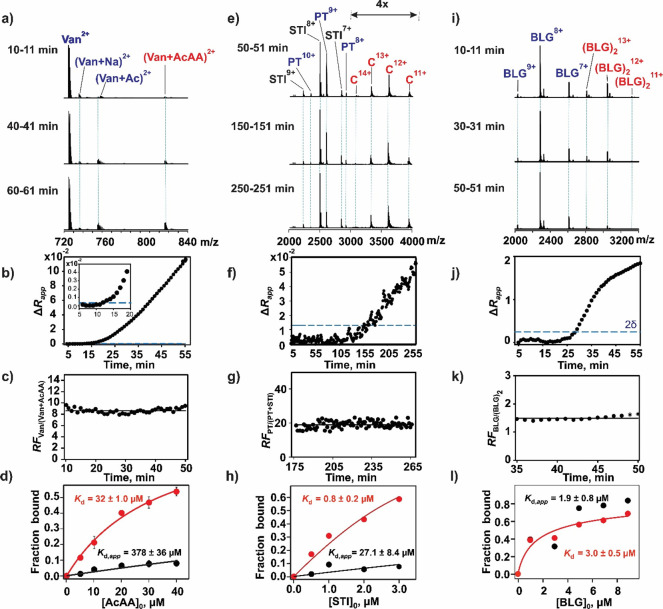
Electrospray ionization mass spectrometry (ESI-MS) is a powerful label-free assay for detecting noncovalent biomolecular complexes and is increasingly used to quantify binding thermochemistry. A common assumption made in ESI-MS affinity measurements is that the relative ion signals of free and bound species quantitatively reflect their relative concentrations in solution. However, this is valid only when the interacting species and their complexes have similar ESI-MS response factors (RFs). For many biomolecular complexes, such as protein-protein interactions, this condition is not satisfied. Existing strategies to correct for nonuniform RFs are generally incompatible with static nanoflow ESI (nanoESI) sources, which are typically used for biomolecular interaction studies, thereby significantly limiting the utility of ESI-MS. Here, we introduce slow mixing mode (SLOMO) nanoESI-MS, a direct technique that allows both the RF and affinity ( ) for a biomolecular interaction to be determined from a single measurement using static nanoESI. The approach relies on the continuous monitoring of interacting species and their complexes under nonhomogeneous solution conditions. Changes in ion signals of free and bound species as the system approaches or moves away from a steady-state condition allow the relative RFs of the free and bound species to be determined. Combining the relative RF and the relative abundances measured under equilibrium conditions enables the to be calculated. The reliability of SLOMO and its ease of use is demonstrated through affinity measurements performed on peptide-antibiotic, protease-protein inhibitor, and protein oligomerization systems. Finally, affinities measured for the binding of human and bacterial lectins to a nanobody, a viral glycoprotein, and glycolipids displayed within a model membrane highlight the tremendous power and versatility of SLOMO for accurately quantifying a wide range of biomolecular interactions important to human health and disease.
电喷雾电离质谱(ESI-MS)是一种强大的无标记检测方法,用于检测非共价生物分子复合物,并且越来越多地用于量化结合热化学。在ESI-MS亲和力测量中一个常见的假设是,游离和结合物种的相对离子信号定量反映了它们在溶液中的相对浓度。然而,只有当相互作用的物种及其复合物具有相似的ESI-MS响应因子(RFs)时,这才成立。对于许多生物分子复合物,如蛋白质-蛋白质相互作用,这种条件并不满足。现有的校正不均匀RFs的策略通常与静态纳流ESI(nanoESI)源不兼容,而静态纳流ESI源通常用于生物分子相互作用研究,从而显著限制了ESI-MS的实用性。在这里,我们介绍了慢混合模式(SLOMO)nanoESI-MS,这是一种直接技术,允许通过使用静态nanoESI的单次测量来确定生物分子相互作用的RF和亲和力( )。该方法依赖于在非均匀溶液条件下对相互作用物种及其复合物的连续监测。当系统接近或远离稳态条件时,游离和结合物种离子信号的变化使得能够确定游离和结合物种的相对RFs。结合相对RF和在平衡条件下测量的相对丰度能够计算出 。通过对肽-抗生素、蛋白酶-蛋白质抑制剂和蛋白质寡聚化系统进行的亲和力测量,证明了SLOMO的可靠性及其易用性。最后,对人源和细菌凝集素与纳米抗体、病毒糖蛋白以及模型膜中展示的糖脂结合的亲和力测量,突出了SLOMO在准确量化对人类健康和疾病重要的广泛生物分子相互作用方面的巨大能力和多功能性。