Harstad Ingunn, Raen Andrea R, Selseng Silje, Sagvik Eli
Department of Public Health and Nursing, Faculty of Medicine and Health Sciences, Norwegian University of Science and Technology, NO 7489 Trondheim, Norway.
Department of Pulmonary Medicine, St Olavs University Hospital, po box3250 Sluppen, N-7006 Trondheim, Norway.
J Clin Tuberc Other Mycobact Dis. 2022 Jul 21;28:100326. doi: 10.1016/j.jctube.2022.100326. eCollection 2022 Aug.
Most tuberculosis (TB) cases in Norway occur among immigrants from high-incidence countries. Although there is an extensive screening program for vulnerable groups, many do not appear for their screening appointment and do not understand why they require screening. This study aimed to further understand these vulnerable groups' knowledge, attitudes and practices (KAP) regarding TB to inform the screening program and health care personnel dealing with TB.
A KAP questionnaire developed by the World Health Organization (WHO) and adjusted to Norwegian conditions was used. The study has a cross-sectional design. One study group was immigrant students receiving primary screening in the municipality (MVIC) who completed an English questionnaire; the other was immigrants who were referred to hospital (POPD) for follow-up of screening results. They were interviewed with a translator when necessary. Statistical analyses to describe and compare groups of participants were done.
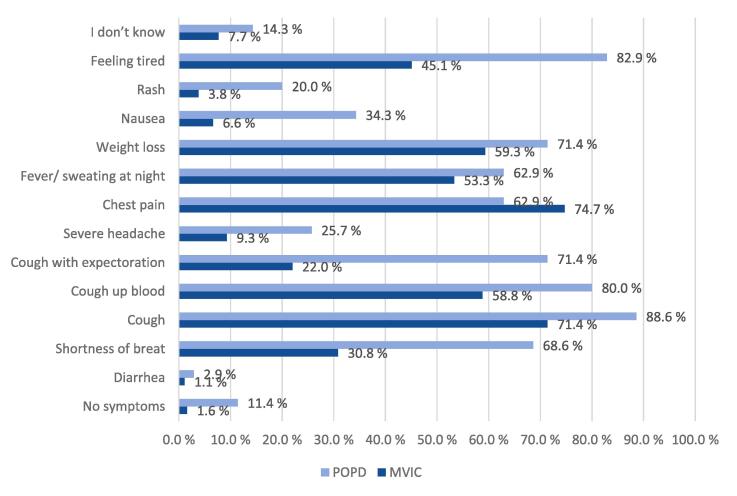
Altogether, 275 persons were eligible, and 219 (85%) participated. In the MVIC group 184 persons (86%) participated and in the POPD group 35 persons (80%). The mean knowledge score was 5.53 (maximum score: 11) with no significant differences between study groups or associations with demographics or length of education. There were serious knowledge gaps related to TB symptoms and transmission. Approximately half would have reacted with fear or surprise if they had TB, and 60% were afraid of being infected. Only 14% would avoid a person with TB.
The mean knowledge score was reasonably good but with some serious knowledge gaps. We detected fear of being infected or having TB disease but no serious stigma. More information and teaching about TB catered towards different immigrant groups are necessary.
挪威的大多数结核病病例发生在来自高发病率国家的移民中。尽管针对弱势群体有广泛的筛查项目,但许多人没有按预约前来筛查,也不明白为什么需要筛查。本研究旨在进一步了解这些弱势群体对结核病的知识、态度和行为(KAP),以为筛查项目和处理结核病的医护人员提供信息。
使用了世界卫生组织(WHO)制定并根据挪威情况进行调整的KAP问卷。该研究采用横断面设计。一个研究组是在市政当局接受初次筛查的移民学生(MVIC),他们填写英文问卷;另一个是被转诊至医院(POPD)以跟进筛查结果的移民。必要时由翻译人员对他们进行访谈。进行了描述和比较参与者组别的统计分析。
共有275人符合条件,219人(85%)参与。MVIC组有184人(86%)参与,POPD组有35人(80%)参与。平均知识得分是5.53(满分:11分),研究组之间、与人口统计学特征或受教育时长之间均无显著差异。在结核病症状和传播方面存在严重的知识空白。如果他们患有结核病,约一半的人会感到恐惧或惊讶,60%的人害怕被感染。只有14%的人会避开结核病患者。
平均知识得分还算不错,但存在一些严重的知识空白。我们发现了对被感染或患结核病的恐惧,但没有严重的污名化现象。有必要针对不同移民群体提供更多关于结核病的信息和教育。