Center for Brain Sciences, the First Affiliated Hospital of Xiamen University, Institute of Neuroscience, Fujian Provincial Key Laboratory of Neurodegenerative Disease and Aging Research, Xiamen University, Xiamen, China.
Institute for Brain Science and Disease, Chongqing Medical University, Chongqing, China.
Signal Transduct Target Ther. 2022 Aug 1;7(1):261. doi: 10.1038/s41392-022-01118-4.
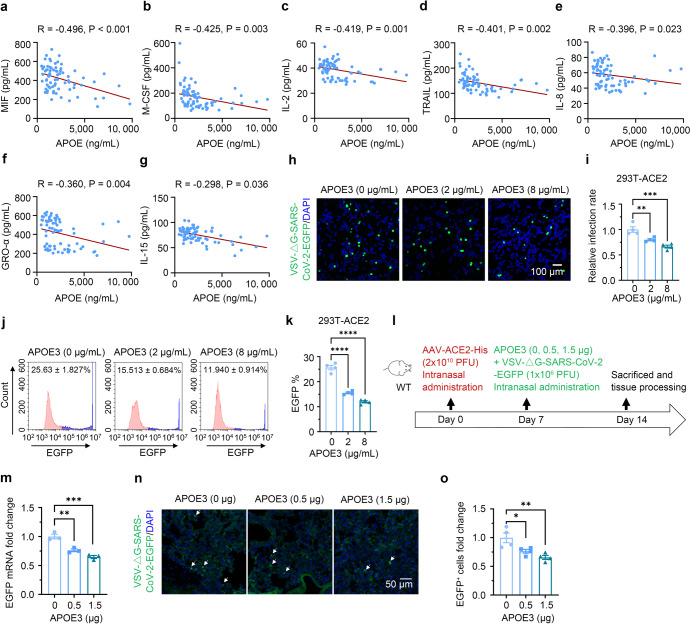
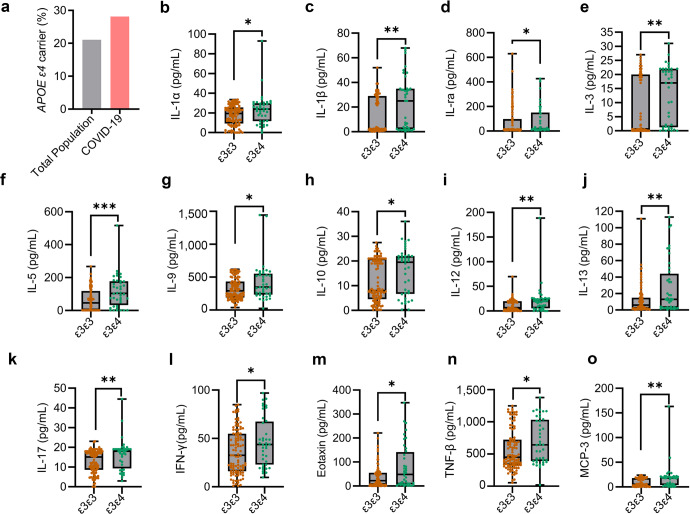
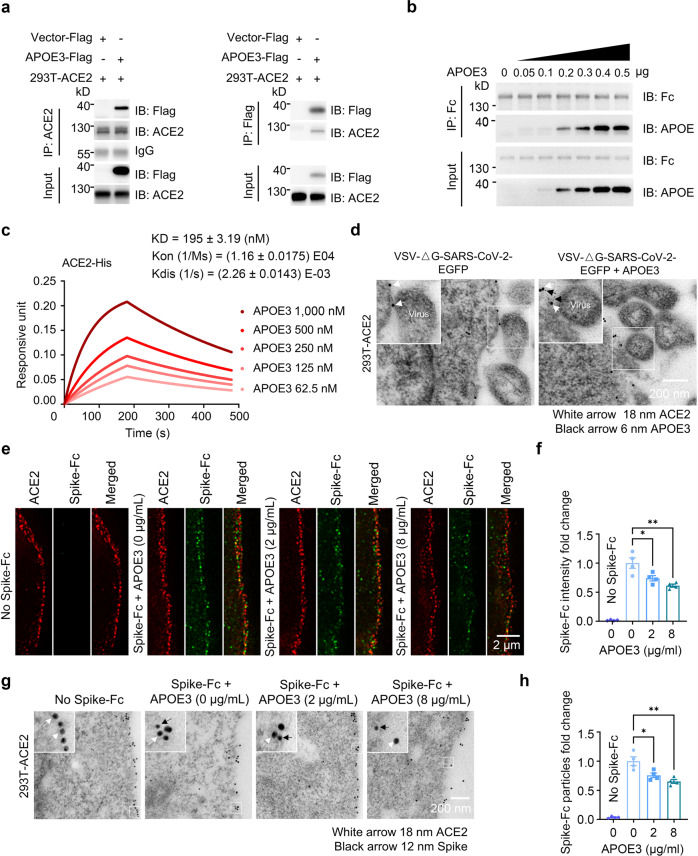
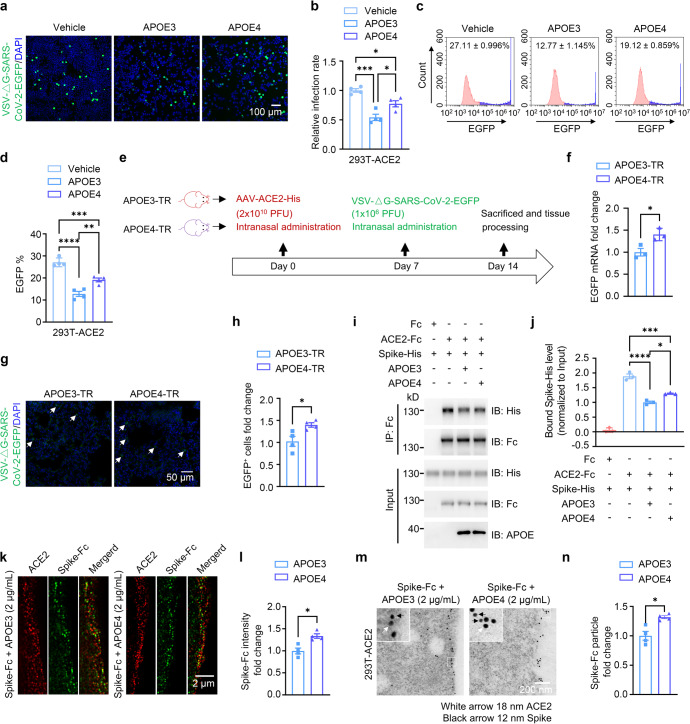
Apolipoprotein E (APOE) plays a pivotal role in lipid including cholesterol metabolism. The APOE ε4 (APOE4) allele is a major genetic risk factor for Alzheimer's and cardiovascular diseases. Although APOE has recently been associated with increased susceptibility to infections of several viruses, whether and how APOE and its isoforms affect SARS-CoV-2 infection remains unclear. Here, we show that serum concentrations of APOE correlate inversely with levels of cytokine/chemokine in 73 COVID-19 patients. Utilizing multiple protein interaction assays, we demonstrate that APOE3 and APOE4 interact with the SARS-CoV-2 receptor ACE2; and APOE/ACE2 interactions require zinc metallopeptidase domain of ACE2, a key docking site for SARS-CoV-2 Spike protein. In addition, immuno-imaging assays using confocal, super-resolution, and transmission electron microscopies reveal that both APOE3 and APOE4 reduce ACE2/Spike-mediated viral entry into cells. Interestingly, while having a comparable binding affinity to ACE2, APOE4 inhibits viral entry to a lesser extent compared to APOE3, which is likely due to APOE4's more compact structure and smaller spatial obstacle to compete against Spike binding to ACE2. Furthermore, APOE ε4 carriers clinically correlate with increased SARS-CoV-2 infection and elevated serum inflammatory factors in 142 COVID-19 patients assessed. Our study suggests a regulatory mechanism underlying SARS-CoV-2 infection through APOE interactions with ACE2, which may explain in part increased COVID-19 infection and disease severity in APOE ε4 carriers.
载脂蛋白 E(APOE)在脂质(包括胆固醇代谢)中起着关键作用。APOE ε4(APOE4)等位基因是阿尔茨海默病和心血管疾病的主要遗传风险因素。尽管 APOE 最近与几种病毒感染的易感性增加有关,但 APOE 及其同工型是否以及如何影响 SARS-CoV-2 感染尚不清楚。在这里,我们显示 73 例 COVID-19 患者的血清 APOE 浓度与细胞因子/趋化因子水平呈负相关。利用多种蛋白质相互作用测定法,我们证明 APOE3 和 APOE4 与 SARS-CoV-2 受体 ACE2 相互作用;APOE/ACE2 相互作用需要 ACE2 的锌金属肽酶结构域,这是 SARS-CoV-2 Spike 蛋白的关键对接位点。此外,使用共聚焦、超分辨率和透射电子显微镜的免疫成像测定法显示,APOE3 和 APOE4 均降低 ACE2/Spike 介导的病毒进入细胞。有趣的是,虽然与 ACE2 具有可比的结合亲和力,但 APOE4 对病毒进入的抑制作用小于 APOE3,这可能是由于 APOE4 的结构更紧凑,并且空间障碍物更小,从而与 Spike 结合 ACE2 竞争。此外,在 142 名 COVID-19 患者中,APOE ε4 携带者与 SARS-CoV-2 感染增加和血清炎症因子升高相关。我们的研究表明,APOE 通过与 ACE2 的相互作用,对 SARS-CoV-2 感染有调节作用,这可能部分解释了 APOE ε4 携带者中 COVID-19 感染和疾病严重程度增加的原因。