Molecular Biology Programme, Institute for Research in Immunology and Cancer, University of Montreal, QC, Canada.
Departments of Medicine and Biochemistry and Molecular Medicine, University of Montreal, QC, Canada.
Mol Oncol. 2022 Sep;16(18):3380-3396. doi: 10.1002/1878-0261.13299. Epub 2022 Aug 16.
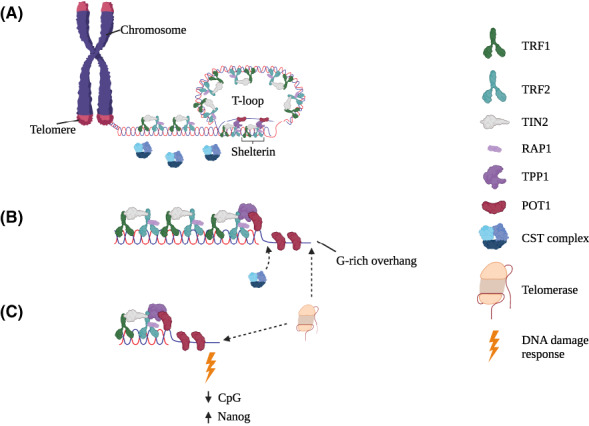
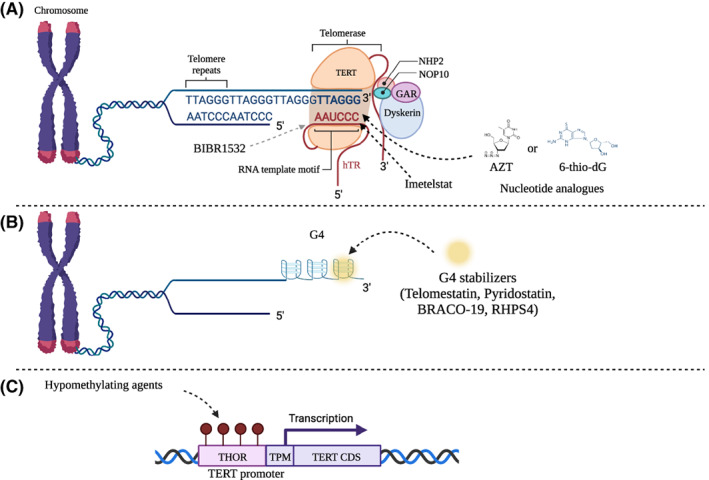
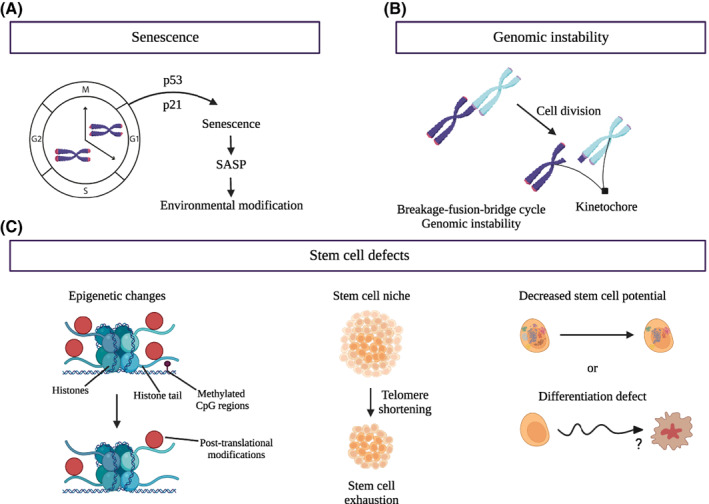
Telomere maintenance is essential for maintaining genome integrity in both normal and cancer cells. Without functional telomeres, chromosomes lose their protective structure and undergo fusion and breakage events that drive further genome instability, including cell arrest or death. One means by which this loss can be overcome in stem cells and cancer cells is via re-addition of G-rich telomeric repeats by the telomerase reverse transcriptase (TERT). During aging of somatic tissues, however, insufficient telomerase expression leads to a proliferative arrest called replicative senescence, which is triggered when telomeres reach a critically short threshold that induces a DNA damage response. Cancer cells express telomerase but do not entirely escape telomere instability as they often possess short telomeres; hence there is often selection for genetic alterations in the TERT promoter that result in increased telomerase expression. In this review, we discuss our current understanding of the consequences of telomere instability in cancer and aging, and outline the opportunities and challenges that lie ahead in exploiting the reliance of cells on telomere maintenance for preserving genome stability.
端粒维持对于正常细胞和癌细胞的基因组完整性至关重要。如果没有功能正常的端粒,染色体就会失去其保护结构,发生融合和断裂事件,进一步导致基因组不稳定,包括细胞停滞或死亡。在干细胞和癌细胞中,可以通过端粒酶逆转录酶(TERT)重新添加富含 G 的端粒重复序列来克服这种丢失。然而,在体组织衰老过程中,端粒酶表达不足会导致增殖停滞,称为复制性衰老,当端粒达到临界短阈值并引发 DNA 损伤反应时,就会触发这种衰老。癌细胞表达端粒酶,但并不能完全逃脱端粒不稳定,因为它们通常拥有短的端粒;因此,TERT 启动子中经常会发生导致端粒酶表达增加的遗传改变的选择。在这篇综述中,我们讨论了我们目前对端粒不稳定在癌症和衰老中的后果的理解,并概述了利用细胞对端粒维持的依赖来保持基因组稳定性所面临的机遇和挑战。