Department of Radiology, School of Medicine, Isfahan University of Medical Sciences, 8174673461, Isfahan, Iran.
Department of Statistics, Faculty of Intelligent Systems Engineering and Data Sciences, Persian Gulf University, 7516913817, Bushehr, Iran.
Emerg Radiol. 2022 Dec;29(6):969-977. doi: 10.1007/s10140-022-02082-w. Epub 2022 Aug 4.
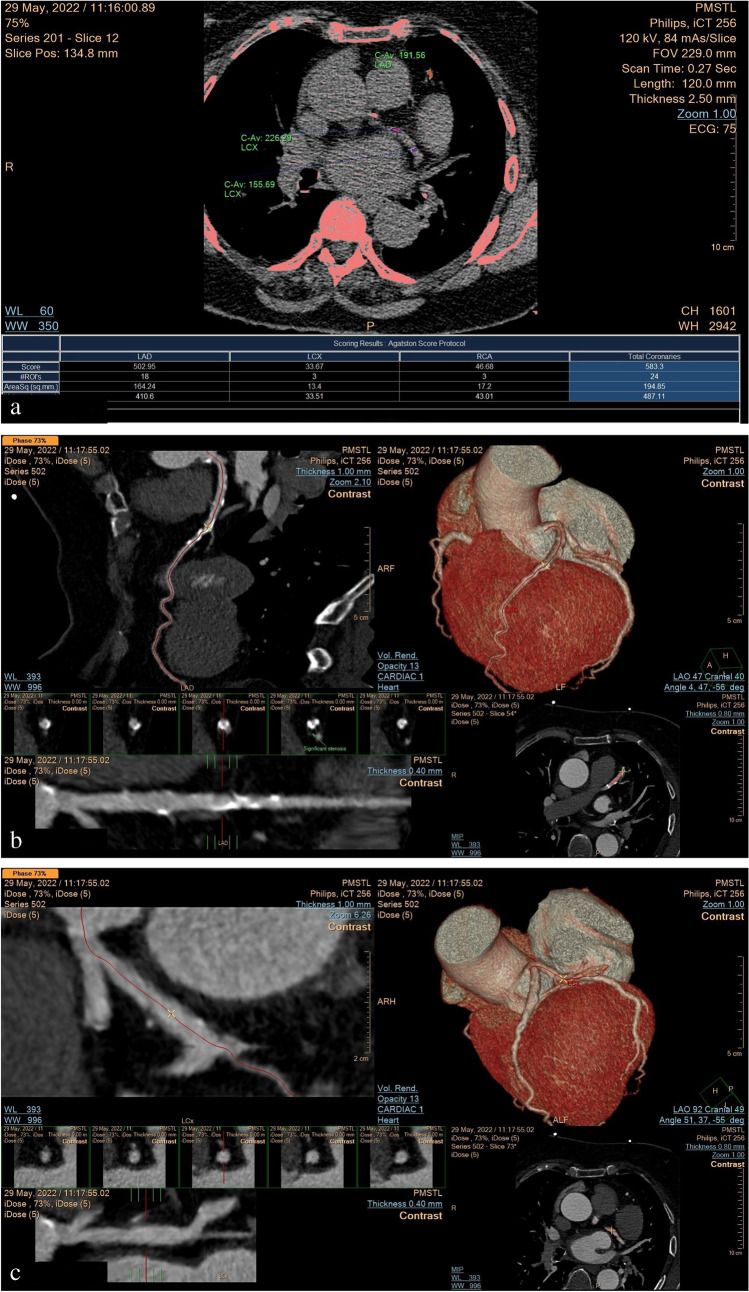
Coronary calcium scores (CCSs) in cardiac-gated computed tomography (CCT) are diagnostic for coronary artery disease (CAD). This study aims to investigate if CCSs can foretell CAD-reporting and data system (CAD-RADS) without performing computed tomography angiography (CTA).
Profiles of 544 patients were studied who had gone through CCT and CTA; the number of calcified regions of interest (ROIs), the Agatston, area, volume, and mass CCSs were calculated. Among the CAD-RADS categories (1 to 5), the mean values were compared for each CCS separately. A cut-offfor each CCS was declared using ROC curve analysis, more than which could predict significant CAD (CAD-RADS 3 to 5). Also, logistic regression models indicated the most probable CAD-RADS category based on the CCSs. P < 0.05 was considered significant.
Among 53% male and 47% female participants with a mean (SD) age of 62.57 (0.84) years, numbers of calcified ROIs were significantly different between each pair of CAD-RADS categories. While other CCSs did not show a significant difference between CAD-RADS 1 and 2 or 2 and 3. All CCSs were significantly different between the non-significant and significant CAD groups; cut-offs for the number of calcified ROIs, the Agatston, area, volume, and mass scores were 9, 128, 44mm, 111mm, and 22 mg, respectively. Formulae A and B predicted the most probable CAD-RADS category (accuracy: 79%) and the probability of significant/non-significant CAD (accuracy: 81%), respectively.
CCSs could predict CAD-RADS with an accuracy of 80%. Further studies are needed to introduce more predictive calcium indices.
心脏门控计算机断层扫描(CCT)中的冠状动脉钙评分(CCS)可用于诊断冠状动脉疾病(CAD)。本研究旨在探讨是否可以在不进行计算机断层血管造影(CTA)的情况下,通过 CCS 预测 CAD 报告和数据系统(CAD-RADS)。
对 544 例接受 CCT 和 CTA 的患者的资料进行研究,计算感兴趣区(ROI)的钙化数量、Agatston、面积、体积和质量 CCS。在 CAD-RADS 类别(1 至 5)中,分别比较各 CCS 的平均值。使用 ROC 曲线分析确定每个 CCS 的截断值,超过该值可预测有意义的 CAD(CAD-RADS 3 至 5)。此外,逻辑回归模型根据 CCS 预测最可能的 CAD-RADS 类别。P < 0.05 被认为具有统计学意义。
在 53%的男性和 47%的女性参与者中,平均(SD)年龄为 62.57(0.84)岁,钙化 ROI 的数量在每个 CAD-RADS 类别之间存在显著差异。而其他 CCS 在 CAD-RADS 1 与 2 或 2 与 3 之间没有显著差异。所有 CCS 在非显著和显著 CAD 组之间均有显著差异;钙化 ROI 数量、Agatston、面积、体积和质量评分的截断值分别为 9、128、44mm、111mm 和 22mg。公式 A 和 B 分别预测了最可能的 CAD-RADS 类别(准确率:79%)和显著/非显著 CAD 的概率(准确率:81%)。
CCS 可预测 CAD-RADS 的准确率为 80%。需要进一步研究以引入更多预测性钙指数。