Division of Developmental Medicine, Boston Children's Hospital, Boston, MA, 02115, USA.
Department of Pediatrics, Harvard Medical School, Boston, MA, USA.
J Neurodev Disord. 2022 Aug 3;14(1):45. doi: 10.1186/s11689-022-09454-w.
Heterogeneity in neurodevelopmental disorders, and attention deficit hyperactivity disorder (ADHD) in particular, is increasingly identified as a barrier to identifying biomarkers and developing standards for clinical care. Clustering analytic methods have previously been used across a variety of data types with the goal of identifying meaningful subgroups of individuals with ADHD. However, these analyses have often relied on algorithmic approaches which assume no error in group membership and have not made associations between patterns of behavioral, neurocognitive, and genetic indicators. More sophisticated latent classification models are often not utilized in neurodevelopmental research due to the difficulty of working with these models in small sample sizes.
In the current study, we propose a framework for evaluating mixture models in sample sizes typical of neurodevelopmental research. We describe a combination of qualitative and quantitative model fit evaluation procedures. We test our framework using latent profile analysis (LPA) in a case study of 120 children with and without ADHD, starting with well-understood neuropsychological indicators, and building toward integration of electroencephalogram (EEG) measures.
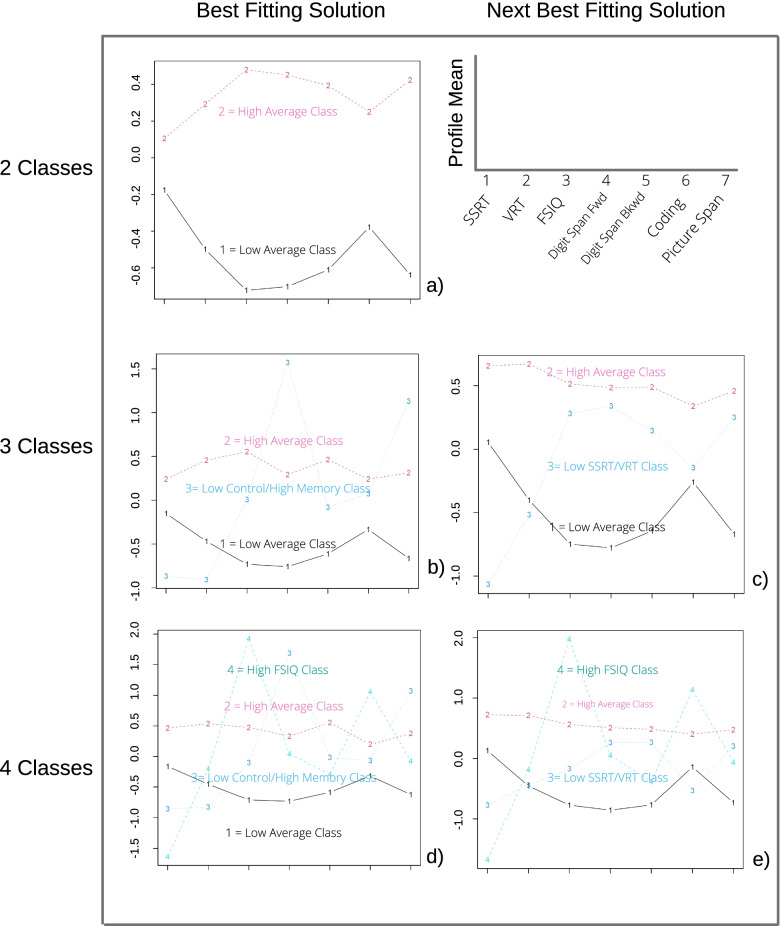
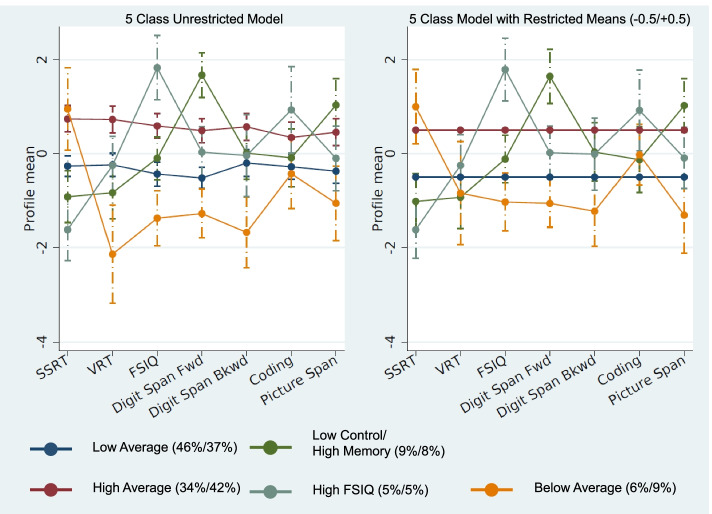
We identified a stable five-class LPA model using seven neuropsychological indicators. Although we were not able to identify a stable multimethod indicator model, we did successfully extrapolate results of the neuropsychological model to identify distinct patterns of resting EEG power across five frequency bands.
Our approach, which emphasizes theoretical as well as empirical evaluation of mixture models, could make these models more accessible to clinical researchers and may be a useful approach to parsing heterogeneity in neurodevelopmental disorders.
神经发育障碍的异质性,尤其是注意缺陷多动障碍(ADHD),越来越被认为是识别生物标志物和制定临床护理标准的障碍。聚类分析方法以前曾在各种数据类型中使用,目的是识别 ADHD 患者中有意义的亚组。然而,这些分析通常依赖于算法方法,这些方法假设群体成员没有错误,并且没有在行为、神经认知和遗传指标之间建立关联。由于在小样本量下使用这些模型存在困难,因此更复杂的潜在分类模型通常未在神经发育研究中使用。
在当前研究中,我们提出了一个在神经发育研究中典型样本量下评估混合模型的框架。我们描述了定性和定量模型拟合评估程序的组合。我们使用潜在剖面分析(LPA)在 120 名 ADHD 儿童和非 ADHD 儿童的案例研究中测试我们的框架,从众所周知的神经心理学指标开始,并逐步整合脑电图(EEG)测量。
我们使用七个神经心理学指标确定了一个稳定的五类 LPA 模型。尽管我们无法确定一个稳定的多方法指标模型,但我们确实成功地将神经心理学模型的结果外推到在五个频带中识别静息 EEG 功率的不同模式。
我们的方法强调对混合模型的理论和实证评估,这可能使这些模型更容易为临床研究人员所接受,并且可能是解析神经发育障碍异质性的有用方法。