Department of Trauma Center/Burns, The First Affiliated Hospital of China Medical University, Shenyang, China.
Department of Emergency, Shenzhen Second People's Hospital, Shenzhen, China.
Front Endocrinol (Lausanne). 2022 Jul 18;13:947157. doi: 10.3389/fendo.2022.947157. eCollection 2022.
Evidence regarding the relationship between the triglyceride-to-high-density lipoprotein cholesterol (TG/HDL-c) ratio and the risk of progression from prediabetes to diabetes remains limited. The purpose of our study was to investigate the relationship between the TG/HDL-C ratio and incident diabetes in prediabetic patients.
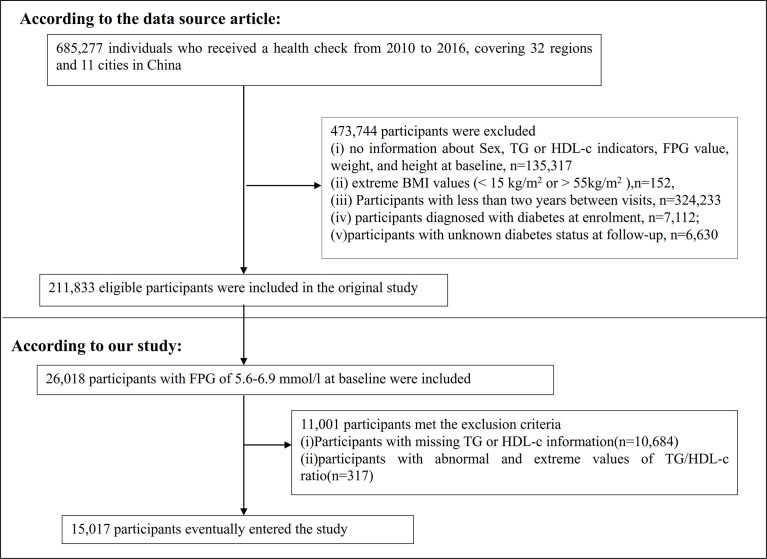
This retrospective cohort study covered 32 regions and 11 cities in China and consecutively and non-selectively collected data from 15,017 patients with prediabetes who had received a health check from 2010 to 2016. Data were obtained from the DATADRYAD database (www.datadryad.org). The Cox proportional-hazards regression model with cubic spline functions and smooth curve fitting (cubic spline smoothing) was used to explore the non-linear relationship between the baseline TG/HDL-c ratio and the risk of diabetes in patients with prediabetes. In addition, we performed a series of sensitivity and subgroup analyses.
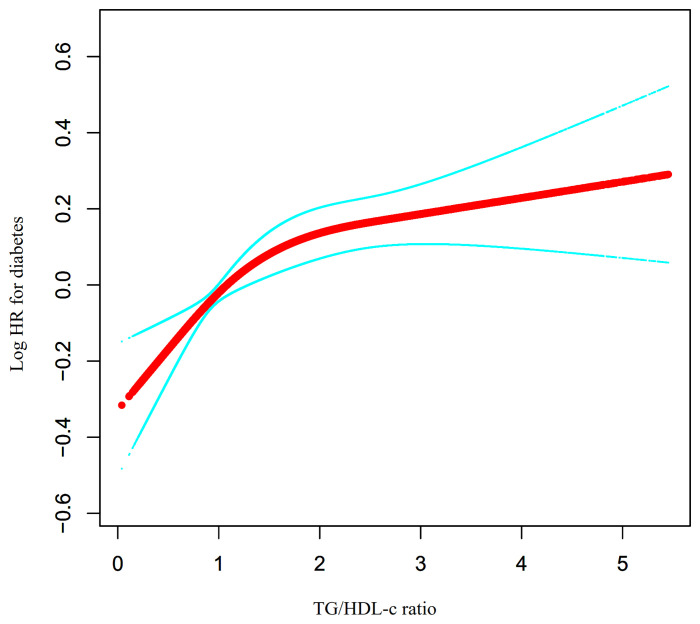
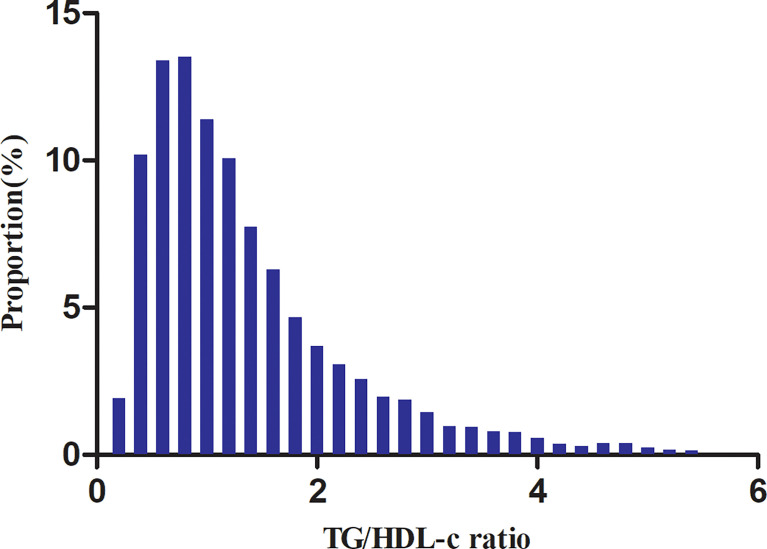
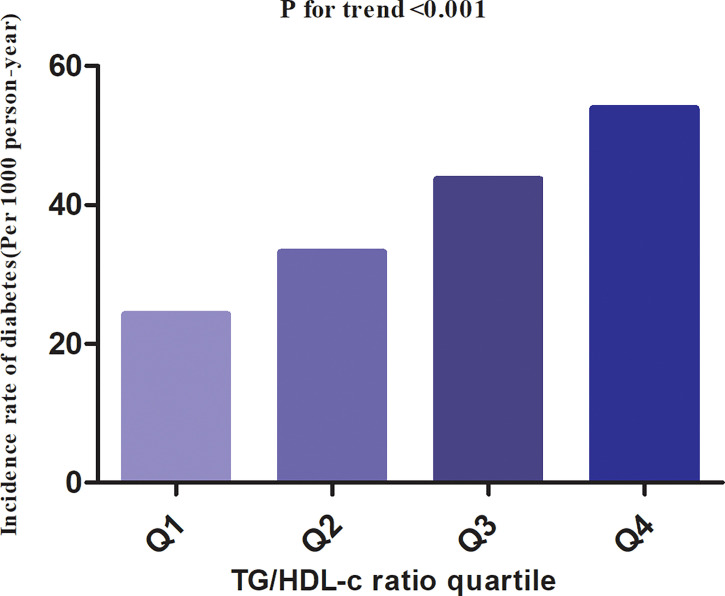
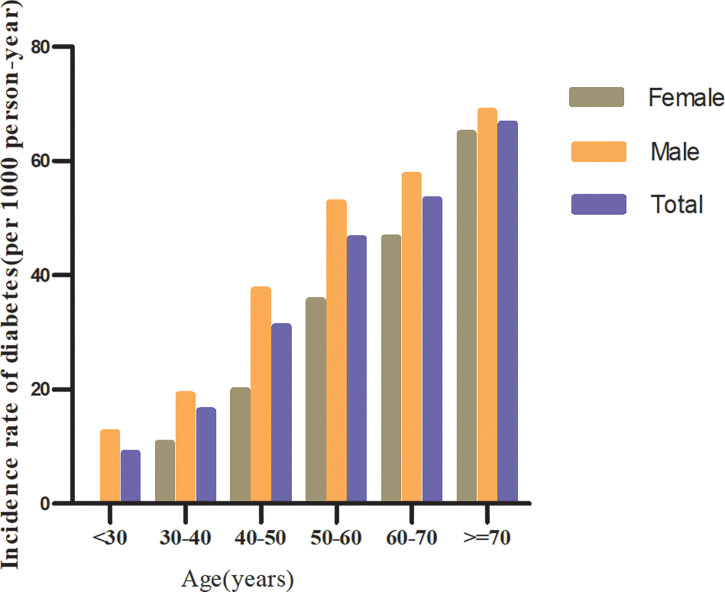
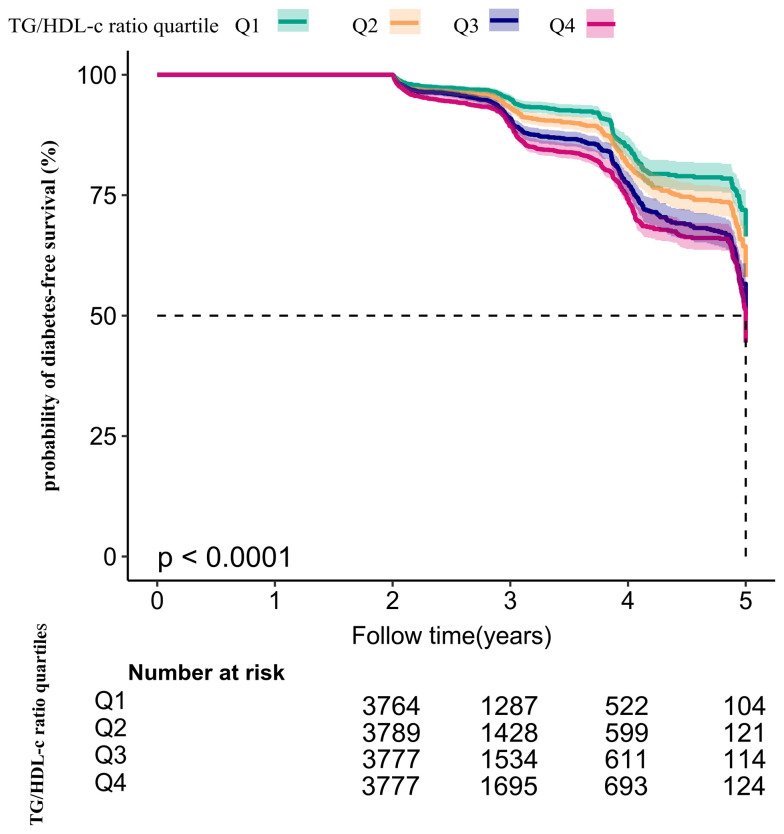
The mean age of the included individuals was 50.95 ± 13.48 years, and 9,745 (64.51%) were men. The median (interquartile range) TG/HDL-c ratio was 1.09 (0.69-1.72). During a median follow-up time of 3.05 years, 1,731 (11.46%) patients had a final diagnosis of diabetes. The analysis after adjusting for covariates showed that the TG/HDL-c ratio was positively related to incident diabetes in patients with prediabetes (HR = 1.111, 95% CI 1.061-1.164). Participants with the highest TG/HDL-c ratio (Q4) had higher diabetes incidence rates than those with the lowest TG/HDL-c ratio (Q1) (P < 0.001 for the trend). There was a non-linear relationship between the TG/HDL-c ratio and the risk of diabetes, and the inflection point of the TG/HDL-c ratio was 1.415. The effect sizes (HR) on the left and right sides of the inflection point were 1.336 (95% CI: 1.134-1.573) and 1.055 (95% CI: 0.988-1.126), respectively. The sensitivity analysis demonstrated the robustness of these results.
This study demonstrates a positive, non-linear relationship between the TG/HDL-c ratio and the risk of diabetes in Chinese patients with prediabetes. Aggressive intervention from a treatment perspective is required to lower the TG/HDL-c ratio below the inflection point (1.415) by lowering TG or increasing HDL-c levels.
有关甘油三酯与高密度脂蛋白胆固醇(TG/HDL-c)比值与糖尿病前期向糖尿病进展风险之间关系的证据仍然有限。本研究的目的是探讨糖尿病前期患者中 TG/HDL-C 比值与糖尿病发病之间的关系。
这是一项回顾性队列研究,覆盖了中国 32 个地区和 11 个城市,连续且非选择性地收集了 2010 年至 2016 年期间接受健康检查的 15017 例糖尿病前期患者的数据。数据来自 DATADRYAD 数据库(www.datadryad.org)。使用 Cox 比例风险回归模型和三次样条函数及平滑曲线拟合(三次样条平滑)来探索基线 TG/HDL-c 比值与糖尿病前期患者糖尿病风险之间的非线性关系。此外,我们进行了一系列敏感性和亚组分析。
纳入研究对象的平均年龄为 50.95±13.48 岁,9745 例(64.51%)为男性。TG/HDL-c 比值的中位数(四分位距)为 1.09(0.69-1.72)。在中位随访时间 3.05 年期间,1731 例(11.46%)患者最终诊断为糖尿病。经调整协变量后分析表明,TG/HDL-c 比值与糖尿病前期患者的糖尿病发病呈正相关(HR=1.111,95%CI 1.061-1.164)。TG/HDL-c 比值最高的四分位数(Q4)组的糖尿病发病率高于 TG/HDL-c 比值最低的四分位数(Q1)组(趋势 P<0.001)。TG/HDL-c 比值与糖尿病风险之间存在非线性关系,TG/HDL-c 比值的拐点为 1.415。拐点左侧和右侧的效应大小(HR)分别为 1.336(95%CI:1.134-1.573)和 1.055(95%CI:0.988-1.126)。敏感性分析证实了这些结果的稳健性。
本研究表明,在中国糖尿病前期患者中,TG/HDL-c 比值与糖尿病发病风险之间呈正相关且存在非线性关系。从治疗角度来看,需要通过降低 TG 或增加 HDL-c 水平,将 TG/HDL-c 比值降低至拐点(1.415)以下,以降低风险。