Sundaria Arpita, Liberta Falk, Savran Dilan, Sarkar Riddhiman, Rodina Natalia, Peters Carsten, Schwierz Nadine, Haupt Christian, Schmidt Matthias, Reif Bernd
Bayerisches NMR Zentrum (BNMRZ) at the Department of Chemistry, Technische Universität München (TUM), Lichtenbergstr. 4, 85747 Garching, Germany.
Helmholtz-Zentrum München (HMGU), Deutsches Forschungszentrum für Gesundheit und Umwelt, Institute of Structural Biology (STB), Ingolstädter Landstr. 1, 85764 Neuherberg, Germany.
J Struct Biol X. 2022 Jul 19;6:100069. doi: 10.1016/j.yjsbx.2022.100069. eCollection 2022.
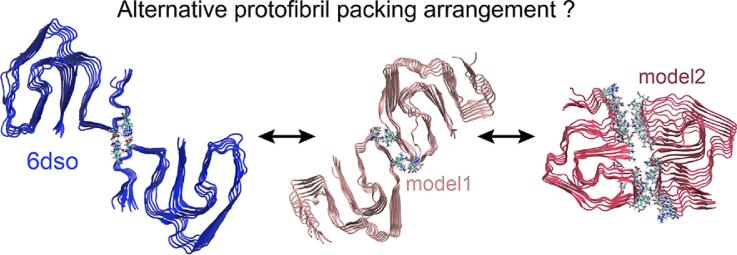
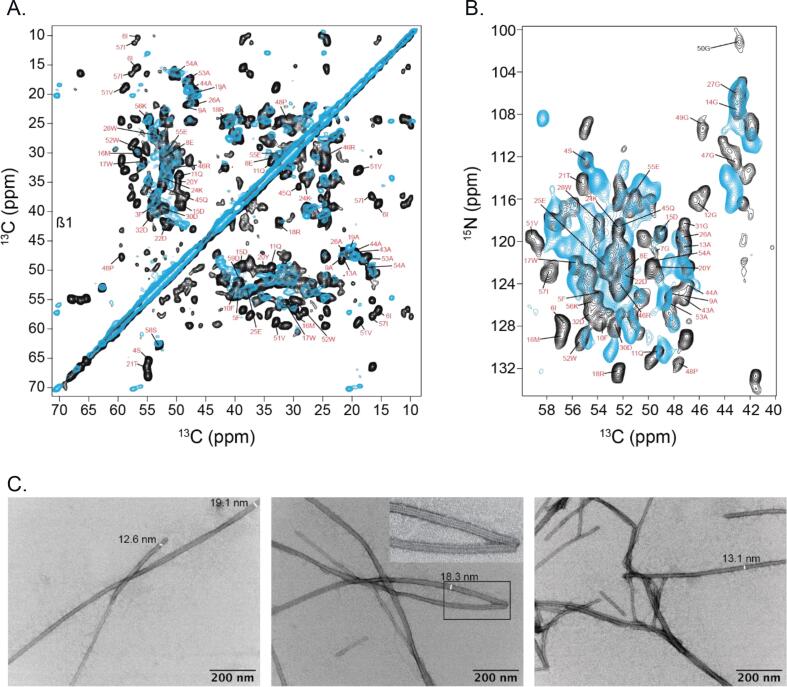
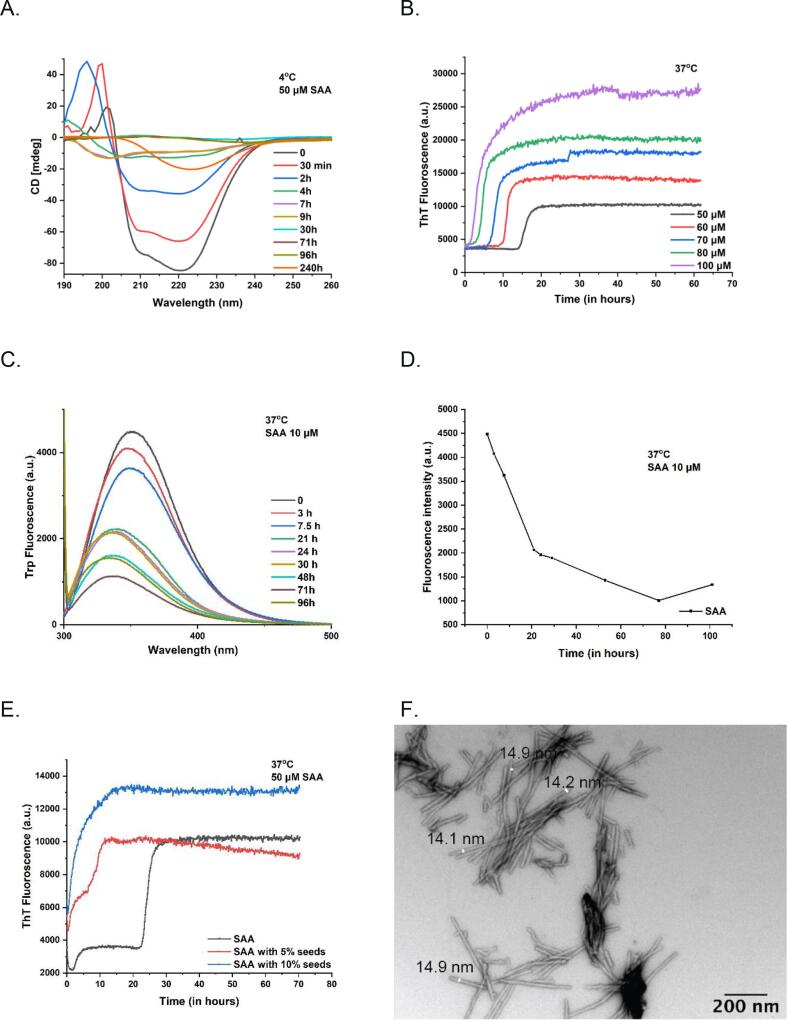
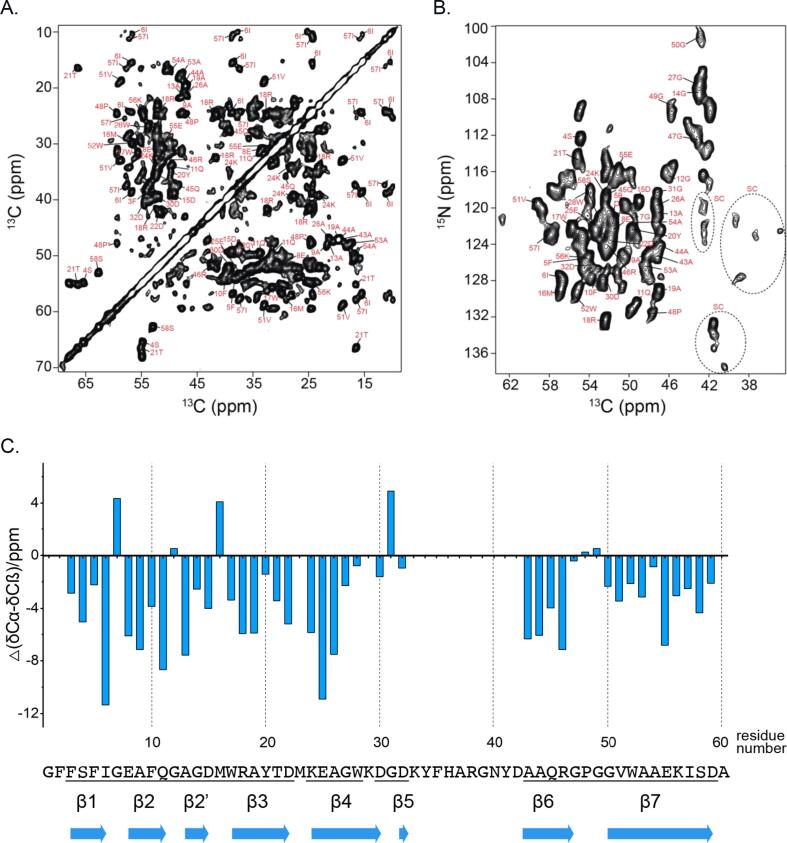
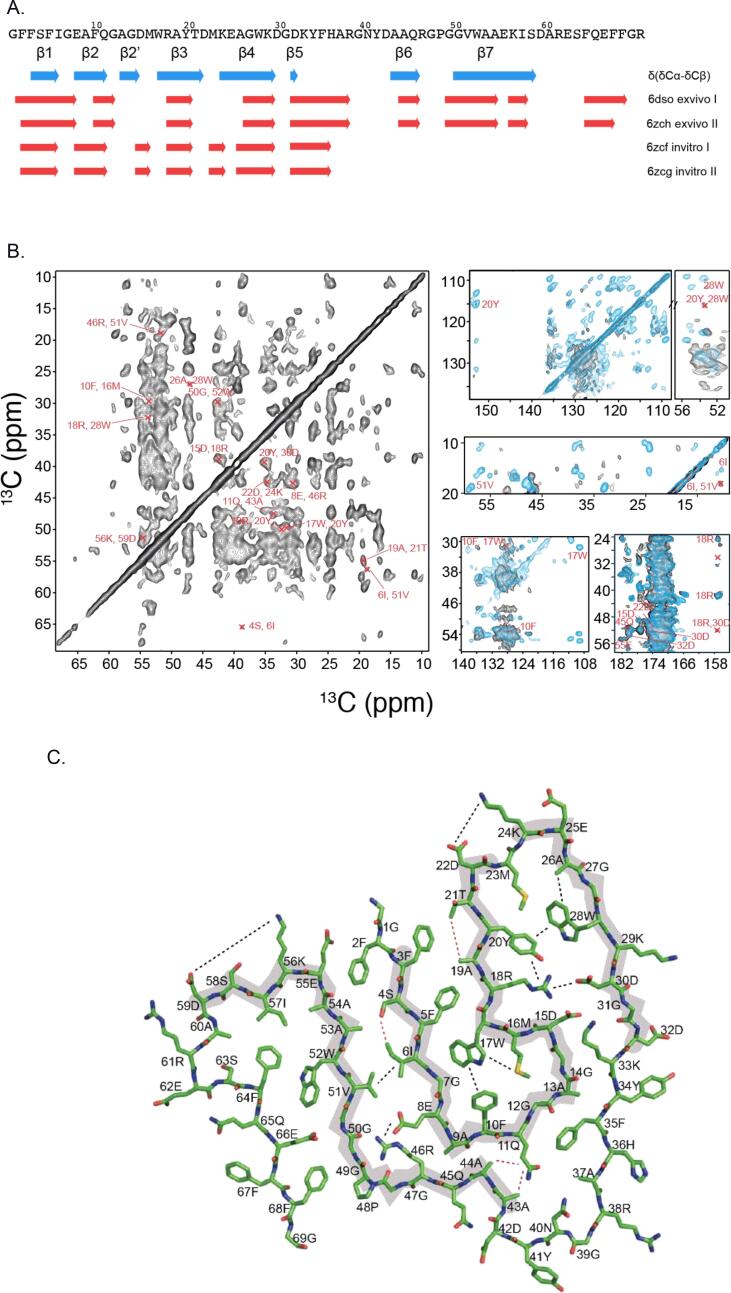
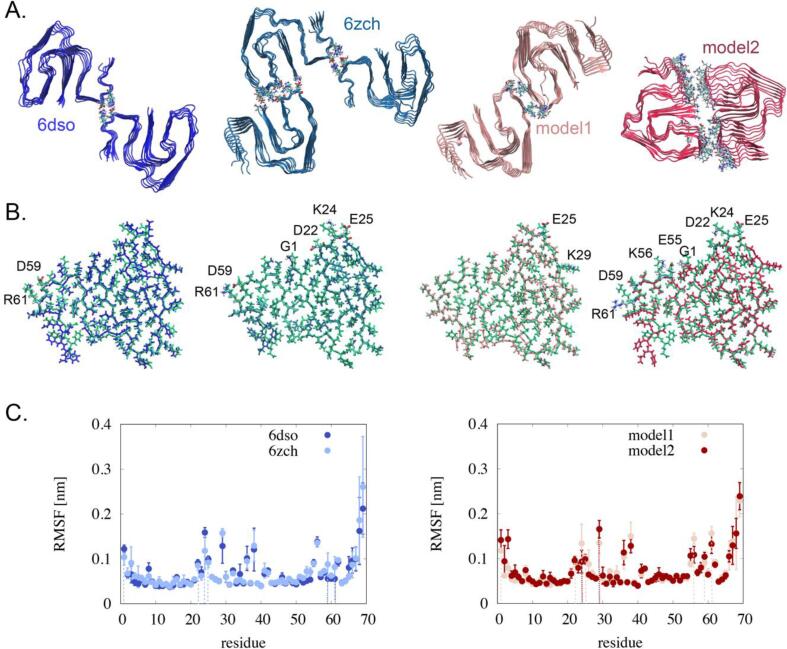
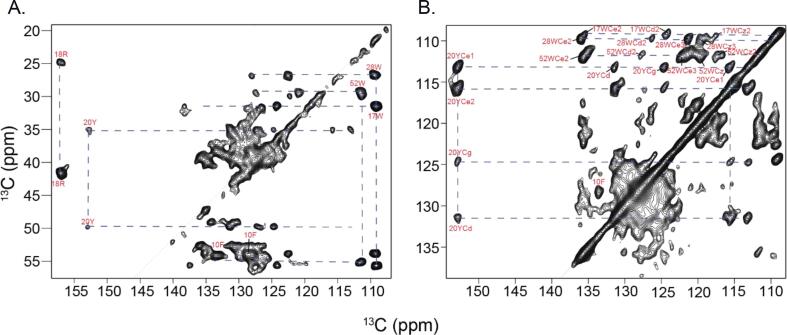
AA amyloidosis is one of the most prevalent forms of systemic amyloidosis and affects both humans and other vertebrates. In this study, we compare MAS solid-state NMR data with a recent cryo-EM study of fibrils involving full-length murine SAA1.1. We address the question whether the specific requirements for the reconstitution of an amyloid fibril structure by cryo-EM can potentially yield a bias towards a particular fibril polymorph. We employ fibril seeds extracted from material to imprint the fibril structure onto the biochemically produced protein. Sequential assignments yield the secondary structure elements in the fibril state. Long-range DARR and PAR experiments confirm largely the topology observed in the cryo-EM study. We find that the β-sheets identified in the NMR experiments are similar to the β-sheets found in the cryo-EM study, with the exception of amino acids 33-42. These residues cannot be assigned by solid-state NMR, while they adopt a stable β-sheet in the cryo-EM structure. We suggest that the differences between MAS solid-state NMR and cryo-EM data are a consequence of a second conformer involving residues 33-42. Moreover, we were able to characterize the dynamic C-terminal tail of SAA in the fibril state. The C-terminus is flexible, remains detached from the fibrils, and does not affect the SAA fibril structure as confirmed further by molecular dynamics simulations. As the C-terminus can potentially interact with other cellular components, binding to cellular targets can affect its accessibility for protease digestion.
AA淀粉样变性是系统性淀粉样变性最常见的形式之一,影响人类和其他脊椎动物。在本研究中,我们将MAS固态核磁共振数据与最近一项关于包含全长小鼠SAA1.1的原纤维的冷冻电镜研究进行了比较。我们探讨了通过冷冻电镜重建淀粉样原纤维结构的特定要求是否可能导致偏向特定的原纤维多晶型的问题。我们使用从材料中提取的原纤维种子将原纤维结构印记到生化产生的蛋白质上。序列归属产生了原纤维状态下的二级结构元件。远程DARR和PAR实验在很大程度上证实了冷冻电镜研究中观察到的拓扑结构。我们发现,核磁共振实验中鉴定出的β折叠与冷冻电镜研究中发现的β折叠相似,但氨基酸33 - 42除外。这些残基不能通过固态核磁共振进行归属,而它们在冷冻电镜结构中形成了稳定的β折叠。我们认为,MAS固态核磁共振和冷冻电镜数据之间的差异是涉及残基33 - 42的第二种构象的结果。此外,我们能够表征原纤维状态下SAA的动态C末端尾巴。C末端是灵活的,与原纤维分离,并且如分子动力学模拟进一步证实的那样,不影响SAA原纤维结构。由于C末端可能与其他细胞成分相互作用,与细胞靶点的结合会影响其对蛋白酶消化的可及性。